
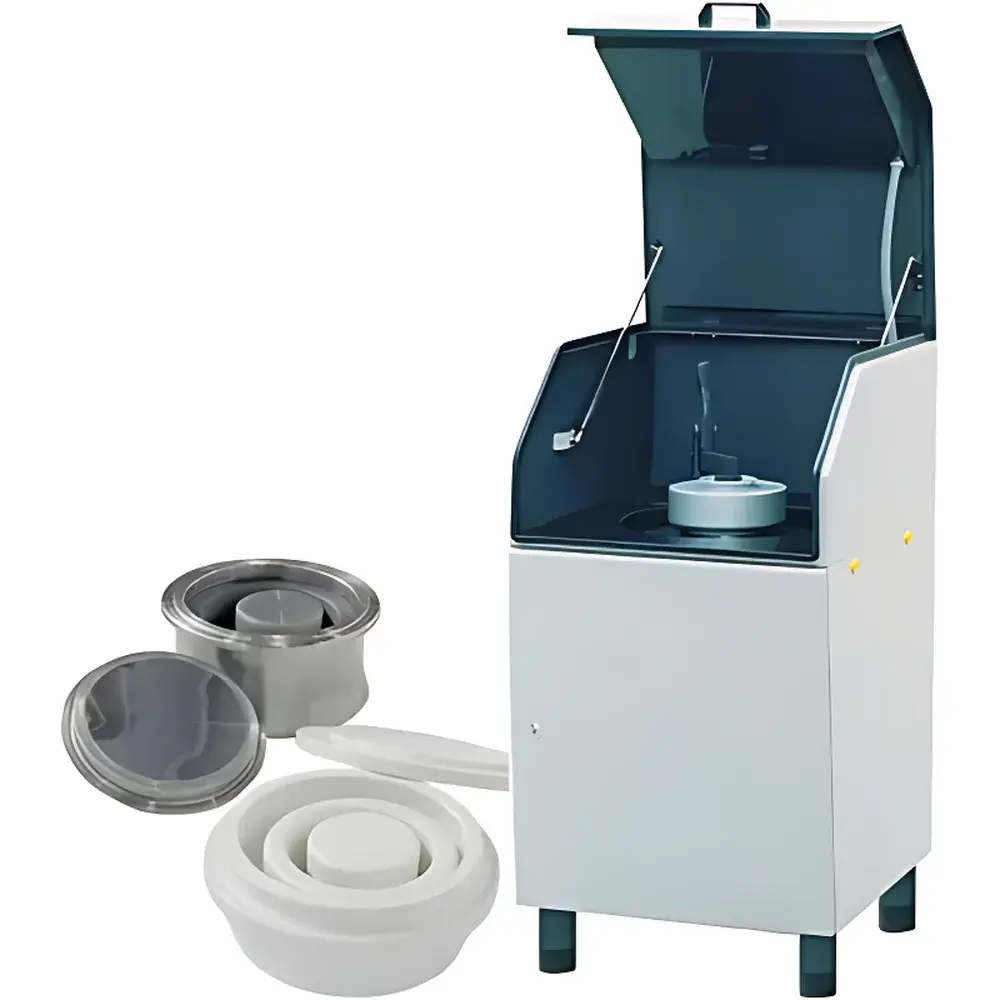
Siebtechnik TS750/TS1000 Vibratory Disc Mill
| Brand | Siebtechnik |
|---|---|
| Origin | Germany |
| Model | TS750 / TS1000 |
| Maximum Feed Size | <15 mm |
| Final Particle Size | <40 µm (dry grinding), <1 µm (wet grinding) |
| Sample Capacity | 4 × 10 mL, 20 mL, 50 mL, 100 mL, or 250 mL per batch |
| Grinding Bowl Volumes | 42–48 mL (10 mL sample), 79 mL (20 mL), 116–194 mL (50 mL), 262–314 mL (100 mL), 683–686 mL (250 mL) |
| Operating Speed | 700 rpm or 1000 rpm (material-dependent) |
| Timer Range | 1 s to 99 min 59 s |
| Power Input | 550 W (TS750) / 800 W (TS1000) |
| Bowl Materials | Chrome steel, tungsten carbide, agate, zirconia, Cu-Ni alloy |
| Dimensions (L×W×H) | 600 × 674 × 1125 mm |
| Compliance | CE-marked, designed for GLP-compliant laboratories |
Overview
The Siebtechnik TS750/TS1000 Vibratory Disc Mill is a high-precision, laboratory-scale comminution instrument engineered for rapid, loss-free, and reproducible fine grinding of diverse solid materials. It operates on the principle of eccentric vibratory motion—generated by a high-torque electromagnetic or mechanical drive system—transmitted to a grinding assembly consisting of a bowl, inner ring, central shaft, and hermetic lid. During operation, samples undergo simultaneous compression, impact, shear, and attrition forces within the confined grinding chamber, enabling efficient particle size reduction without thermal degradation or cross-contamination. Designed for analytical sample preparation, the system delivers sub-40 µm dry-ground powders and sub-micron suspensions under wet-grinding conditions—meeting stringent requirements for X-ray fluorescence (XRF), inductively coupled plasma (ICP), scanning electron microscopy (SEM), and geochemical analysis workflows.
Key Features
- Two model variants (TS750 and TS1000) optimized for distinct throughput and energy input demands: 550 W and 800 W nominal power ratings respectively.
- Dual-speed operation (700 rpm or 1000 rpm) selectable based on bowl material and sample hardness—ensuring optimal energy transfer while minimizing wear.
- Programmable digital timer with 1-second resolution (1 s to 99 min 59 s), supporting both single-cycle and multi-step protocols for method standardization.
- Modular grinding assemblies: interchangeable bowls (42–686 mL effective volume), rings, and shafts fabricated from five chemically inert, low-contamination materials—chrome steel, tungsten carbide, agate, zirconia, and Cu-Ni alloy—to accommodate aggressive matrices including silicates, oxides, polymers, and biological tissues.
- Optional pneumatic clamping system for rapid, tool-free bowl fixation—reducing setup time and enhancing operator safety during high-throughput environments.
- Acoustically shielded grinding chamber compliant with ISO 7779 and EU Directive 2006/42/EC, limiting operational noise to ≤72 dB(A) at 1 m distance.
- No routine lubrication or mechanical maintenance required; robust cast-iron frame ensures long-term dimensional stability and vibration damping.
Sample Compatibility & Compliance
The TS750/TS1000 accommodates a broad spectrum of sample types—including ores, ceramics, coal, soils, plant matter, pharmaceutical excipients, and composite materials—with maximum feed size up to 15 mm. Its closed-system design prevents airborne particulate release, satisfying OSHA PEL and EU REACH guidelines for operator protection. All wet-grinding configurations support aqueous and organic solvent media (e.g., ethanol, isopropanol), enabling dispersion stabilization prior to laser diffraction or sedimentation analysis. The instrument conforms to CE marking requirements (2014/30/EU EMC Directive and 2006/42/EU Machinery Directive) and supports audit-ready documentation under GLP and ISO/IEC 17025 frameworks. Optional data logging interfaces facilitate traceability aligned with FDA 21 CFR Part 11 when integrated with validated LIMS platforms.
Software & Data Management
While the base configuration features an intuitive front-panel interface with LED display and tactile push-button controls, optional RS-232 or USB connectivity enables remote parameter setting, real-time status monitoring, and event-triggered data export (timestamp, speed, duration, power draw). When deployed in regulated environments, the system supports electronic signature capture and audit trail generation via third-party laboratory software (e.g., LabWare LIMS, Thermo Fisher SampleManager). Method templates can be stored locally (up to 99 programs) with password-protected access levels for QA/QC personnel—ensuring consistent execution across shifts and operators.
Applications
This mill serves as a critical preprocessing tool across multiple sectors: geological laboratories preparing homogenized rock powders for major/minor element quantification; cement and refractory manufacturers assessing fineness modulus and Blaine surface area; environmental labs grinding contaminated soil cores for TCLP extraction; and academic research groups processing nanocomposite precursors for TEM grid mounting. Its ability to deliver statistically representative sub-µm dispersions also supports rheological characterization of nanoparticle suspensions and binder formulation development in additive manufacturing R&D.
FAQ
What is the recommended maintenance schedule for the TS750/TS1000?
No scheduled lubrication or internal servicing is required. Routine cleaning of the grinding bowl, ring, and shaft using appropriate solvents (e.g., acetone for organics, dilute HNO₃ for metal residues) is sufficient between runs.
Can the instrument be validated for GMP use?
Yes—when equipped with optional digital I/O and connected to a validated software platform, it meets IQ/OQ/PQ criteria for pharmaceutical raw material comminution under USP <1118> and ICH Q5C.
Is cross-contamination minimized during sequential grinding of dissimilar samples?
Absolutely—the use of dedicated bowl/ring/shaft sets per sample class, combined with automated cleaning cycles and material-specific wear resistance (e.g., zirconia for acidic matrices), ensures negligible carryover (<0.001% w/w verified by ICP-MS blank testing).
How does vibration amplitude affect particle size distribution?
Amplitude is fixed per model (TS750: ±1.2 mm; TS1000: ±1.5 mm) and calibrated at factory level. Consistent amplitude—coupled with precise speed and time control—is fundamental to achieving narrow PSD reproducibility (RSD <2.5% for D₅₀ across n=10 replicates).
Are spare parts and certified calibration services available globally?
All consumables (bowls, rings, shafts, seals) are stocked by Siebtechnik’s authorized distributors. Factory-certified recalibration—including dynamic force verification and timing accuracy certification—is offered biannually or per ISO/IEC 17025 requirements.



