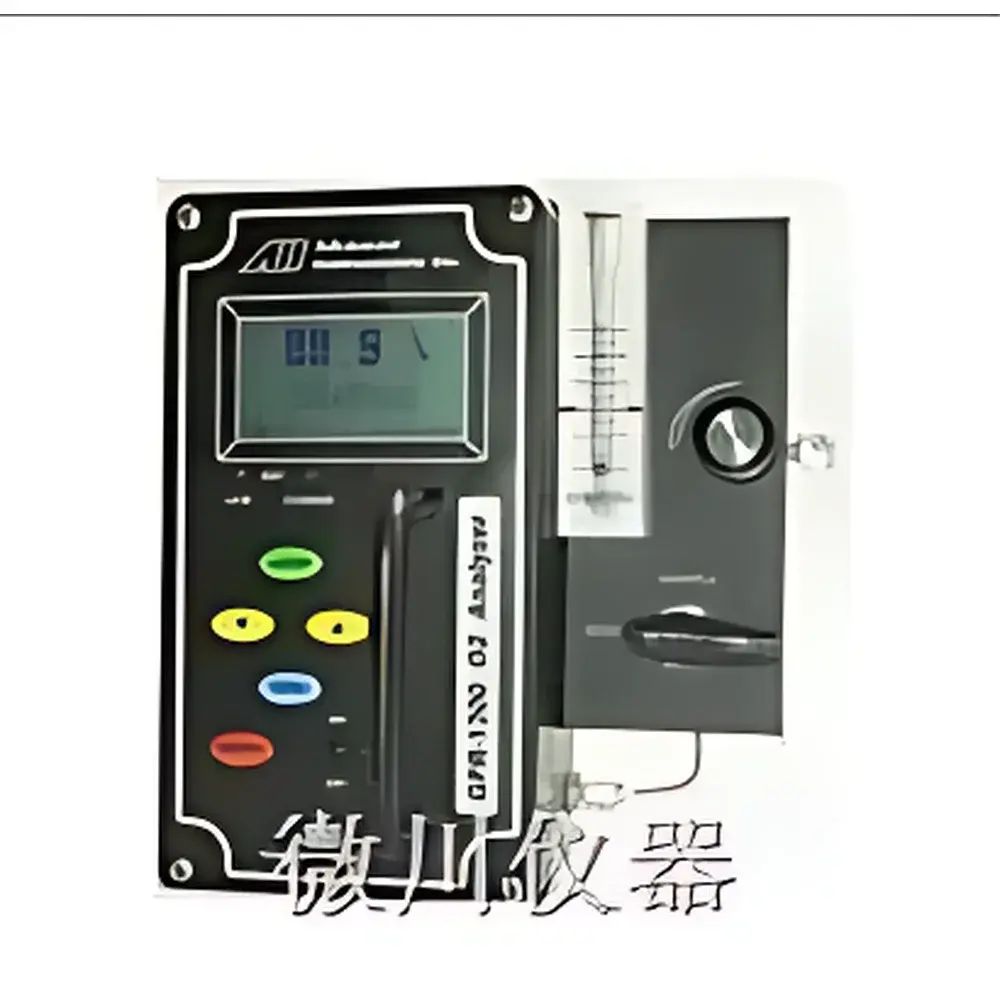
AII GPR-2300 Portable Oxygen Analyzer
| Brand | AII |
|---|---|
| Origin | USA |
| Model | GPR-2300 |
| Measurement Principle | Supergalvanic Electrochemical Sensor |
| Range | 0–100% O₂ (Auto/Manual Span Selection) |
| Accuracy | ±0.1% of full scale (at 25°C, 1 atm) |
| Resolution | 0.01% of full scale |
| Linearity | R² > 0.995 |
| Response Time (T₉₀) | 10 s |
| Recovery Time (Air → 10 ppm) | 30 min (60 s with purge) |
| Sensor Lifetime | >24 months at 1000 ppm O₂ |
| Power | Rechargeable battery (30-day runtime per charge) |
| Enclosure | Anodized aluminum, NEMA 4X rated |
| Dimensions | 5" × 9" × 3" (127 × 229 × 76 mm) |
| Weight | 8 lbs (3.5 kg) |
| Operating Temperature | −5 to +45°C with built-in temperature compensation |
| Pressure Range | 5–100 psig |
| Sample Flow Rate | 0.2–5 L/min (recommended: 1 L/min) |
| Certifications | ISO 9001, CE, Class I, Division 1, Groups A, B, C, D (Intrinsically Safe) |
Overview
The AII GPR-2300 Portable Oxygen Analyzer is a field-deployable, intrinsically safe instrument engineered for high-reliability oxygen measurement in demanding industrial and safety-critical environments. It employs a supergalvanic electrochemical sensor—a self-powered, zero-bias, diffusion-limited cell that delivers stable, drift-free output without external polarization voltage. Unlike polarographic or fuel-cell-based sensors, the supergalvanic design ensures extended operational life, minimal maintenance, and immunity to ambient humidity fluctuations when used within specified gas matrices. The analyzer is calibrated for direct volumetric %O₂ measurement across the full 0–100% range, supporting both manual span selection and automatic range switching to optimize signal-to-noise ratio across low-ppm and high-percentage applications. Its integrated temperature and pressure compensation algorithms maintain measurement integrity under variable process conditions, while the real-time display of sample temperature and pressure enables traceable, context-aware data interpretation.
Key Features
- Intrinsically safe construction certified to Class I, Division 1, Groups A, B, C, D—suitable for hazardous locations including petrochemical refineries, pharmaceutical inerting zones, and semiconductor tool purges.
- NEMA 4X-rated anodized aluminum enclosure with IP66 protection—resistant to dust ingress, water jets, and corrosive atmospheres; includes rugged carrying case for field transport.
- Five sealed, tactile membrane keys enabling glove-compatible operation for power control, span selection, calibration initiation, alarm configuration, and system diagnostics.
- Dual independent alarm outputs (high/low setpoints), plus dedicated low-battery, over-range, and sensor-fault alerts—all configurable via front-panel interface with audible and visual indicators.
- Integrated sample conditioning system featuring a four-way protective valve, precision flow control valve, and calibrated rotameter (0.2–5 L/min), with optional rapid-purge capability for fast recovery between high- and low-O₂ measurements.
- Rechargeable lithium-ion battery delivering up to 30 days of continuous operation on a single charge—ideal for unattended spot-checks, commissioning verification, and confined-space entry pre-screening.
Sample Compatibility & Compliance
The GPR-2300 is validated for use with dry or moderately humid oxygen-containing streams, including air, nitrogen blankets, argon sparge gases, hydrogen mixtures (H₂ ≤ 10%), and inert carrier gases. For applications involving acidic components (e.g., CO₂, H₂S, SO₂), the optional acid-resistant sensor variant must be specified at time of order—this version utilizes chemically stabilized electrolyte and corrosion-resistant electrodes to prevent electrode passivation and signal decay. All configurations comply with ISO 9001 quality management requirements and bear CE marking per EU Directive 2014/34/EU (ATEX). The instrument supports GLP/GMP-aligned workflows through user-accessible calibration logs, timestamped event records, and non-volatile memory retention of last calibration date, span gas concentration, and operator ID (when paired with optional PC software).
Software & Data Management
While the GPR-2300 operates autonomously via its onboard interface, optional USB-to-serial connectivity enables integration with AII’s proprietary LogView™ desktop application. This platform supports export of time-stamped measurement datasets (O₂ %, temperature, pressure, flow rate) in CSV format for QA/QC reporting and regulatory submission. Audit trails include calibration history, alarm events, battery status transitions, and firmware revision logs—fully compliant with FDA 21 CFR Part 11 requirements when deployed with electronic signature-enabled enterprise configurations. No cloud dependency or subscription model is required; all data remains resident on the host PC unless explicitly archived to network storage.
Applications
- Verification of inert gas purity during tank blanketing, pipeline purging, and reactor startup procedures in chemical and hydrocarbon processing.
- Monitoring residual oxygen in pharmaceutical lyophilization chambers, nitrogen-sealed packaging lines, and cleanroom environmental controls.
- Confined space entry certification per OSHA 1910.146—rapid verification of O₂ levels prior to worker deployment.
- Field validation of fixed online analyzers during commissioning, troubleshooting, or periodic performance checks.
- Quality assurance of modified atmosphere packaging (MAP) in food processing facilities—measuring headspace O₂ in sealed trays and pouches.
- Calibration transfer standard for laboratory-grade paramagnetic or zirconia-based analyzers requiring traceable field reference.
FAQ
What calibration gas is recommended for routine verification?
A certified 80% FS nitrogen balance gas (i.e., 80% O₂ in N₂) is recommended for span calibration; zero-point verification may be performed using certified <10 ppm O₂ in N₂ or high-purity nitrogen.
Can the GPR-2300 measure oxygen in hydrogen-rich environments?
Yes—up to 10% H₂ by volume is supported without interference; higher concentrations require consultation with AII Application Engineering to assess cross-sensitivity and recommend sensor optimization.
Is temperature compensation automatic or user-adjustable?
Fully automatic—integrated Pt100 RTD continuously monitors sample temperature and applies real-time correction based on NIST-traceable calibration coefficients stored in sensor EEPROM.
How often should the sensor be replaced under typical field use?
Under normal operating conditions (≤1000 ppm average exposure), the supergalvanic sensor maintains metrological stability for ≥24 months; replacement intervals are tracked via internal sensor-hour counter and logged in system memory.
Does the instrument support analog output for integration into DCS systems?
No—the GPR-2300 is a standalone portable unit with no 4–20 mA or RS-485 output; for permanent installation with analog interfacing, consider the AII XLT-2300 series or consult AII for OEM integration options.
Related Products