
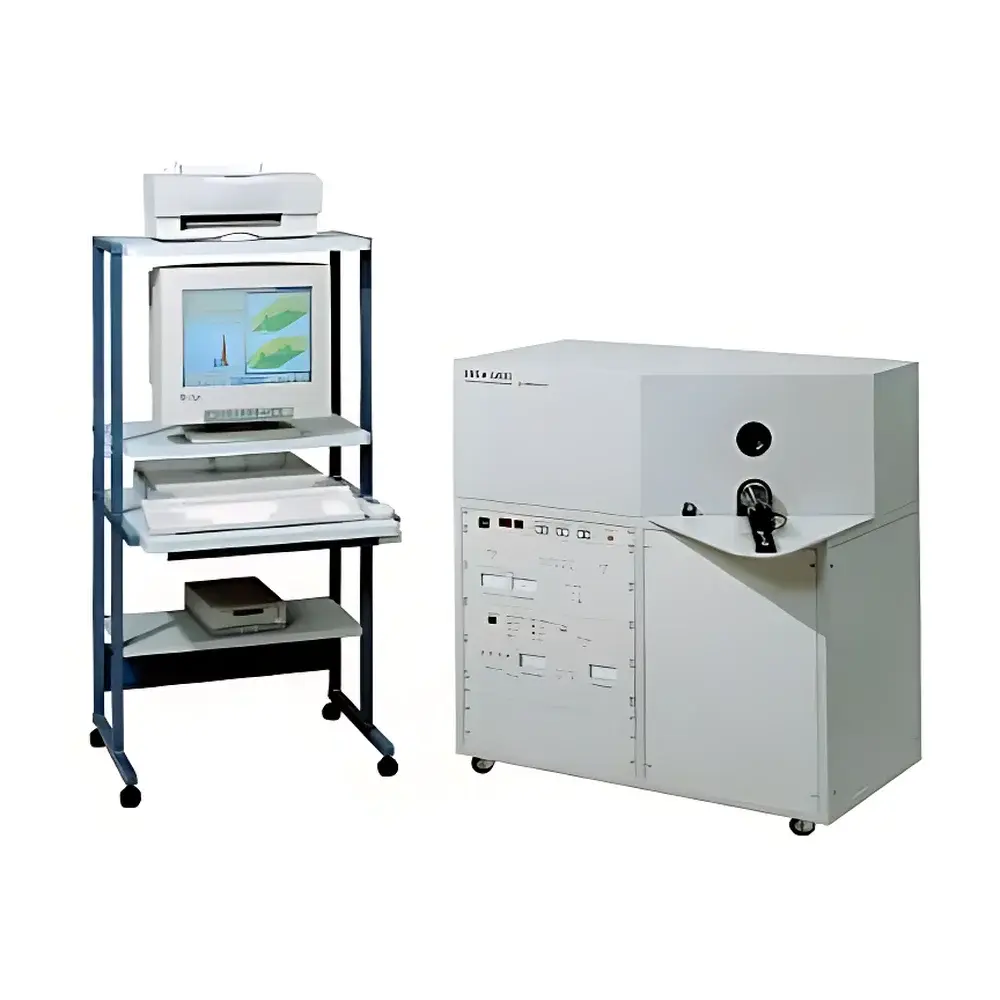
Shimadzu/KRATOS AMICUS X-ray Photoelectron Spectrometer
| Brand | Shimadzu/KRATOS |
|---|---|
| Origin | United Kingdom |
| Manufacturer | KRATOS Analytical (a Shimadzu company) |
| Type | AMICUS |
| X-ray Source | Mg/Al Kα dual anode, non-monochromated |
| Maximum Power | 300 W (top-illumination geometry) |
| Anode Design | Conical bulk target |
| Energy Resolution | < 0.8 eV (Mo 3d₅/₂) |
| Typical Resolution & Sensitivity | 1.15 eV @ 700 kcps (Ag 3d₅/₂) |
| Software | Vision™ (Windows XP/Vista/7 compatible) |
| Vacuum Monitoring & Control | Real-time chamber pressure display, automated valve sequencing, full experimental parameter scripting, unattended operation capability |
| Optional Accessories | High-temperature catalytic reaction cell |
Overview
The Shimadzu/KRATOS AMICUS X-ray Photoelectron Spectrometer is a high-performance, research-grade surface analysis instrument engineered for quantitative elemental identification, chemical state determination, and depth-profiling of solid materials at the nanoscale. Based on the photoelectric effect—where incident X-ray photons eject core-level electrons whose kinetic energy is measured to derive binding energy—the AMICUS delivers precise, reproducible XPS spectra with exceptional signal-to-noise ratio and spatial uniformity. Designed and manufactured by KRATOS Analytical in the UK—a Shimadzu Group company—the system integrates robust vacuum architecture, thermally stable electron optics, and a field-proven top-illumination X-ray source configuration to eliminate shadowing artifacts and ensure homogeneous excitation across large-area samples (up to 10 mm × 10 mm). Its non-monochromated Mg/Al Kα dual-anode source enables rapid survey acquisition while maintaining sufficient energy resolution for routine oxidation state differentiation in catalysts, thin films, polymers, and corrosion layers.
Key Features
- 300 W high-power top-illumination X-ray source ensures uniform photon flux distribution and eliminates geometric shadowing—critical for accurate quantification of heterogeneous or topographically complex surfaces.
- Conical bulk-target anode design significantly reduces carbon contamination buildup during extended acquisition, enhancing long-term spectral stability and reducing maintenance frequency.
- Energy resolution better than 0.8 eV (measured on Mo 3d₅/₂) meets ISO 18118:2017 requirements for high-fidelity chemical shift discrimination; typical operating resolution of 1.15 eV at 700 kcps (Ag 3d₅/₂) balances sensitivity and peak separation for industrial QA/QC workflows.
- Integrated differential pumping stages maintain ultra-high vacuum (UHV) conditions (< 1 × 10⁻⁹ mbar) in the analysis chamber independent of load-lock or sample transfer cycles—ensuring minimal surface recontamination between measurements.
- Modular hardware architecture supports seamless integration of optional in situ accessories, including the high-temperature catalytic reaction cell (operable up to 600 °C under controlled gas environments), enabling operando surface chemistry studies aligned with ASTM E2489 and ISO 15472 methodologies.
Sample Compatibility & Compliance
The AMICUS accommodates standard 12.5 mm diameter conductive stubs, custom multi-sample holders, and flat substrates up to 50 mm × 50 mm with manual stage positioning. Non-conductive samples (e.g., ceramics, oxides, biological films) are analyzed using low-energy flood gun charge neutralization (0–10 eV, adjustable current), validated per ISO 18118 Annex B protocols. All vacuum interlocks, pressure monitoring, and emergency vent sequences comply with CE Machinery Directive 2006/42/EC and IEC 61010-1 safety standards. Data acquisition metadata—including instrument parameters, calibration history, and environmental logs—is structured to support GLP/GMP audit readiness and aligns with FDA 21 CFR Part 11 principles for electronic records and signatures when used with validated Vision™ software configurations.
Software & Data Management
Vision™ software serves as the unified interface for instrument control, spectral acquisition, peak fitting, quantification, and reporting. It provides real-time visualization of all vacuum chamber pressures (analysis, transfer, load-lock), programmable valve sequencing, and fully scriptable experimental routines—including multi-region mapping, angle-resolved XPS (ARXPS), and time-resolved acquisition. Raw data is stored in vendor-neutral .vms format (compatible with CasaXPS and commercial spectral libraries such as NIST XPS Database v4.1), and export options include ASCII, CSV, and JCAMP-DX for third-party chemometric analysis. Audit trail functionality logs user actions, parameter changes, and software version history—essential for regulated environments requiring traceability under ISO/IEC 17025 accreditation.
Applications
- Catalyst surface characterization: identification of active metal oxidation states (e.g., Pt⁰ vs. Pt²⁺), support interactions (e.g., TiO₂–CeO₂ interfaces), and coke deposition kinetics via sequential in situ oxidation/reduction cycles.
- Thin-film and coating analysis: thickness estimation via attenuation modeling (Shirley background + Tougaard algorithm), interfacial diffusion profiling in ALD-grown dielectrics, and passivation layer integrity assessment in photovoltaic absorbers.
- Corrosion science: speciation of passive oxide layers (Cr₂O₃ vs. CrOOH) on stainless steels, chloride-induced breakdown mechanisms, and inhibitor adsorption behavior on aluminum alloys.
- Advanced packaging and microelectronics: detection of trace fluorine residues from etch processes, Cu–SiN interfacial silicide formation, and organic residue identification post-CMP cleaning.
- Biomedical material interfaces: protein adsorption conformation analysis on plasma-treated polymer scaffolds, calcium phosphate phase identification in bioactive coatings, and leachate-induced surface degradation of orthopedic implants.
FAQ
What vacuum level is maintained during analysis, and how is it monitored?
The analysis chamber operates continuously below 1 × 10⁻⁹ mbar, with real-time pressure readouts for all vacuum zones displayed in Vision™ software. Capacitance manometers and ion gauges are calibrated annually per ISO 20483 procedures.
Is monochromated X-ray capability available on the AMICUS platform?
No—the AMICUS is configured exclusively with a non-monochromated Mg/Al Kα dual-anode source. Monochromation is not supported due to its fixed optical path and optimized high-flux design.
Can the system be integrated into an existing UHV cluster or transferred to another vacuum system?
Yes—KRATOS provides flange-matched UHV-compatible transfer interfaces (CF-100 or CF-150) and vacuum interlock handshaking protocols for integration with sputter systems, MBE chambers, or LEED/AES modules.
What documentation is provided for regulatory compliance validation?
Shimadzu/KRATOS supplies IQ/OQ documentation templates, factory calibration certificates (traceable to NPL standards), and software validation guidance aligned with GAMP5 and ISO/IEC 17025 Annex A.3 requirements.
How frequently does the X-ray anode require replacement under typical usage?
With proper cooling and adherence to recommended power cycling protocols, the conical bulk anode typically exceeds 15,000 hours of operational lifetime before performance degradation necessitates replacement—verified via routine Mo 3d resolution checks per ISO 18118 Section 7.2.




