
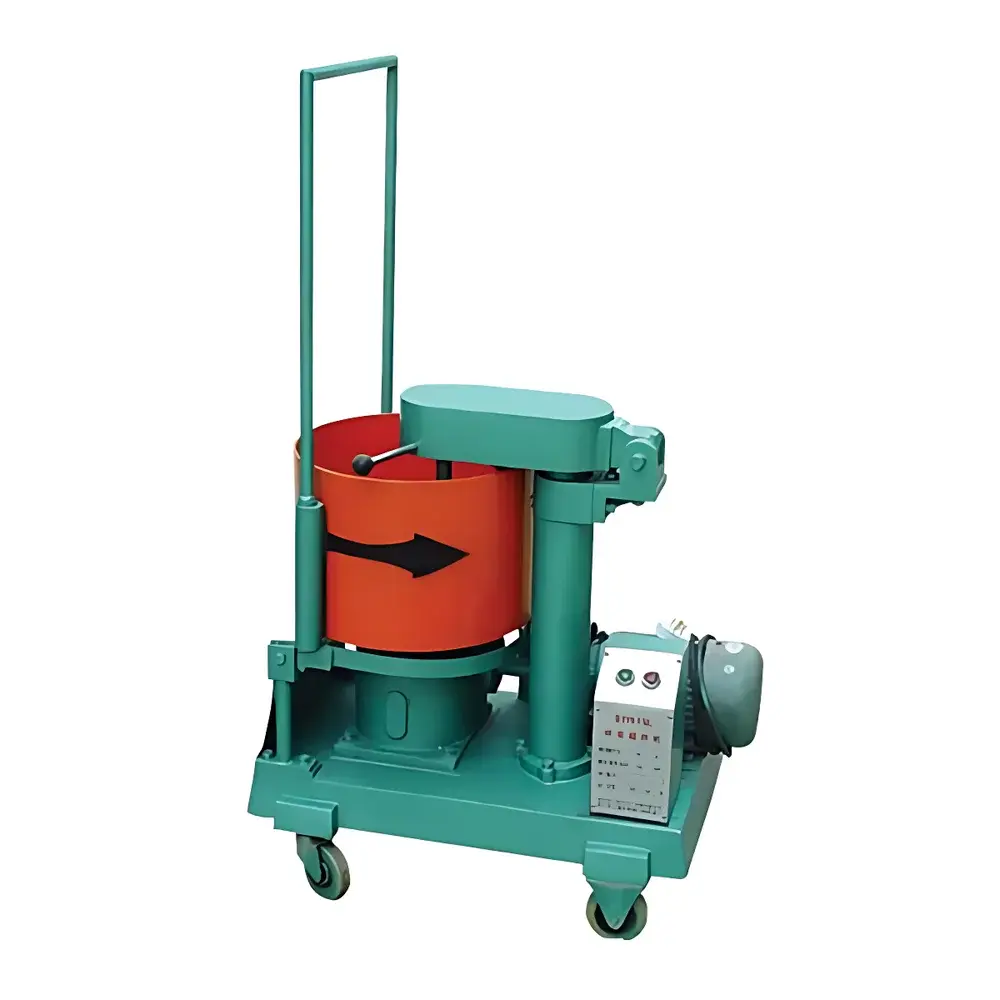
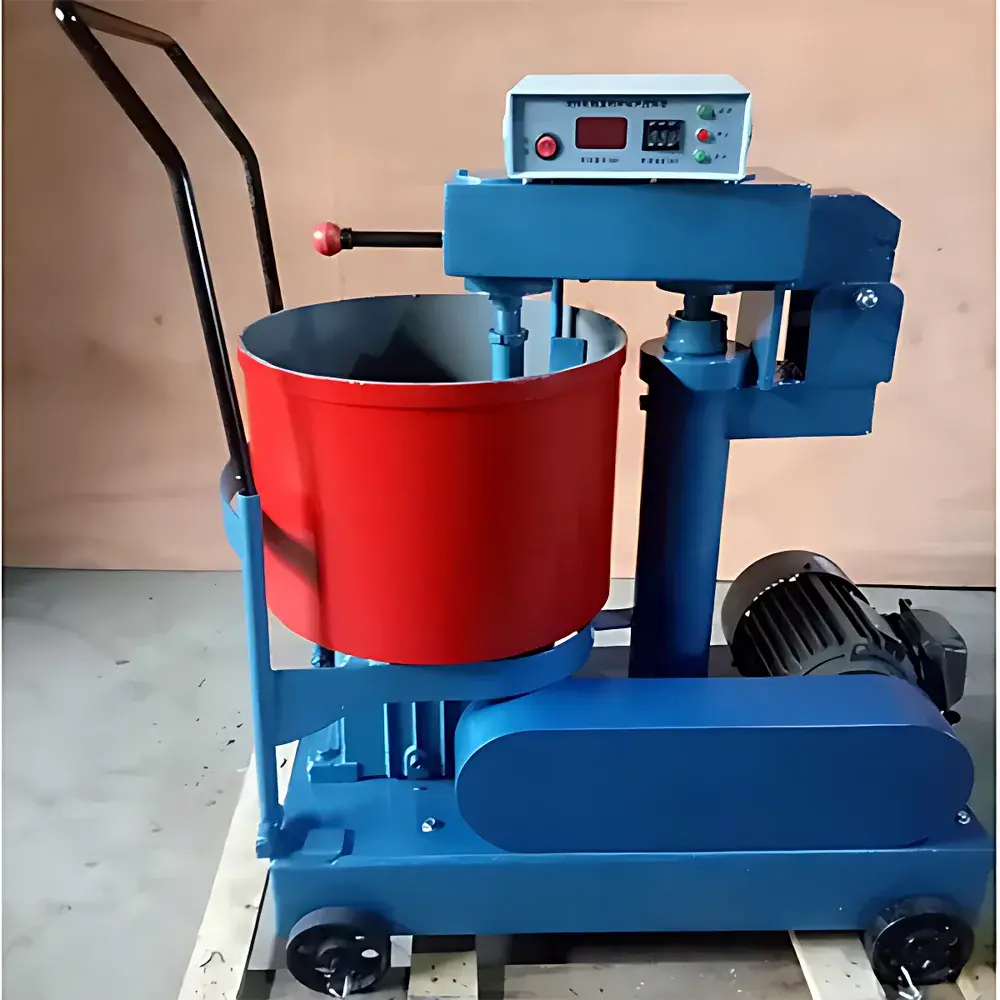
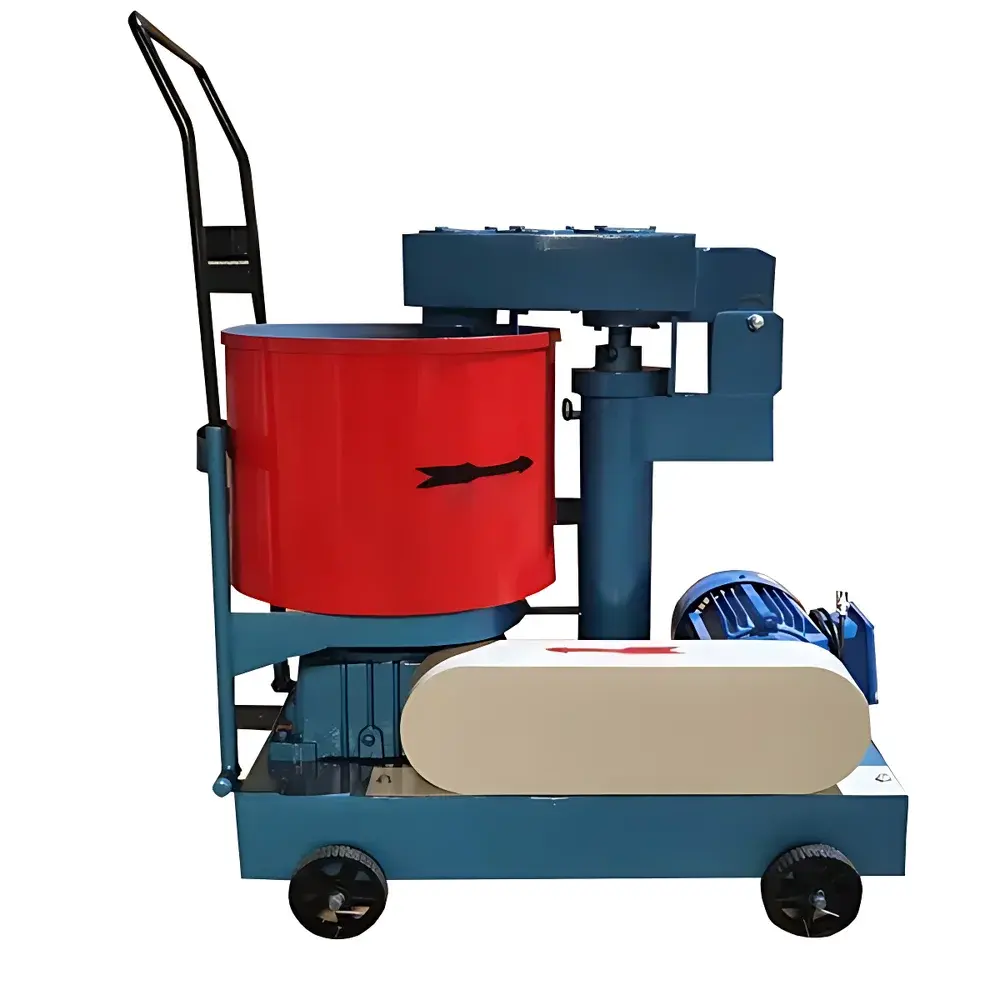
Rongjida UJZ-15 15-Liter Vertical Mortar Mixer for Laboratory Use
| Brand | Rongjida |
|---|---|
| Origin | Shanghai, China |
| Manufacturer Type | Direct Manufacturer |
| Country of Origin | China |
| Model | UJZ-15 |
| Test Type | Mortar Mixing |
| Mixing Capacity (Rated Discharge) | 15 L |
| Total Bowl Volume | 28 L |
| Impeller Diameter | φ200 mm |
| Impeller Rotation Speed | 80 ± 4 rpm (clockwise) |
| Bowl Rotation Speed | 60 ± 2 rpm (counterclockwise) |
| Bowl Inner Diameter | φ380 mm |
| Bowl Depth | 250 mm |
| Clearance Between Fixed Blade and Bowl Wall | 2 ± 0.5 mm |
| Clearance Between Impeller and Bowl Bottom | 2 ± 0.5 mm |
| Power Supply | 380 V AC |
| Rated Power | 1500 W |
| Blade Configuration | Dual-tier, 4 blades per tier, mounted at 45° angle |
Overview
The Rongjida UJZ-15 is a precision-engineered vertical mortar mixer designed specifically for standardized laboratory preparation of construction mortars in compliance with JGJ 70–90 (Standard Test Methods for Basic Properties of Building Mortar), the national standard issued by China’s Ministry of Housing and Urban-Rural Development. It operates on a dual-rotation principle: the mixing impeller rotates clockwise while the mixing bowl rotates counterclockwise—generating controlled shear and convective flow to ensure uniform dispersion of dry powders (e.g., cement, lime, fine aggregates) and subsequent homogeneous hydration upon water addition. This counter-rotational architecture minimizes dead zones, reduces segregation risk, and delivers reproducible batch-to-batch consistency essential for compressive strength testing, adhesion evaluation, and workability assessment in R&D, quality control, and certification laboratories.
Key Features
- Dual independent drive system: Separately regulated motor outputs for impeller (80 ± 4 rpm) and bowl (60 ± 2 rpm), enabling precise control over shear rate and bulk motion.
- Optimized blade geometry: Two-tier configuration with four 45°-angled blades per tier ensures efficient radial and axial material turnover across the full 28 L bowl volume.
- Tight mechanical tolerances: Consistent 2 ± 0.5 mm clearance between fixed scraper and bowl wall, and between impeller tip and bowl bottom—critical for complete material discharge and avoidance of unmixed residue.
- Robust powertrain: Worm-gear reduction coupled with spur gear transmission delivers high torque stability under variable load conditions typical of stiff mortar batches.
- Programmable operation interface: Integrated controller supports timed no-load verification, directional validation, and repeatable start/stop sequencing aligned with ASTM C305 and ISO 679 procedural requirements.
- Ergonomic tilt mechanism: Manual hydraulic-assisted bowl tipping enables safe, controlled discharge at adjustable angles without mechanical strain or spillage.
Sample Compatibility & Compliance
The UJZ-15 accommodates a broad spectrum of dry-powder and semi-dry formulations including but not limited to cementitious mortars, gypsum-based plasters, polymer-modified renders, refractory castables, and synthetic stone matrixes. Its 15 L rated discharge capacity aligns with standard specimen mold volumes used in compressive strength testing (e.g., 70.7 mm cubes per GB/T 17671 and EN 196-1). The mixer meets structural and operational requirements referenced in JGJ 70–90, GB/T 2419 (fluidity test), and ASTM C270 (specification for mortar for unit masonry). All metallic wetted components are constructed from corrosion-resistant carbon steel with surface passivation suitable for repeated exposure to alkaline cement slurries. No electrical or mechanical components are rated for hazardous area use (ATEX/IECEx).
Software & Data Management
This model features a dedicated microcontroller-based operating panel with LED status indicators and tactile push-button controls—designed for durability in dusty laboratory environments. While it does not incorporate PC connectivity or digital data logging, its deterministic timing logic ensures strict adherence to standardized mixing durations defined in JGJ 70–90 Section 4.2 (e.g., 120 s low-speed pre-mix followed by 120 s high-speed final mix). For GLP/GMP-aligned workflows, users may document run parameters (batch ID, operator, date/time, raw material lot numbers, water addition sequence) manually in a bound logbook or integrate the mixer into a validated LIMS via external timer relay triggers. Firmware revision history and calibration records must be maintained per ISO/IEC 17025 Clause 6.4.10.
Applications
- Preparation of standardized mortar specimens for compressive, flexural, and bond strength testing per GB/T 17671, EN 1015-11, and ASTM C109.
- Formulation development of repair mortars, grouts, and self-leveling compounds requiring tight particle distribution control.
- Quality assurance testing in precast concrete and masonry unit manufacturing facilities.
- Academic research on hydration kinetics, rheological evolution, and air-entrainment behavior during early-stage mixing.
- Batch-scale blending of pigment-dispersed decorative stuccos and engineered quartz composites.
FAQ
What is the maximum allowable batch weight for a 15 L discharge volume?
Maximum recommended dry mass is 22 kg (assuming typical bulk density of 1450–1550 kg/m³ for dry mortar mixes); total slurry mass should not exceed 30 kg to maintain mechanical stability during rotation.
Can this mixer be used for wet-mix shotcrete preparation?
No—this device lacks the high-shear intensity and continuous feed capability required for fiber-reinforced or accelerator-dosed shotcrete; it is intended solely for static batch mixing of non-fibrous, low-slump mortars.
Is periodic recalibration required?
Yes—rotational speed verification using a certified handheld tachometer is recommended every 6 months or after any gearbox servicing; bowl and impeller clearances should be measured annually with feeler gauges per maintenance schedule.
What lubrication is specified for the worm gear reducer?
ISO VG 30 mineral-based industrial gear oil (equivalent to SAE 10W); fill level must be maintained between the lower and upper marks on the sight glass, with full replacement every 3 months under daily operation.
Does the unit comply with CE or UL safety directives?
It conforms to GB/T 5226.1–2019 (equivalent to IEC 60204-1) for electrical safety in machinery, but carries no CE marking or UL listing; end-users are responsible for local regulatory acceptance per their jurisdiction’s machinery directive implementation.
Related Products





