
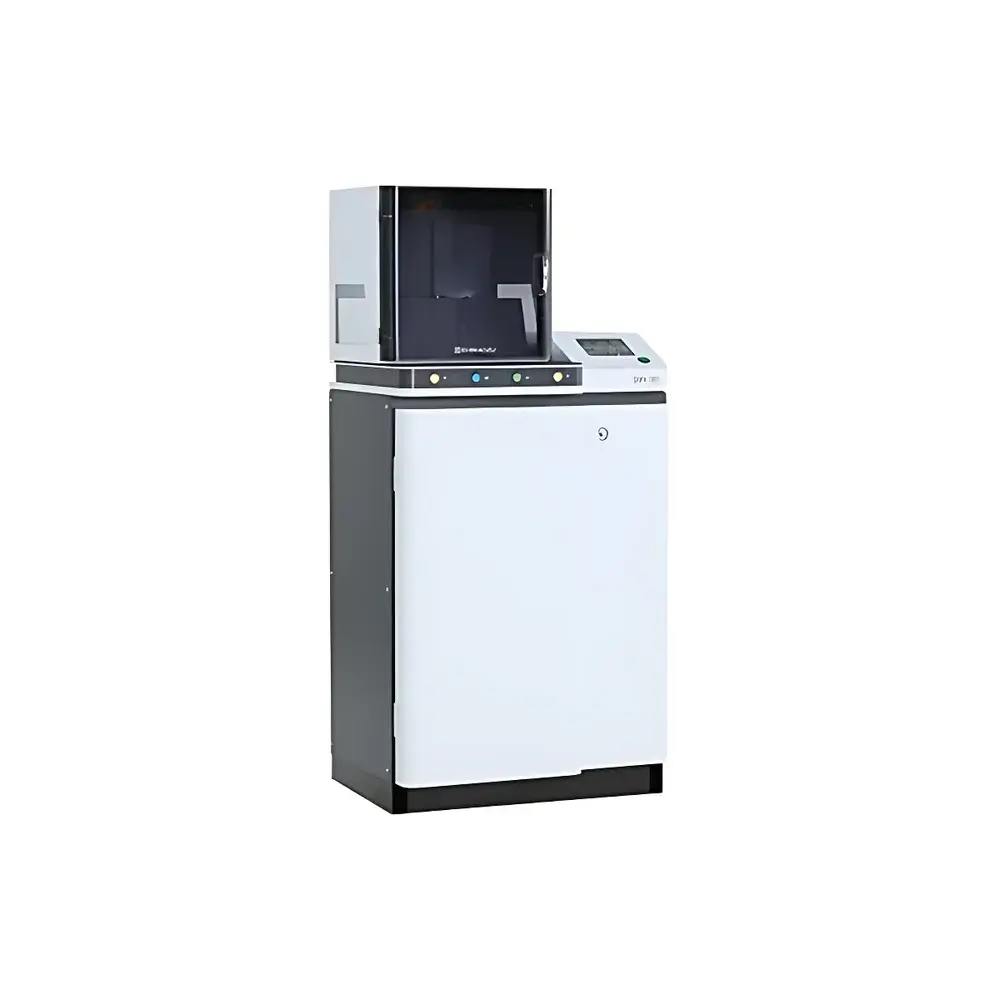
Shimadzu SMV-301 / SMV-301RT Automatic Mooney Viscometer
| Brand | Shimadzu |
|---|---|
| Origin | Japan |
| Manufacturer | Shimadzu Corporation |
| Model | SMV-301 / SMV-301RT |
| Compliance Standards | JIS K6300, ISO 289, ASTM D1646, BS 1673 |
| Temperature Resolution | 0.1 °C |
| Temperature Accuracy | ±0.3 °C |
| Rotational Speed Range (SMV-301RT) | 0.5–5 rpm |
| Mooney Viscosity Range | 0–200 M (optional 400 M) |
| Test Temperature Range | Ambient to 200 °C |
| Sample Dimensions | Ø ≈ 50 mm × Thickness ≈ 6 mm |
| Rotor Type | L-shaped |
| Curing Point Setting Range | 0–99.9 M (up to 10 points) |
| Viscosity Measurement Duration | 0–99 min 59 sec (up to 10 time points) |
Overview
The Shimadzu SMV-301 and SMV-301RT are fully automated Mooney viscometers engineered for precise, standardized determination of Mooney viscosity and scorch behavior in raw and synthetic rubbers. Based on the fundamental principle of rotational viscometry under controlled shear—where a calibrated L-shaped rotor rotates at fixed speed within a heated, confined rubber sample—the instruments quantify torque resistance as a function of time and temperature. This measurement directly correlates to polymer molecular weight distribution, processability, and vulcanization onset, making it indispensable for quality control in rubber compounding, tire manufacturing, and elastomer R&D laboratories. Both models comply with internationally recognized test standards including JIS K6300, ISO 289, ASTM D1646, and BS 1673, ensuring data traceability and regulatory acceptability across global supply chains.
Key Features
- High-resolution color LCD touchscreen interface enabling intuitive setup of test parameters—including temperature ramp profiles, rotor speed (SMV-301RT only), torque acquisition intervals, and scorch point thresholds—with real-time graphical display of viscosity vs. time curves.
- Optimized thermal architecture featuring thin-film heating elements and advanced PID feedback control, achieving temperature stabilization within ≤90 seconds after sample insertion and maintaining long-term stability at ±0.3 °C across the full operating range (ambient to 200 °C).
- SMV-301RT variant integrates a high-precision servo motor drive system, supporting programmable rotor speeds from 0.5 to 5 rpm—enabling multi-speed Mooney viscosity profiling and low-shear stress relaxation measurements per ISO 6673.
- Robust pneumatic compression system ensures consistent 11.5 kN (±0.5 kN) clamping force during testing, guaranteeing uniform sample geometry and minimizing edge effects.
- Built-in statistical analysis module calculates mean, standard deviation, CV%, and confidence intervals across replicate runs, supporting GLP-compliant reporting and internal method validation protocols.
- Modular accessory support includes optional pre-heating trays, calibration torque kits, and sample cutting dies conforming to ISO 289 Annex A specifications.
Sample Compatibility & Compliance
The SMV-301/301RT accommodates standard cylindrical rubber specimens (Ø 50 mm × 6 mm thickness), compatible with natural rubber (NR), styrene-butadiene rubber (SBR), ethylene propylene diene monomer (EPDM), nitrile rubber (NBR), and thermoplastic elastomers (TPEs). All hardware and firmware configurations adhere to the mechanical, thermal, and metrological requirements specified in JIS K6300-2:2022, ISO 289-1:2020, ASTM D1646–23, and BS 1673:2018. The instrument’s temperature sensor calibration is traceable to NIST-certified reference standards, and its torque transducer undergoes annual verification per ISO/IEC 17025-accredited procedures.
Software & Data Management
Control and analysis are executed via Shimadzu’s dedicated MooneyVisco software (v3.2+), which supports audit-trail-enabled operation in accordance with FDA 21 CFR Part 11 requirements—including electronic signatures, user-level access control (administrator/operator), and immutable raw data logging. Export formats include CSV, PDF reports with embedded metadata (operator ID, timestamp, instrument serial number, calibration status), and XML for integration into LIMS environments. Raw torque/time datasets retain millisecond-level timestamp resolution, enabling post-acquisition reprocessing of scorch onset (t5, t35) using derivative-based algorithms per ASTM D1646 Annex A.
Applications
- Quality assurance of incoming raw rubber lots against supplier specifications and internal process limits.
- Optimization of mixing cycles and filler dispersion efficiency in compound development.
- Scorch safety assessment for extrusion and calendering processes—identifying premature crosslinking risk before vulcanization.
- Correlation studies between Mooney viscosity and downstream rheological properties (e.g., melt flow index, oscillatory G’, G’’).
- Supporting ISO/TS 16949 and IATF 16949 compliance through documented measurement uncertainty budgets and equipment qualification records (IQ/OQ/PQ).
FAQ
What distinguishes the SMV-301RT from the base SMV-301 model?
The SMV-301RT features a servo-driven rotor system enabling variable rotational speeds (0.5–5 rpm) and stress relaxation capability, while the SMV-301 operates exclusively at the standard 2 rpm speed.
Is the instrument suitable for testing thermoplastic elastomers (TPEs)?
Yes—provided the TPE remains dimensionally stable under compression at the selected test temperature; recommended maximum temperature is 10 °C below the material’s melting onset (DSC-determined).
How is temperature uniformity verified across the cavity?
Shimadzu provides a certified temperature mapping report (per ASTM E2251) performed with 9-point RTD probe array during factory acceptance testing; users may repeat this annually using optional mapping accessories.
Can test methods be password-protected and locked for production use?
Yes—MooneyVisco software allows administrator-defined method templates with write-protection, preventing unauthorized parameter changes during routine QC operations.
Does the system support remote diagnostics or preventive maintenance alerts?
Integrated Ethernet connectivity enables secure remote support via Shimadzu’s ServiceLink platform, and the software logs operational hours, thermal cycle counts, and torque drift trends to trigger scheduled maintenance notifications.



