
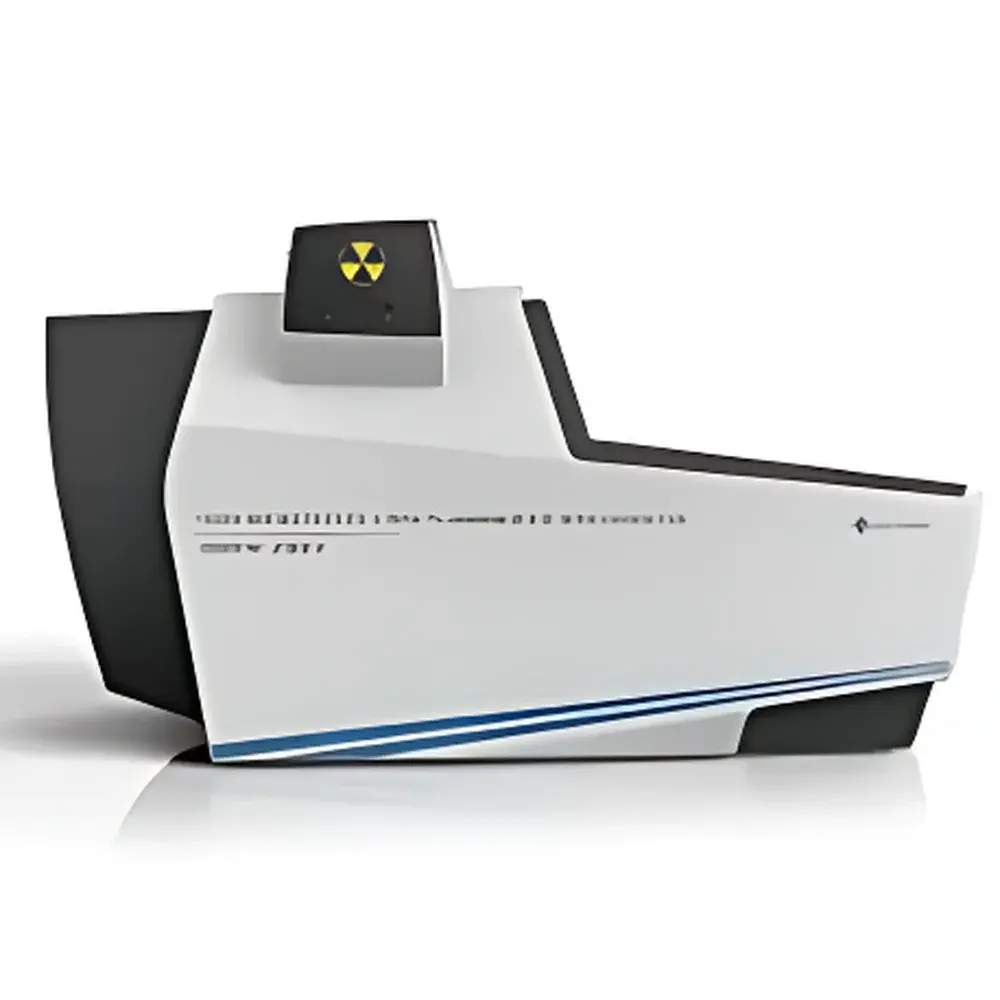
Anchor Wisdom MERAK-CEMII Benchtop Wavelength-Dispersive X-Ray Fluorescence Spectrometer for Cement Full-Element Analysis
| Brand | Anchor Wisdom |
|---|---|
| Origin | Beijing, China |
| Model | MERAK-CEMII |
| Price Range | USD 70,000 – 140,000 |
| Compliance | GB/T 176–2008 |
| Elements Analyzed | Na, Mg, Al, Si, P, S, Cl, K, Ca, Ti, V, Cr, Mn, Fe, Ni, Cu, Zn |
| Detection Principle | Wavelength-Dispersive XRF (WDXRF) with High-Flux Doubly Curved Crystal Spectrometer (HF DCCS) and Secondary Target Excitation |
| Sample Form | Solid powders (pressed pellets or fused beads) |
| Vacuum/Atmosphere | Ambient air operation (no vacuum pump or He purge required) |
| Cooling | Peltier-cooled detector (no liquid nitrogen) |
| Stability | Ready for measurement within 3 minutes after power-on |
Overview
The Anchor Wisdom MERAK-CEMII is a purpose-engineered benchtop wavelength-dispersive X-ray fluorescence (WDXRF) spectrometer designed exclusively for full-element quantitative analysis in cement and silicate-based materials. Unlike energy-dispersive (EDXRF) systems, the MERAK-CEMII employs high-resolution crystal diffraction optics—specifically a patented High-Flux Doubly Curved Crystal Spectrometer (HF DCCS)—combined with secondary target excitation to deliver superior peak-to-background ratios and detection sensitivity for light elements (Na through Zn). This architecture enables trace-level quantification of critical oxides—including Na2O, MgO, Al2O3, SiO2, SO3, Cl−, K2O, CaO, TiO2, and Fe2O3—with precision fully compliant with GB/T 176–2008, the Chinese national standard for chemical analysis of cement. Its compact footprint, ambient-air operation, and absence of cryogenic cooling or vacuum subsystems make it uniquely suited for routine QC laboratories in cement plants, precast facilities, and building materials R&D centers where reliability, low operational overhead, and regulatory traceability are non-negotiable.
Key Features
- Light-element capability down to sodium (Na), enabled by HF DCCS optics and optimized secondary target excitation geometry
- Benchtop form factor with integrated X-ray tube (low-power, air-cooled), miniaturized high-voltage generator, and ASIC-based signal processing electronics
- No vacuum chamber or helium purge required—enables rapid sample turnover and eliminates gas supply dependencies
- Peltier-cooled silicon drift detector (SDD) with high count-rate handling and long-term gain stability
- Pre-calibrated factory methods for cement raw meal, clinker, and finished cement—fully aligned with GB/T 176–2008 oxide reporting formats
- Onboard rate-based raw mix optimization algorithm; real-time output of LSF, SM, and AM indices directly exportable to DCS via Modbus TCP or OPC UA
- Robust mechanical design with no moving optical components—minimizes recalibration frequency and field service intervals
Sample Compatibility & Compliance
The MERAK-CEMII accepts standard 32-mm or 40-mm pressed powder pellets (prepared using hydraulic presses and binder-free techniques) or fused borate beads. It supports both major and minor oxide quantification across the full cement compositional range—from high-lime raw meals to low-alkali sulfate-resistant cements. All analytical methods are validated per ISO 12855 (XRF—quantitative analysis of ceramic and glass materials) and aligned with the metrological requirements of GB/T 176–2008, including repeatability thresholds (e.g., ≤0.02 wt% for Na2O, ≤0.001 wt% for Cl−, ≤0.015 wt% for K2O). The system meets GLP documentation standards with audit-trail-enabled software, user-access controls, and electronic signature support compliant with FDA 21 CFR Part 11 when deployed in regulated manufacturing environments.
Software & Data Management
MERAK-CEMII operates on Anchor Wisdom’s proprietary CEMSuite v3.2 software platform—a Windows-based application supporting method creation, calibration curve management, statistical process control (SPC), and automated report generation in PDF/Excel formats. All measurements include timestamped metadata (operator ID, sample ID, instrument conditions, calibration version). Raw spectral data and processed results are stored in an encrypted SQLite database with configurable backup policies. The software includes built-in uncertainty estimation per ISO/IEC 17025 Annex A.3 and supports seamless integration into LIMS via ODBC or RESTful API. Optional modules include multivariate calibration (PLS regression) for complex matrix corrections and remote diagnostics with TLS-secured cloud telemetry.
Applications
- Routine quality control of cement raw meal composition for kiln feed optimization
- Final clinker and portland cement certification per GB 175 and ASTM C150
- Trace chloride and alkali monitoring to prevent reinforcement corrosion and ASR expansion
- Raw material blending verification for limestone, clay, sand, iron ore, and industrial by-products (e.g., fly ash, slag)
- Compositional screening of refractory ceramics, glass frits, and specialty construction mortars
- Research-grade elemental mapping support (via optional motorized XYZ stage) for heterogeneity studies in sintered phases
FAQ
Does the MERAK-CEMII require vacuum or helium purging for light-element analysis?
No. Its HF DCCS optical path and secondary target configuration enable high-sensitivity Na–Cl detection under ambient air conditions.
How does the instrument ensure compliance with GB/T 176–2008 repeatability requirements?
Through factory-installed, matrix-matched calibrations validated using NIST SRM 2686a (cement clinker) and in-house reference materials; daily drift correction uses internal Sc/Rb reference lines.
Can the system interface directly with plant DCS or MES platforms?
Yes—via native Modbus TCP, OPC UA, or ASCII serial protocols; all oxide outputs and rate-based配料 indices are mapped to standard tag structures.
What maintenance is required beyond routine cleaning and calibration verification?
Annual verification of X-ray tube output stability and detector resolution (FWHM at Mn Kα); no consumables or scheduled part replacements are specified in the first 5 years.
Is method transfer possible between MERAK-CEMII units across different sites?
Yes—calibration files, spectral libraries, and SOP templates are exportable/importable in standardized XML format, enabling harmonized multi-site operations.
Related Products





