
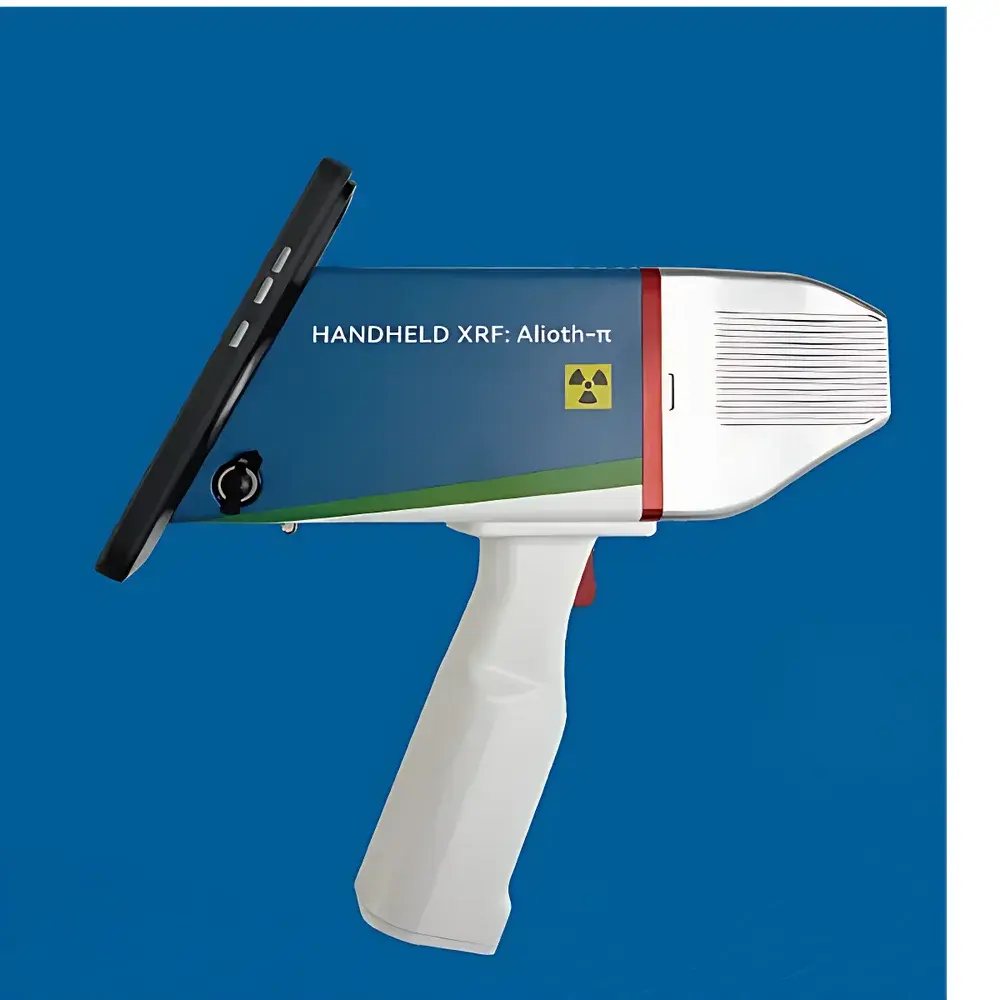
Anchor Wisdom Alioth-π Handheld X-ray Fluorescence (XRF) Spectrometer
| Brand | Anchor Wisdom |
|---|---|
| Origin | Beijing, China |
| Manufacturer Type | Authorized Distributor |
| Country of Origin | China |
| Model | Alioth-π |
| Price Range | USD 4,200 – 5,600 (FOB) |
| Detection Limit (Pb in aqueous matrix) | <0.3 mg/L |
| Detection Limit (Cd in aqueous matrix) | <0.5 mg/L |
| Measurement Time | 60 s per analysis |
| Detector Resolution | ≤145 eV (Mn Kα) |
| X-ray Tube | Transmission-target microfocus tube |
| Optical Path | Optimized 3D ultra-short path (sample–tube–detector) with multilayer scatter suppression coating |
| Camera | Integrated 1-MP visible-light imager with real-time video capture |
| Enclosure Rating | IP67-equivalent dual-layer liquid ingress protection |
| Housing Material | Aerospace-grade Al-Mg alloy |
| Software Algorithm | Holographic Fundamental Parameters (FP) quantification engine |
| Operating Mode | PC-controlled or standalone tablet interface |
| Warm-up Time | <3 s |
| Power Supply | Rechargeable Li-ion battery (8+ hrs continuous operation) |
Overview
The Anchor Wisdom Alioth-π Handheld X-ray Fluorescence (XRF) Spectrometer is an engineered solution for field-deployable, high-fidelity elemental analysis across heterogeneous sample matrices. Unlike conventional handheld XRF systems relying on reflective target tubes and extended optical paths, the Alioth-π implements a transmission-target microfocus X-ray source coupled with a precisely aligned 3D ultra-short excitation geometry—minimizing photon loss and geometric divergence. This architecture enables detection performance comparable to benchtop WDXRF and high-end EDXRF systems, particularly for low-Z elements (Na–Cl) and heavy metals (Pb, Cd, Hg, As) in complex, non-uniform media. The instrument operates on the principle of energy-dispersive X-ray fluorescence: primary X-rays induce characteristic secondary emission from atoms in the sample; emitted photons are resolved by a high-resolution silicon drift detector (SDD), and spectral deconvolution is performed using physics-based fundamental parameters modeling rather than empirical calibration curves.
Key Features
- Transmission-target microfocus X-ray tube with optimized beam collimation and thermal management for stable output over extended duty cycles.
- Three-dimensional ultra-short optical path design integrating sample plane, X-ray source, and SDD detector within a sub-30 mm axial envelope—reducing scattering artifacts and enhancing signal-to-background ratio.
- Multilayer interference-coated internal shielding to suppress bremsstrahlung and Compton-scattered radiation, improving peak-to-background metrics for trace-level quantification.
- Integrated 1-megapixel visible-light camera supporting synchronized image capture, geotagged sampling documentation, and real-time video logging—critical for GLP-compliant field audits and chain-of-custody reporting.
- Dual-layer liquid barrier system enabling direct immersion into aqueous solutions, slurries, or leachates without housing compromise—validated for continuous operation in ISO 9001-certified wet-lab environments.
- Aerospace-grade aluminum-magnesium alloy chassis (density: ~1.8 g/cm³) with ergonomic grip contouring and balanced mass distribution (net weight: 1.42 kg), reducing operator fatigue during multi-hour survey campaigns.
- Sub-3-second cold-start capability and seamless transition between sleep/wake states—enabling rapid sequential measurements at discrete loci without thermal stabilization delays.
Sample Compatibility & Compliance
The Alioth-π accommodates solid, powdered, liquid, and semi-solid specimens—including metal alloys, painted surfaces, soil extracts, mining slurry, electroplating baths, and perovskite thin films. Its immersion-rated design conforms to IEC 60529 IP67 mechanical ingress protection standards when fitted with factory-sealed port covers. For regulatory workflows, the system supports audit-ready data export compliant with ISO/IEC 17025:2017 clause 7.7 (result reporting) and ASTM E1621–22 (standard guide for elemental analysis by portable XRF). While not pre-certified for FDA 21 CFR Part 11, its software architecture permits integration with third-party electronic lab notebook (ELN) platforms offering full electronic signature, audit trail, and role-based access control.
Software & Data Management
Control and analysis are executed via the proprietary Alioth Studio Suite—a cross-platform application (Windows/macOS/Linux) supporting both tethered PC operation and wireless tablet deployment. Quantitative analysis leverages the Holographic Fundamental Parameters (FP) algorithm, which solves the Sherman equation iteratively using matrix composition estimates, mass absorption coefficients, and detector response functions—eliminating reliance on matrix-matched reference standards. Raw spectra (.spe), processed reports (.pdf/.xlsx), and metadata-rich image logs (.jpg + EXIF + GPS tags) are stored in a timestamped, immutable project directory structure. Batch processing, spectral library matching (NIST SRM databases included), and custom limit-of-detection (LOD) calculation per element/matrix are supported.
Applications
- Environmental monitoring: Rapid screening of Pb, Cd, As, and Cr in contaminated soils, wastewater effluents, and sediment cores per EPA Method 6200.
- RoHS/WEEE compliance testing: Non-destructive verification of restricted substances in electronics housings, cable sheaths, and printed circuit board finishes.
- Mineral exploration: In-situ grade estimation of Cu, Zn, Ni, and Co in drill core fragments and trench samples—reducing lab turnaround time by >70%.
- Coating thickness & composition: Quantitative analysis of Cr(VI) conversion coatings, Zn-Ni electroplating layers, and TiO₂ pigment dispersion in architectural paints.
- Advanced materials R&D: Elemental stoichiometry mapping of mixed-halide perovskites (e.g., Cs₀.₀₅FA₀.₈₃MA₀.₁₂Pb(I₀.₈₃Br₀.₁₇)₃) without vacuum chamber requirements.
FAQ
Does the Alioth-π require external calibration standards for routine quantification?
No. Its holographic fundamental parameters engine enables standardless quantification for homogeneous and layered samples, though certified reference materials (CRMs) are recommended for method validation per ISO/IEC 17025.
Can it measure light elements such as magnesium or aluminum in air?
Yes—optimized vacuum-path geometry and low-noise SDD enable reliable Mg Kα (1.25 keV) and Al Kα (1.49 keV) detection in ambient air mode, subject to surface oxidation and matrix effects.
Is spectral data export compatible with third-party chemometric tools?
Yes. Raw .spe files adhere to the IAEA-compatible ASCII format and can be imported into MATLAB, Python (using PyMCA or silx libraries), or Unscrambler for PCA, PLS-R, or clustering workflows.
What is the typical lifetime of the X-ray tube under field use conditions?
Rated for ≥10,000 hours of cumulative operation at 40 kV/100 µA, with automatic power throttling during idle periods to extend service life.
How is measurement reproducibility verified across operators and sites?
Built-in daily verification protocol includes NIST-traceable check sources (Fe-55, Cd-109) and automated repeatability assessment (RSD ≤3.2% for Pb at 100 ppm in polymer matrix, n=10).
Related Products





