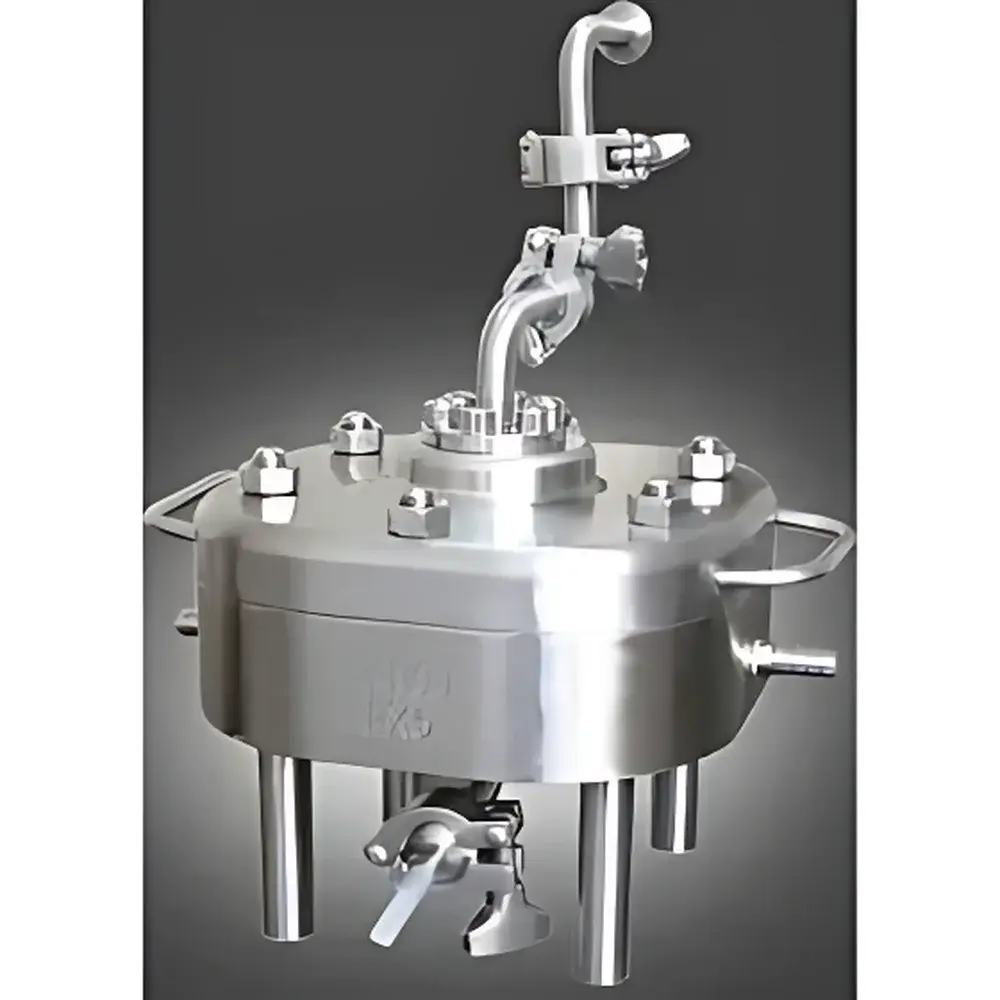
ATS NANOJ EX5 Membrane Extruder
| Brand | ATS |
|---|---|
| Origin | Jiangsu, China |
| Manufacturer Type | Direct Manufacturer |
| Product Category | Domestic |
| Model | NANOJ EX5 |
| Price Range | USD 7,000 – 140,000 (FOB) |
| Compatible Vesicle Type | Liposomes |
| Standard Filter Pore Size | 100 nm |
| Optional Pore Sizes | 50, 200, 400, 800 nm |
Overview
The ATS NANOJ EX5 Membrane Extruder is an engineered benchtop system designed for precise, reproducible size reduction and homogenization of lipid-based nanocarriers—primarily liposomes—through controlled membrane extrusion. It operates on the principle of forced passage of pre-homogenized dispersions through defined-pore polycarbonate or track-etched membranes under regulated pressure and temperature. Unlike shear-intensive methods such as sonication or high-shear mixing, membrane extrusion delivers narrow polydispersity index (PDI < 0.1) and minimal structural perturbation, making it the gold-standard technique for final-step liposome sizing prior to sterile filtration, in vitro characterization, or preclinical formulation development. The NANOJ EX5 is explicitly engineered for integration into end-to-end nanomedicine process workflows, particularly when paired with ATS high-pressure homogenizers (AH-NANO, AH-1500, AH-BASIC, AH-PILOT), enabling a two-stage refinement strategy: primary droplet disruption via high-pressure homogenization followed by secondary size fractionation and polishing via temperature-regulated extrusion.
Key Features
- Double-walled jacketed extrusion chamber enabling precise thermal control (range: 4 °C to 60 °C) via external circulator—critical for processing temperature-sensitive or high-viscosity formulations (e.g., sucrose-stabilized liposomes, polymer-lipid hybrids)
- Modular membrane holder accommodating standard 25 mm or 47 mm diameter track-etched polycarbonate membranes (pore sizes: 50, 100, 200, 400, 800 nm), each certified for low protein binding and endotoxin-free performance
- Stainless-steel fluid path compliant with USP Class VI materials; fully autoclavable components (excluding seals and temperature sensors)
- Manual or pneumatic actuation options; calibrated pressure gauge (0–10 bar) with overpressure relief valve for operator safety and process consistency
- Integrated leak-tight sealing mechanism ensuring zero cross-contamination between sequential extrusion cycles—essential for GMP-aligned small-batch production and QC testing
Sample Compatibility & Compliance
The NANOJ EX5 is validated for extrusion of aqueous liposomal dispersions, nanoemulsions, polymer nanoparticles, and exosome suspensions. Its temperature-jacketed architecture enables reliable processing of viscous, sugar-stabilized, or cholesterol-enriched formulations that would otherwise clog or fracture under ambient conditions. All wetted surfaces meet ISO 10993-5 biocompatibility requirements. When used with 100 nm pore membranes, the system achieves bacterial retention per ASTM F838-22 (Brevundimonas diminuta challenge), supporting its use as a terminal sterile filtration step in non-aseptic lab environments. The device conforms to ICH Q5A(R2) guidance for nanoscale therapeutic product characterization and supports documentation required for GLP-compliant particle size analysis per USP and ISO 13320:2020.
Software & Data Management
While the NANOJ EX5 is a manually operated mechanical system without embedded firmware, it is fully compatible with third-party process documentation tools. Users routinely integrate it into electronic lab notebooks (ELN) such as LabArchives or Benchling using standardized SOP templates. Pressure, temperature, cycle count, membrane lot number, and batch ID are logged manually or via external digital gauges with CSV export capability. For regulated environments, the system supports audit-trail-ready records aligned with FDA 21 CFR Part 11 when paired with validated ELN platforms—ensuring traceability from extrusion run to DLS/NTA characterization data.
Applications
- Final sizing and PDI optimization of liposomal drug products (e.g., doxorubicin, mRNA-LNPs) prior to lyophilization or fill-finish
- Preparation of monodisperse model vesicles for membrane biophysics studies (e.g., fluorescence resonance energy transfer, calorimetry)
- Downstream polishing of nanoparticle suspensions after microfluidic synthesis or solvent evaporation
- Routine quality control of nanocarrier batches in academic core facilities and contract development labs
- Scalable process development bridging from R&D (NANOJ EX5) to pilot-scale (NANOJ EX-Pilot) and GMP manufacturing
FAQ
Can the NANOJ EX5 be used for sterile filtration?
Yes—when equipped with certified 100 nm or smaller pore membranes, it meets ASTM F838-22 criteria for bacterial retention and is widely employed as a final sterile polishing step for research-grade liposomal formulations.
Is temperature control mandatory for all applications?
No—but highly recommended for formulations containing cryoprotectants (e.g., trehalose, sucrose), high cholesterol content (>40 mol%), or elevated phospholipid concentrations (>20 mM), where viscosity increases significantly below 37 °C.
What maintenance is required for long-term reliability?
Routine cleaning with ethanol/water (70:30), ultrasonic bath decontamination of membrane holders, and annual replacement of silicone O-rings and pressure seals—documented in the included maintenance log template.
Does ATS provide IQ/OQ documentation support?
Yes—qualified installation and operational qualification protocols (IQ/OQ) are available upon request for GMP-aligned installations, including calibration certificates for pressure transducers and temperature sensors traceable to NIST standards.