
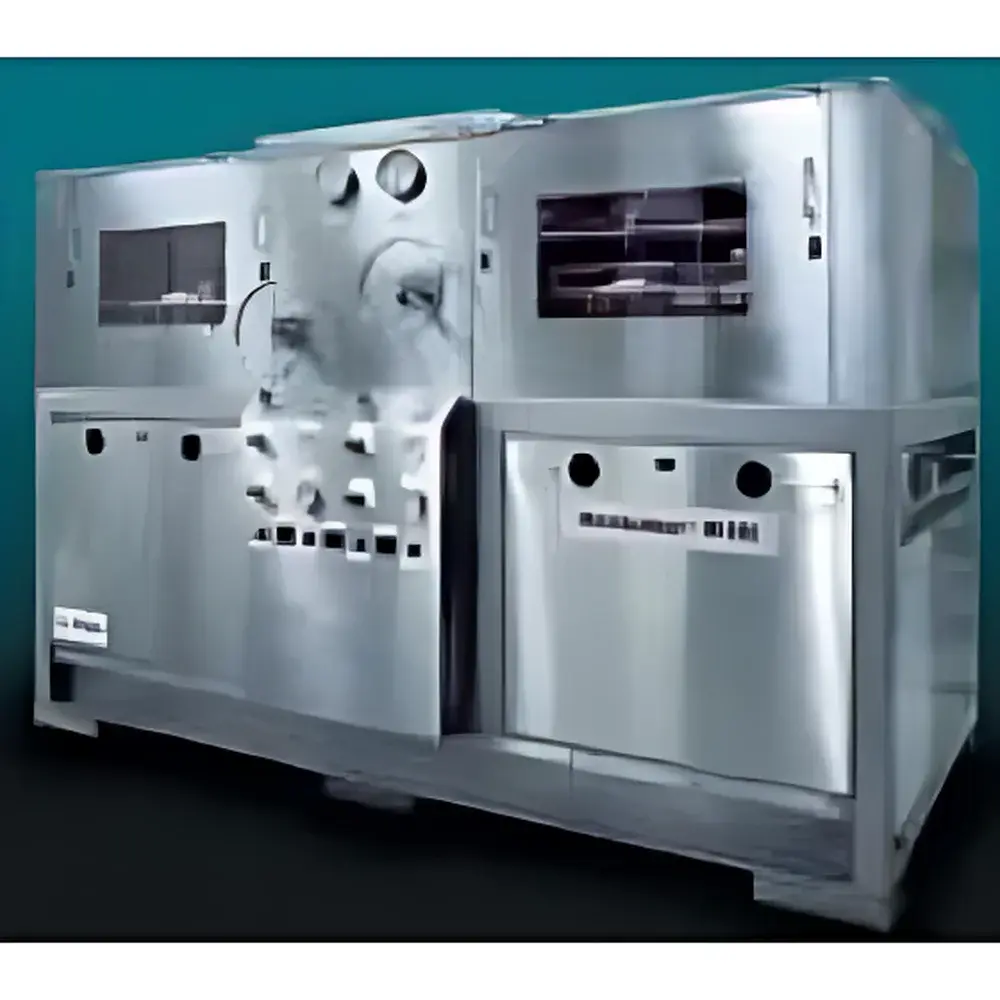
Microfluidics M-610 High-Pressure Microfluidizer Nanohomogenizer
| Origin | USA |
|---|---|
| Manufacturer Type | Authorized Distributor |
| Origin Category | Imported |
| Model | M-610 |
| Instrument Type | High-Pressure Homogenizer |
| Max Operating Pressure | 18,000 psi |
| Flow Rate Range | 124–270 mL/min |
| Feed Temperature Range | –25°C to 75°C |
| Minimum Sample Volume | 14 mL |
| Compressed Air Requirement | 28–57 SCFM at 80 psi (7.5–15 hp) |
| Dimensions | 60 × 39 × 68 cm |
| Weight | 26.4 kg |
Overview
The Microfluidics M-610 High-Pressure Microfluidizer Nanohomogenizer is an engineered platform for reproducible, scalable nanoparticle formation and cell disruption via controlled high-pressure fluid dynamics. Unlike conventional rotor-stator or ultrasonic homogenizers, the M-610 employs a fixed-geometry interaction chamber—patented by Microfluidics International Corporation (now part of Precision NanoSystems)—to generate consistent shear, impact, and cavitation forces under precisely regulated pressure. Fluid is accelerated to supersonic velocities and directed into a Y- or Z-shaped microchannel geometry, where opposing streams collide with micron-scale precision. This process enables sub-150 nm particle size reduction with narrow polydispersity index (PDI), essential for formulation development in biopharmaceuticals, lipid nanoparticles (LNPs), and advanced colloidal systems. Designed for laboratory-scale R&D, the M-610 operates within a pressure range of 3,000–18,000 psi, supporting both batch and continuous processing modes—including recirculation loops for multi-pass refinement.
Key Features
- Fixed-geometry interaction chamber with no moving parts—ensures long-term dimensional stability, eliminates wear-related drift, and guarantees process repeatability across runs.
- Minimal sample requirement of 14 mL, yielding ≥12 mL recoverable processed volume—ideal for precious biological samples and early-stage formulation screening.
- Single-pass microbial or mammalian cell disruption achieving >95% lysis efficiency while preserving intracellular integrity and minimizing thermal degradation or proteolytic activation.
- Linear scalability from lab (M-610) to pilot (M-110EH) and production-scale (M-725, M-925) Microfluidizer systems—validated through empirical correlation of pressure, flow rate, and particle size distribution (PSD).
- Integrated clean-in-place (CIP) capability—no disassembly required for routine sanitization or sterilization-in-place (SIP) using steam, NaOH, or ethanol, supporting GLP-compliant workflows.
Sample Compatibility & Compliance
The M-610 accommodates a broad spectrum of viscosities and solid loadings—from low-viscosity aqueous emulsions to high-concentration suspensions containing up to 40% w/w solids (e.g., TiO₂, SiO₂, carbon nanotubes). It is routinely deployed in formulations compliant with USP , ISO 22412, and ASTM D7857 for nanoparticle characterization. The system meets mechanical safety requirements per ANSI B11.1 and electrical standards per UL 61010-1. When integrated with validated SOPs and audit-trail-enabled software (see below), it supports FDA 21 CFR Part 11 compliance for electronic records and signatures in regulated environments.
Software & Data Management
While the M-610 operates via analog pressure regulation and manual flow control, it is fully compatible with third-party data acquisition systems (e.g., LabVIEW, MATLAB, or PLC-based SCADA) for real-time logging of pressure, temperature, flow rate, and cycle count. For full digital traceability, users may pair the instrument with Microfluidics’ optional Process Monitoring Module (PMM), which provides time-stamped event logging, password-protected parameter locking, and exportable CSV reports—enabling alignment with GMP documentation requirements and internal quality management systems (QMS).
Applications
- Nanomedicine: Production of uniform liposomes, lipid nanoparticles (LNPs), and polymeric micelles for mRNA delivery and targeted therapeutics.
- Bioprocessing: High-efficiency lysis of E. coli, yeast, and mammalian cells without exogenous enzymes or detergents—preserving native protein conformation and activity.
- Materials Science: Deagglomeration and surface functionalization of nanocellulose, graphene oxide, quantum dots, and metal-organic frameworks (MOFs).
- Consumer Products: Stabilization of oil-in-water and water-in-oil nanoemulsions for cosmetics, nutraceuticals, and functional food ingredients.
- Industrial Chemistry: Homogenization of pigment dispersions (e.g., inkjet inks), catalyst slurries, and adhesive precursors requiring sub-200 nm primary particle control.
FAQ
What distinguishes the M-610’s interaction chamber from valve-based homogenizers?
The fixed-geometry microchannel eliminates erosion-prone valves and seals, delivering constant energy input per unit mass—critical for PSD reproducibility and regulatory filing consistency.
Can the M-610 process heat-sensitive biologics without denaturation?
Yes—by optimizing pressure, pass number, and feed temperature (–25°C to 75°C), thermal rise can be limited to <5°C per pass; cryogenic jacketing options are available for ultra-sensitive payloads.
Is the M-610 suitable for GMP manufacturing environments?
It serves as a qualified R&D tool; for commercial manufacturing, Microfluidics offers IQ/OQ-validated models (e.g., M-725) with full 21 CFR Part 11 compliance and stainless-steel wetted parts.
How is cleaning validated between batches?
CIP efficacy is verified using conductivity probes, rinse water TOC analysis, and ATP bioluminescence assays—protocols documented in user-generated validation reports per ISO 14644 and EU Annex 1 principles.
Does Microfluidics provide technical support for scale-up studies?
Yes—Microfluidics’ Application Scientists offer collaborative process mapping, DOE-based optimization, and tech transfer support to bridge lab-to-plant transitions with minimal requalification effort.



