
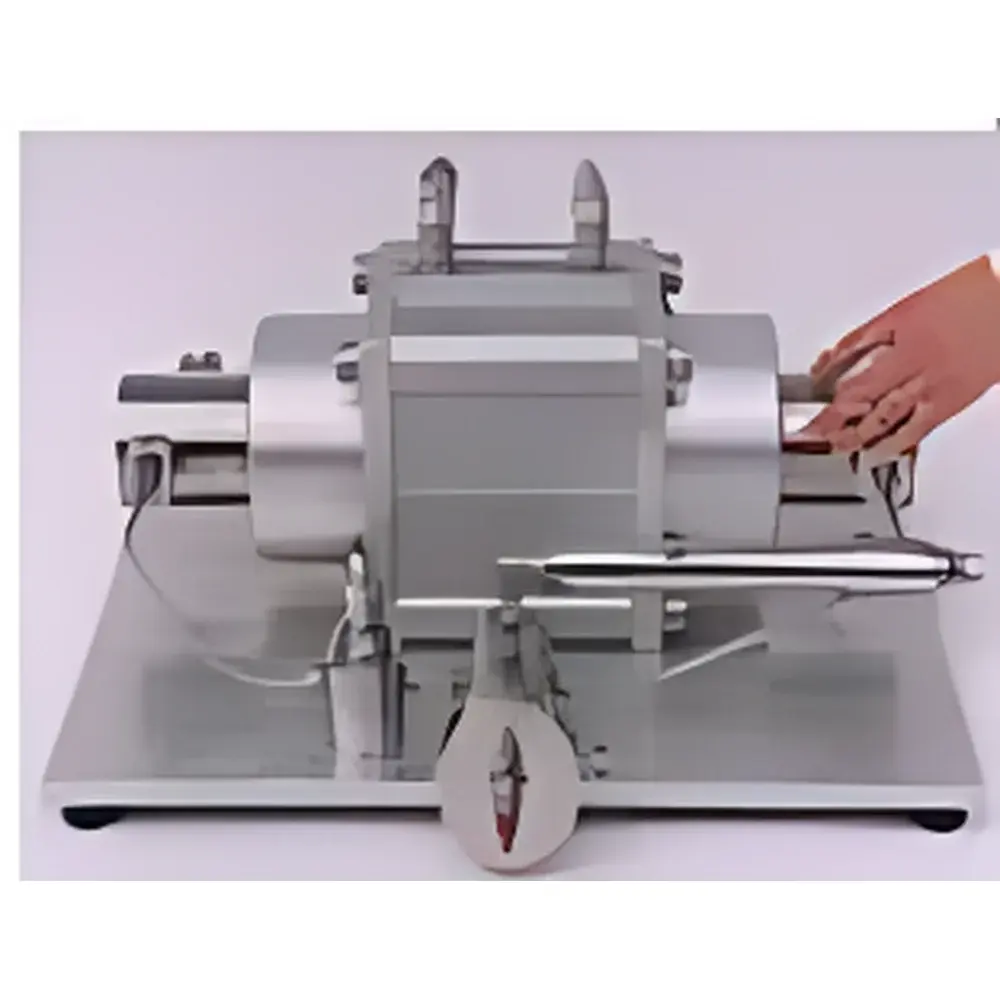
Avestin EmulsiFlex-C50 Laboratory-Scale Ultra-High-Pressure Nano-Homogenizer
| Brand | Avestin |
|---|---|
| Origin | Canada |
| Model | EmulsiFlex-C50 |
| Maximum Operating Pressure | 30,000 psi (200 MPa) |
| Flow Rate | 15–50 L/h |
| Minimum Sample Volume | 25 mL |
| Drive Type | Pneumatic Dual-Piston |
| Chamber Material | ASTM-certified 316L stainless steel |
| Sterilization | In-line steam sterilization (SIP) |
| Compliance | FDA-compliant materials, GMP-compatible design |
| Dimensions (W×D×H) | 450 × 760 × 500 mm |
| Sample Compatibility | Aqueous & organic suspensions, liposomes, emulsions, nanocrystals, cell lysates |
Overview
The Avestin EmulsiFlex-C50 is a laboratory-scale ultra-high-pressure nano-homogenizer engineered for reproducible, scalable nanoparticle formation and cellular disruption under strictly controlled process conditions. It operates on the principle of microfluidic shear and cavitation-induced particle size reduction, where samples are forced at precisely regulated pressures through a fixed-geometry interaction chamber—generating intense turbulent flow, impingement, and pressure drop gradients that induce mechanical disintegration at sub-100 nm resolution. Unlike rotor-stator or ultrasonic systems, this piston-driven homogenizer delivers consistent energy input per unit volume across batch and semi-continuous operation modes, making it suitable for process development aligned with ICH Q5A and Q5C guidelines for biopharmaceuticals and nanomedicine formulations.
Key Features
- Ultra-high pressure capability up to 30,000 psi (200 MPa), enabling reliable generation of nanoparticles <100 nm in hydrodynamic diameter as verified by dynamic light scattering (DLS) and transmission electron microscopy (TEM).
- Pneumatic dual-piston drive system ensures stable pressure delivery with minimal pulsation—critical for maintaining narrow polydispersity index (PDI <0.15) in liposomal and polymeric nanoparticle batches.
- GMP-compliant wetted path constructed entirely from electropolished ASTM F899-grade 316L stainless steel; zero elastomeric seals or O-rings in fluid-contact zones to eliminate leachables and support full SIP validation per ASME BPE-2023 standards.
- Integrated safety architecture includes real-time pressure monitoring, automatic circuit cutoff upon overpressure (>120% setpoint), and fail-safe pneumatic lockout during maintenance cycles.
- Modular configuration supports optional add-ons including inline heat exchangers for temperature-sensitive biologics and sterile-grade filtration extruders for post-homogenization size fractionation.
Sample Compatibility & Compliance
The EmulsiFlex-C50 accommodates a broad range of sample types—including mammalian and microbial cell suspensions, phospholipid dispersions, oil-in-water emulsions, polymer nanoparticle precursors, and crystalline drug suspensions—with validated performance across pH 2–12 and viscosity ranges up to 500 cP. All wetted surfaces meet USP Class VI and FDA 21 CFR 177.1380 requirements for food-contact and pharmaceutical use. The absence of gaskets or crevices enables full Clean-in-Place (CIP) and Steam-in-Place (SIP) protocols compliant with EU Annex 1 and FDA Process Validation Guidance. Documentation packages include material traceability certificates, surface finish reports (Ra ≤ 0.4 µm), and third-party verification of endotoxin-free assembly.
Software & Data Management
While the base EmulsiFlex-C50 operates via analog pressure regulators and manual flow control, optional digital instrumentation kits provide RS-485/Modbus RTU connectivity for integration into laboratory information management systems (LIMS) or MES platforms. Pressure, temperature, and cumulative processing time are logged with ±0.5% full-scale accuracy and timestamped audit trails compliant with 21 CFR Part 11 requirements when paired with qualified electronic signature modules. Raw data export supports CSV and XML formats compatible with JMP, MATLAB, and Python-based statistical process control (SPC) workflows.
Applications
- Cell lysis for recombinant protein extraction and inclusion body solubilization (validated for E. coli, yeast, and CHO cell lines).
- Liposome manufacturing per USP guidelines, including PEGylated and cationic formulations for mRNA delivery.
- Nanocrystal production of poorly water-soluble APIs (BCS Class II/IV), achieving supersaturation stability in vitro and in vivo.
- Preparation of uniform nanoemulsions for topical and parenteral delivery systems requiring long-term physical stability.
- Scale-down modeling for clinical-stage formulation development, supporting Quality-by-Design (QbD) frameworks and Design Space definition per ICH Q8(R2).
FAQ
What is the minimum viable sample volume for method development?
The system supports validated processing down to 25 mL per cycle; with optimized chamber geometry and recirculation mode, effective throughput can be extended to sub-10 mL equivalent volumes using closed-loop configurations.
Is the EmulsiFlex-C50 suitable for GMP manufacturing environments?
Yes—the unit is designed to meet core GMP engineering principles: fully drainable pathways, SIP/CIP readiness, material certification packages, and documentation traceability aligned with ISO 9001:2015 and PIC/S PE 009-16 Annex 15.
How does the EmulsiFlex-C50 compare to microfluidizer-based platforms?
Unlike microfluidizers relying on fixed ceramic interaction chambers, the EmulsiFlex-C50 employs precision-machined stainless-steel valves and chambers offering superior durability under repeated high-cycle operation and compatibility with abrasive or high-salt formulations.
Can the system be integrated into automated workflow platforms?
With optional digital pressure transducers and programmable logic controller (PLC) interfaces, the C50 supports synchronization with peristaltic feed pumps, temperature controllers, and automated sampling stations for unattended multi-batch operation.
What regulatory documentation is supplied with the instrument?
Standard delivery includes Factory Acceptance Test (FAT) report, Material Certificates (EN 10204 3.1), Electropolishing Validation Report, and a comprehensive User Requirement Specification (URS)-aligned Installation Qualification (IQ) protocol template.



