
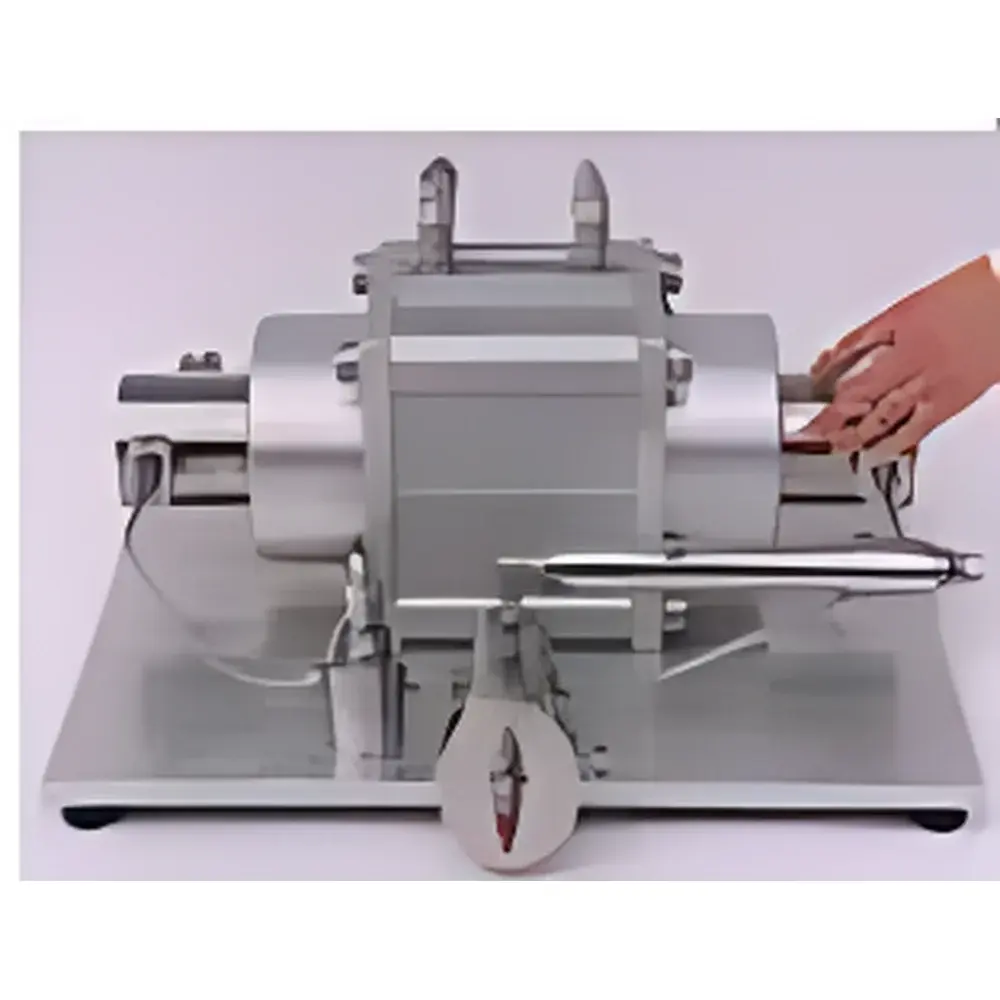
Avestin EmulsiFlex-D20 High-Pressure Homogenizer for Biopharmaceutical Production
| Brand | Avestin |
|---|---|
| Origin | Canada |
| Manufacturer | Avestin Inc., Ottawa, ON |
| Model | EmulsiFlex-D20 |
| Operating Pressure | 35,000 psi (2,413 bar) / Max Continuous: 30,000 psi (2,070 bar) |
| Flow Rate | 20 L/h |
| Minimum Sample Volume | 50 mL |
| Sample Hold-up Volume | <1 mL |
| Drive Type | Electric Single-Plunger Pump |
| Dimensions (W×D×H) | 730 × 600 × 640 mm |
| Weight | 120 kg |
| Power Supply | 3-phase, 50/60 Hz, 230/400 V |
| Construction Material | ASTM A240 316L stainless steel + ceramic wear components |
| Sterilization | Direct steam-in-place (SIP) compatible |
| Compliance | GMP-compliant design, FDA 21 CFR Part 11–ready software architecture, USP <1043> and ISO 22442-1 applicable for bioprocess equipment qualification |
Overview
The Avestin EmulsiFlex-D20 is a high-pressure homogenizer engineered for scalable, reproducible, and GMP-aligned processing in biopharmaceutical development and manufacturing. Utilizing positive-displacement plunger pump technology and a patented fixed-geometry interaction chamber, it subjects fluid streams to controlled hydrodynamic shear, cavitation, and impact forces—enabling efficient cell disruption, lipid nanoparticle (LNP) formation, nanoemulsion generation, and submicron particle size reduction. With a maximum rated pressure of 35,000 psi (2,413 bar) and stable continuous operation up to 30,000 psi (2,070 bar), the EmulsiFlex-D20 delivers consistent particle size distributions below 100 nm—validated across multiple independent studies for mRNA-LNP formulation, viral vector purification, and recombinant protein release from microbial or mammalian host cells. Its compact footprint and low hold-up volume (<1 mL) support both early-stage process development and pilot-scale production under quality-by-design (QbD) principles.
Key Features
- Patented metal-to-metal fluid path with zero elastomeric seals or O-rings—eliminating extractables, leachables, and dead-leg contamination risks
- Direct steam-in-place (SIP) capability integrated into all wetted surfaces, compliant with ASME BPE-2023 sanitary design guidelines
- GMP-grade construction using ASTM A240 316L stainless steel and ceramic-coated critical wear components (e.g., homogenizing valve seat and plunger tip)
- Real-time pressure monitoring with automatic circuit cutoff and 20% transient overpressure tolerance for operational safety and system longevity
- Modular architecture supporting optional integration of inline heat exchangers and post-homogenization filtration extruders (e.g., polycarbonate track-etched membranes)
- Low minimum sample requirement (50 mL) and minimal residual volume (<1 mL) — ideal for high-value biologics, clinical trial batches, and formulation screening
Sample Compatibility & Compliance
The EmulsiFlex-D20 accommodates a broad range of biologically relevant feedstocks—including Gram-negative and Gram-positive bacterial lysates, yeast spheroplasts, CHO and HEK293 cell suspensions, liposomal dispersions, polymeric micelles, and protein-stabilized nanosuspensions. All wetted materials meet USP Class VI biological reactivity standards and FDA 21 CFR 178.3570 requirements for indirect food additives. Equipment qualification documentation supports IQ/OQ/PQ execution per ASTM E2500-13 and Annex 15 (EU GMP). The absence of polymer gaskets ensures compatibility with aggressive solvents (e.g., ethanol, chloroform) and alkaline lysis buffers (pH 12–14), while maintaining structural integrity at temperatures up to 121°C during SIP cycles.
Software & Data Management
Equipped with an embedded industrial PLC and touchscreen HMI, the EmulsiFlex-D20 logs time-stamped pressure, flow rate, temperature, and cycle count data to internal non-volatile memory. Exportable CSV files conform to ALCOA+ data integrity principles and integrate natively with LIMS and MES platforms via Modbus TCP or OPC UA protocols. Audit trail functionality satisfies FDA 21 CFR Part 11 requirements—including electronic signatures, user-level access control, and immutable record retention—for regulated environments operating under ICH Q5A, Q5C, and Q7 frameworks.
Applications
- Cell disruption for intracellular protein recovery (E. coli, Pichia pastoris, Bacillus subtilis)
- Lipid nanoparticle (LNP) formulation for mRNA therapeutics and vaccines
- Nanosuspension preparation of poorly water-soluble APIs per USP
- Homogenization of sterile ophthalmic emulsions and parenteral nutrition admixtures
- Reduction of particle size in vaccine adjuvants (e.g., squalene-in-water emulsions)
- Preparation of uniform exosome isolates and extracellular vesicle formulations
FAQ
What regulatory standards does the EmulsiFlex-D20 meet for pharmaceutical use?
It adheres to ASME BPE-2023 hygienic design criteria, complies with FDA 21 CFR Parts 210/211 for equipment qualification, and supports validation against EU GMP Annex 1 and ICH Q5A for biological product manufacturing.
Can the system be validated for sterile processing?
Yes—its SIP-compatible architecture, zero-dead-leg geometry, and 316L stainless steel construction enable full sterilization cycle validation per ISO 13408-2 and PDA TR No. 1.
Is remote monitoring and control supported?
Standard Ethernet connectivity enables secure remote diagnostics and parameter adjustment via encrypted web interface; optional SCADA integration available.
How is maintenance performed without compromising sterility?
All serviceable components—including the homogenizing valve assembly and plunger seal—can be replaced using aseptic techniques without disassembling the main fluid path or breaking SIP integrity.
Does Avestin provide installation qualification (IQ) documentation?
Yes—factory-issued IQ templates, material certifications (MTRs), surface finish reports (Ra ≤ 0.4 µm), and FAT/SAT protocols are included with each unit shipment.





