
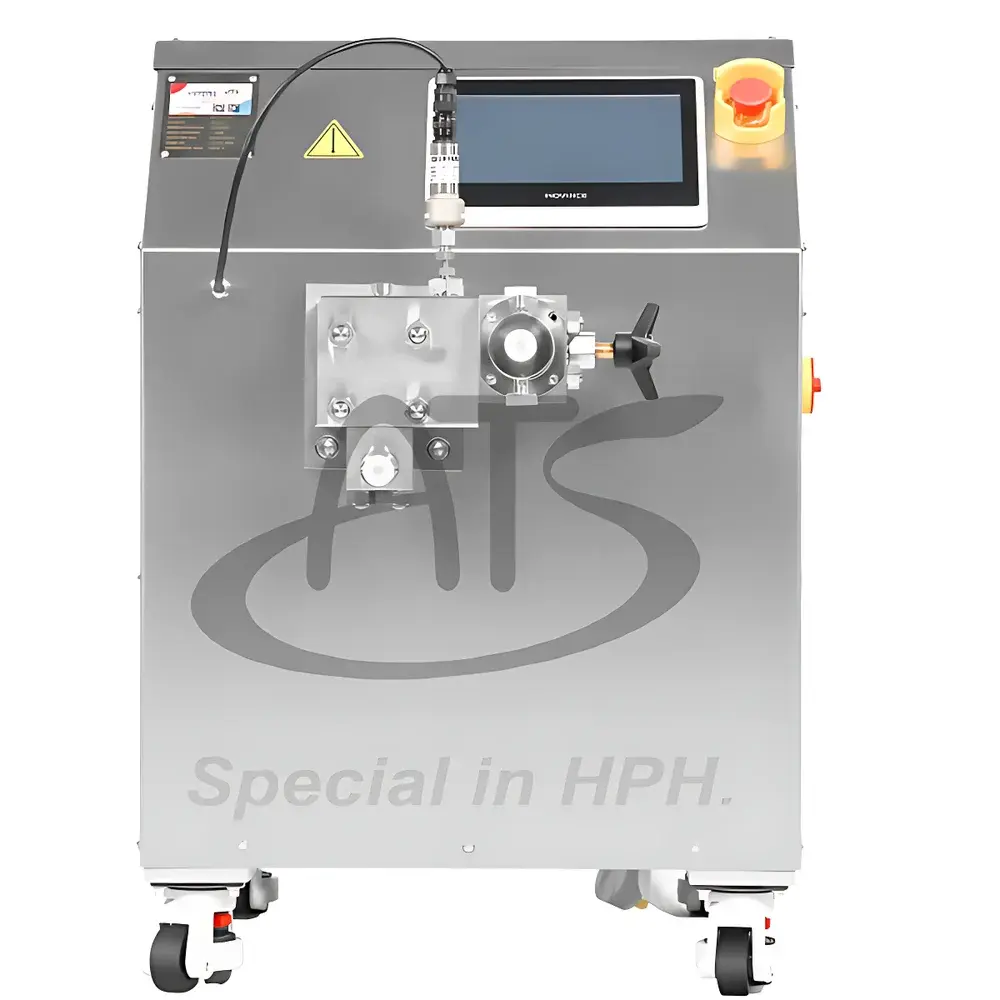
ATS AH-PILOT Universal Pilot-Scale High-Pressure Homogenizer
| Brand | ATS |
|---|---|
| Origin | Jiangsu, China |
| Manufacturer | ATS (Producer) |
| Type | High-Pressure Homogenizer |
| Model | AH-PILOT |
| Dimensions (W×D×H) | 500×800×500 mm |
| Processing Capacity | 200–200,000 mL per batch |
| Max Operating Pressure | 1500 bar |
| Feed Flow Rate | 15–40 L/h |
| Max Inlet Viscosity | < 2000 cP |
| Max Inlet Particle Size | < 500 µm |
| Temperature Control | On-Position Cooling (≤20 °C) |
| Motor | 5.5 kW, 3-Phase, 50 Hz, IP55, Class F Insulation |
| Lubrication | Solid Grease |
| Compliance | CE Certified, GMP-Compliant Design |
Overview
The ATS AH-PILOT is a universal pilot-scale high-pressure homogenizer engineered for reproducible, scalable cell disruption and nano-emulsion formation in pharmaceutical, biotechnological, and food R&D environments. It operates on the principle of controlled high-pressure cavitation, impact, and shear—achieved by forcing process fluid through a precisely engineered, adjustable valve orifice at pressures up to 1500 bar (21,750 psi). As the fluid exits the narrow restriction zone at supersonic velocities (≥1000 m/s), it undergoes rapid pressure drop, generating intense hydrodynamic forces including turbulent shear, localized cavitation collapse, and high-velocity particle–impact against a hardened collision ring. This multi-mechanism action ensures uniform sub-100 nm particle size distribution and >95% lysis efficiency for Gram-negative bacteria such as E. coli, while maintaining structural integrity and biological activity of intracellular proteins, enzymes, and nucleic acids.
Key Features
- Two-stage homogenization architecture for sequential pressure application—enhancing consistency and reducing thermal load per pass.
- Integrated on-position cooling system with dual-path thermal management: direct heat extraction at the homogenization valve via internal coolant channels, plus optional external chiller coupling for continuous temperature control ≤20 °C.
- Patented feed valve design eliminating manual air purging—enabling immediate, bubble-free material introduction even with viscous or gaseous-phase-sensitive feeds (<2000 cP).
- Variable-frequency drive (VFD) motor control (5.5 kW, 3-phase, IP55, Class F insulation) enabling precise flow regulation from 15 to 40 L/h—critical for optimizing residence time and energy input across diverse sample matrices.
- GMP-compliant sanitary construction: all wetted surfaces fabricated from electropolished AISI 316L stainless steel; zero dead-leg geometry; clean-in-place (CIP)-compatible fluid pathways.
- CE-marked mechanical safety architecture, including redundant pressure relief valves, real-time pressure monitoring with digital display, and emergency stop interlock circuitry compliant with EN ISO 13850.
Sample Compatibility & Compliance
The AH-PILOT accommodates a broad range of biological and colloidal systems—including microbial cultures (E. coli, yeast, microalgae), mammalian and insect cells, viral vectors, liposomes, polymeric nanoparticles, and protein-stabilized emulsions. Its inlet tolerance supports particles up to 500 µm and viscosities up to 2000 cP without pre-filtration. The system meets fundamental requirements for GLP/GMP-aligned workflows: audit-trail-capable operation logs (via optional software integration), traceable parameter recording (pressure, flow, temperature, cycle count), and design conformity to ISO 22000 (food), ISO 13485 (medical devices), and ICH Q5A/Q5D (biopharmaceuticals). CE certification validates compliance with EU Machinery Directive 2006/42/EC and Pressure Equipment Directive 2014/68/EU.
Software & Data Management
While the base AH-PILOT operates via intuitive tactile HMI with real-time analog pressure gauges and digital flow indicators, an optional ATS Homogenization Suite provides FDA 21 CFR Part 11–compliant data acquisition. This module records timestamped operational parameters (inlet/outlet temperature, homogenization pressure, flow rate, total cycles), generates PDF reports with electronic signatures, and supports export to LIMS or ELN platforms via CSV or OPC UA protocols. All firmware updates are digitally signed and version-controlled, ensuring consistent calibration traceability across installations.
Applications
- Pre-clinical and clinical-stage bioprocess development: bacterial/yeast lysate preparation for recombinant protein purification, inclusion body solubilization, and membrane protein extraction.
- Vaccine manufacturing: disruption of whole-cell antigens (e.g., Mycobacterium, Brucella) and enveloped virus fragmentation for subunit antigen generation.
- Nanomedicine formulation: production of lipid nanoparticles (LNPs), nanostructured lipid carriers (NLCs), and polymer micelles with PDI <0.15.
- Functional food ingredient engineering: stabilization of omega-3 emulsions, anthocyanin nanocapsules, and probiotic encapsulation matrices.
- Enzyme activation studies: controlled release of intracellular hydrolases, kinases, and dehydrogenases without denaturation.
FAQ
What is the maximum recommended processing volume per batch?
The AH-PILOT supports batch volumes from 200 mL to 200 L, with optimal throughput validated at 40 L/h under continuous recirculation mode.
Can the system handle heat-sensitive biomolecules?
Yes—the integrated on-position cooling maintains valve-zone temperature ≤20 °C during operation, minimizing thermal degradation of labile proteins and nucleic acids.
Is the unit suitable for sterile processing?
When coupled with steam-in-place (SIP)-rated accessories and validated CIP protocols, the AH-PILOT meets ASME BPE-2023 sanitary interface standards for aseptic intermediate-scale operations.
What maintenance intervals are recommended for the homogenizing valve assembly?
Valve wear inspection is advised every 200 operational hours or after processing ≥500 L of abrasive suspensions; replacement intervals vary by feed composition but typically exceed 500 h for low-solids biological lysates.
Does ATS provide IQ/OQ documentation support?
Yes—factory-verified Installation Qualification (IQ) and Operational Qualification (OQ) templates, aligned with ASTM E2500 and ISPE Baseline Guide Vol. 5, are available upon request.



