
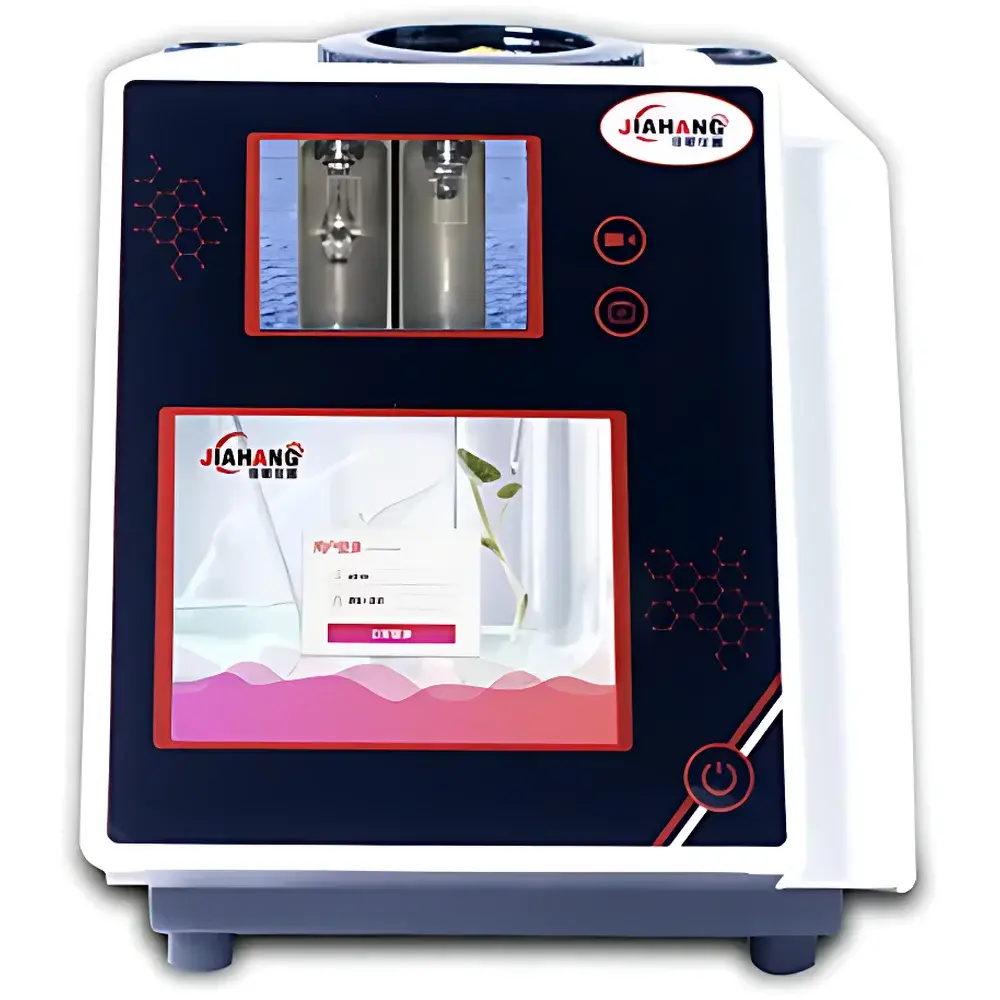
JIAHANG JHD50 Automated Dropping Point & Softening Point Tester (Cup-and-Ball Method)
| Brand | JIAHANG |
|---|---|
| Origin | Shanghai, China |
| Manufacturer Type | Direct Manufacturer |
| Model | JHD50 |
| Temperature Range | Ambient to 400 °C |
| Temperature Resolution | 0.1 °C |
| Accuracy | ±0.2 °C (≤250 °C), ±0.5 °C (>250 °C) |
| Heating Rate | 0.1–20 °C/min |
| Sample Capacity | 2 samples per run |
| Display | Dual-screen — 5.6″ + 4.3″ color TFT LCD |
| User Accounts | Up to 15 |
| Predefined Methods | 100 stored protocols |
| Data Interfaces | USB, RS-232, Ethernet |
| GLP Compliance | Yes |
| Power Supply | 220 V, 50 Hz, 120 W |
| Standards Compliance | ASTM D3204, D3461, D3104, D3954, D6090 |
| ISO 2176 | 1972, 4625:2 |
Overview
The JIAHANG JHD50 Automated Dropping Point & Softening Point Tester is an engineered solution for precise thermal transition characterization of semi-solid and thermoplastic materials using the standardized cup-and-ball method. Based on classical ASTM, ISO, and pharmacopoeial definitions, the instrument determines the temperature at which a material begins to flow under controlled heating—either as the first drop falls from a standardized cup (dropping point) or as a steel ball embedded in a sample disc deforms under its own weight (softening point). Unlike manual or semi-automated systems, the JHD50 integrates real-time high-definition video monitoring, dual-sample parallel operation, and programmable thermal ramping to eliminate operator subjectivity and enhance inter-laboratory reproducibility. Its architecture supports both routine QC workflows and method development in regulated environments, with full traceability aligned to GLP principles.
Key Features
- Dual-sample concurrent testing: Simultaneous analysis of two independent specimens reduces turnaround time by up to 50% without compromising thermal uniformity or measurement integrity.
- Real-time HD video observation: Integrated 1080p optical system captures dynamic morphological changes—including meniscus formation, droplet detachment, and ball penetration—with timestamped frame logging for retrospective verification.
- Configurable environmental control: Optional low-temperature chamber (-20 °C start) and inert gas purge (N₂ or Ar) enable testing of oxidation-sensitive or low-melting materials such as pharmaceutical ointments, bio-based waxes, and reactive resins.
- Thermal precision engineering: PID-controlled heating block with calibrated platinum RTD sensor ensures stable ramp rates (0.1–20 °C/min) and certified accuracy per ISO/IEC 17025 calibration practices.
- Regulatory-ready interface: Dual-color display (5.6″ main + 4.3″ auxiliary) provides real-time thermal profile, video feed, and status alerts; all user actions, parameter changes, and result exports are logged with electronic signatures and audit trail support.
Sample Compatibility & Compliance
The JHD50 accommodates a broad spectrum of organic and polymeric materials including asphalt binders, rosin esters, polyethylene waxes, epoxy resins, cosmetic creams, and pharmaceutical suppository bases. Sample cups and steel balls conform dimensionally and metallurgically to ASTM D3461 and ISO 4625 specifications. The instrument’s firmware enforces method-specific constraints—for example, limiting ramp rate during pharmacopoeial softening point tests (ChP 0612) to prevent thermal overshoot. All calibration certificates reference NIST-traceable standards, and the system supports IQ/OQ documentation packages required for FDA 21 CFR Part 11 and EU Annex 11 validation.
Software & Data Management
Embedded firmware enables storage of 100 pre-programmed test protocols with adjustable parameters: target temperature, hold time, ramp rate, video capture interval, and pass/fail criteria. Raw data—including temperature vs. time curves, annotated video frames, and metadata (operator ID, sample ID, instrument serial number)—are exportable via USB, RS-232, or TCP/IP to LIMS or ELN platforms. Audit trails record every login, method edit, and result deletion with immutable timestamps. Data files comply with ASTM E2500-18 for analytical instrument qualification and include checksums for integrity verification.
Applications
- Quality control of bituminous binders in road construction materials per ASTM D36 and EN 1427.
- Stability assessment of topical drug formulations under ICH Q5C guidelines.
- Thermal specification verification of encapsulation resins used in electronics packaging.
- R&D screening of bio-wax alternatives in sustainable cosmetics.
- Batch release testing of food-grade paraffin and microcrystalline waxes per USP <741>.
FAQ
Does the JHD50 meet FDA 21 CFR Part 11 requirements for electronic records?
Yes—the system implements role-based access control, electronic signatures, and tamper-evident audit trails compliant with Part 11 Subpart B for closed systems.
Can the instrument be validated for GMP manufacturing environments?
Yes—JIAHANG provides IQ/OQ documentation templates, calibration certificates traceable to national metrology institutes, and risk-based URS alignment support.
Is video footage exportable for regulatory submission?
Yes—H.264-encoded MP4 files with embedded metadata (temperature, time, operator) are exportable directly to external storage or network drives.
What maintenance is required to sustain accuracy over time?
Annual recalibration of the RTD sensor and mechanical verification of cup/ball geometry are recommended; preventive maintenance kits and certified service engineers are available globally.
How does the dual-sample mode ensure thermal equivalence between channels?
Independent PID loops and matched heating zones maintain ≤0.3 °C inter-channel deviation across the full 0–400 °C range, verified per ASTM E77.






