
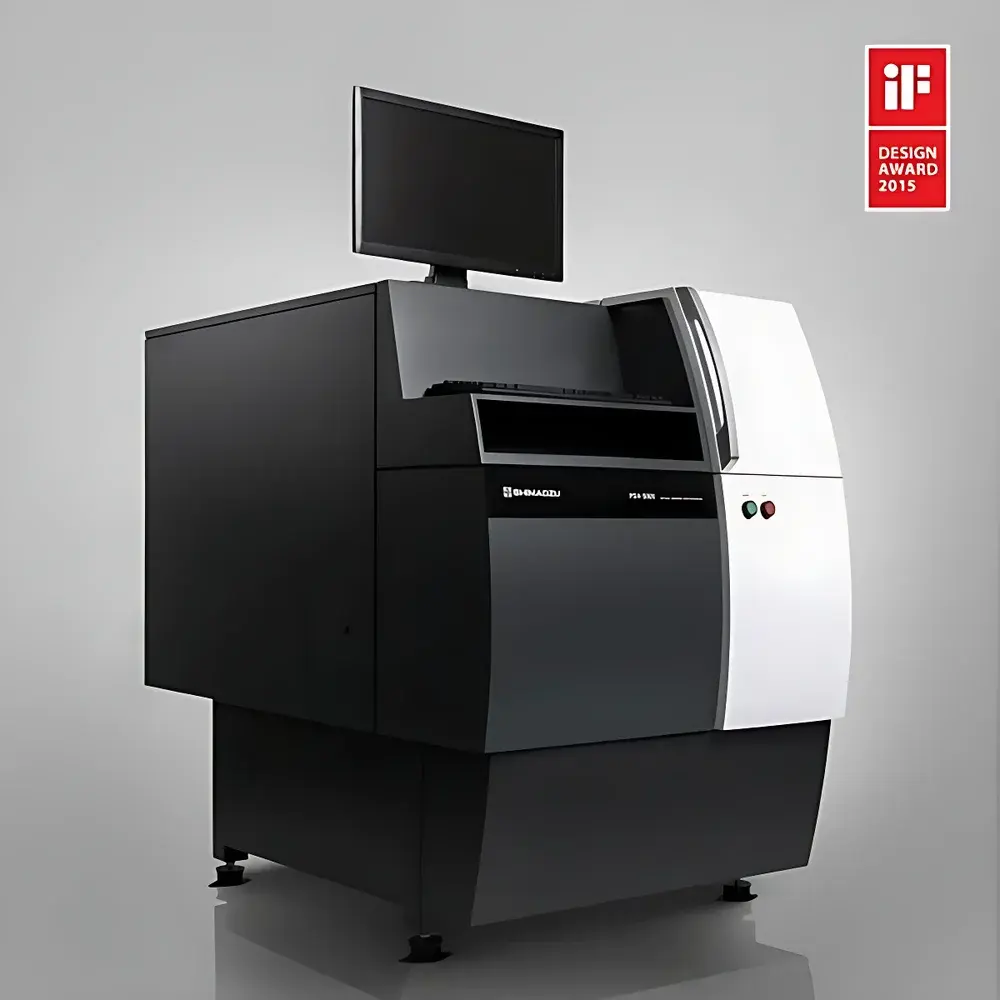
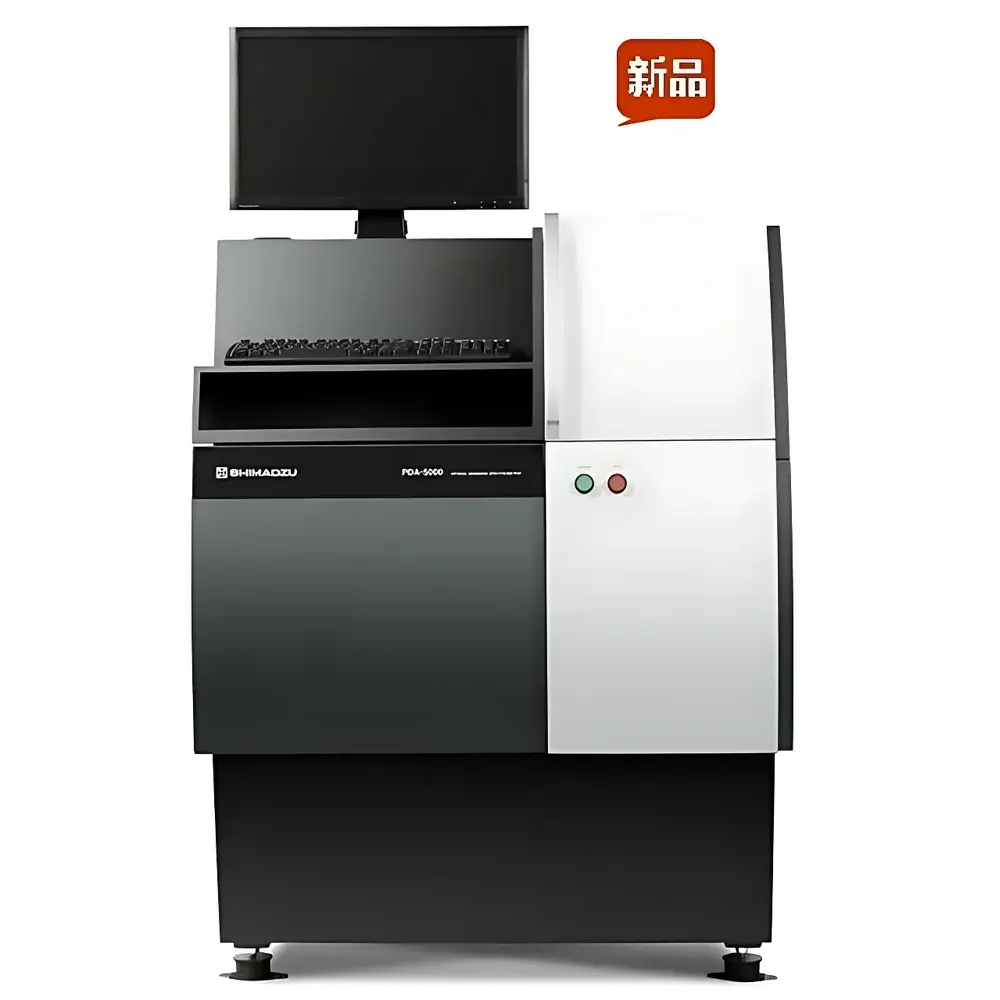
Shimadzu PDA-5000 Direct-Reading Optical Emission Spectrometer
| Brand | Shimadzu |
|---|---|
| Origin | Jiangsu, China |
| Manufacturer Type | Manufacturer |
| Regional Classification | Domestic |
| Model | PDA-5000 |
| Instrument Type | Floor-standing |
| Excitation Method | Spark |
| Detector Type | Photomultiplier Tube (PMT) |
| Focal Length | 600 mm |
| Grating Groove Density | 2400 lines/mm |
| Wavelength Range | 120–800 nm |
| Maximum Number of Channels | 24 |
Overview
The Shimadzu PDA-5000 is a floor-standing direct-reading optical emission spectrometer (OES) engineered for high-precision elemental analysis of solid metallic samples in industrial quality control and production environments. It operates on the principle of spark-induced atomic emission spectroscopy: a controlled high-voltage spark excites atoms on the sample surface, causing them to emit characteristic wavelengths of ultraviolet and visible light. These emissions are dispersed via a high-resolution Czerny-Turner optical system with a 600 mm focal length and 2400 lines/mm holographic grating, then detected by an array of photomultiplier tubes (PMTs). The instrument’s rigid cast iron optical bench—selected for low thermal expansion—ensures long-term mechanical stability, while its continuously evacuated, temperature-controlled (38 ± 0.1 °C) spectrometer chamber eliminates atmospheric absorption interference across the full 120–800 nm spectral range, including critical vacuum UV lines (e.g., C, P, S, N).
Key Features
- Digital spark source with fully adjustable energy and frequency parameters—no auxiliary electrode required, enabling maintenance-free operation and adaptable excitation conditions for diverse alloys (e.g., low-conductivity aluminum, high-carbon steels, and refractory metals).
- Vacuum-stabilized optical system: continuous vacuum pumping prevents transient pressure fluctuations that compromise intensity reproducibility; eliminates need for argon purging, reducing operational cost and complexity.
- Sliding-sealed spark stand with large stainless-steel sample stage—designed for dust resistance in foundry or shop-floor environments and compatible with irregular geometries, wires, and small parts via optional fixtures.
- Automated standardization logic: combines time-based recalibration with result-triggered re-standardization, minimizing drift-related errors without manual intervention.
- Modular channel architecture: supports up to 24 pre-aligned PMT detectors; additional analytical channels can be field-installed to accommodate evolving regulatory or product-specification requirements.
- Integrated thermal management: spectrometer chamber maintained at constant 38 ± 0.1 °C using precision PID-controlled heating—critical for wavelength calibration stability over extended duty cycles.
Sample Compatibility & Compliance
The PDA-5000 is validated for routine analysis of ferrous and non-ferrous metals, including carbon steels, cast irons (gray, ductile, high-chromium), stainless steels (austenitic, ferritic, duplex), bearing steels (e.g., SUJ2, 52100), high-speed tool steels, and aluminum/silicon alloys. Sample preparation follows ISO 11577:2018 (metallic materials — spark optical emission spectrometry — general rules) and ASTM E415-21 (standard test method for analysis of carbon and low-alloy steel by spark OES). Its hardware architecture and software audit trail functionality support compliance with GLP and GMP environments; data integrity features—including user access control, electronic signatures, and change history logging—are aligned with FDA 21 CFR Part 11 requirements when deployed with validated software configurations.
Software & Data Management
The instrument is operated via Shimadzu’s dedicated OES analysis platform, which provides real-time spectral visualization, multi-point calibration curve management (factory + user-defined curves), and statistical process control (SPC) integration. All measurement data—including raw intensities, background-corrected net signals, and certified reference material (CRM) traceability logs—are stored in a structured SQLite database with immutable timestamps. Export options include CSV, XML, and PDF reports compliant with ISO/IEC 17025 documentation standards. Remote diagnostics, firmware updates, and spectral library synchronization are supported over secure TLS-encrypted LAN/WAN connections.
Applications
The PDA-5000 delivers quantitative analysis of major, minor, and trace elements (e.g., C, Si, Mn, P, S, Cr, Ni, Mo, V, Cu, Al, Ti, B, N) in incoming raw material inspection, ladle-to-ladle process monitoring, final product certification, and failure analysis. Typical use cases include: verification of alloy grade conformity in automotive crankshafts and gears; sulfur/phosphorus control in pipeline steels per API 5L; chromium/nickel ratio validation in food-grade stainless tubing (ASTM A270); and carbon equivalence calculation for weldability assessment in structural fabrication. Its robustness enables uninterrupted operation in foundries, rolling mills, and Tier-1 automotive supplier labs where uptime and repeatability are mission-critical.
FAQ
What sample forms can the PDA-5000 analyze?
Solid metallic samples with flat, machined surfaces ≥ 10 mm in diameter; optional accessories enable analysis of wires (≥ 1 mm Ø), chips, and small castings.
Does the instrument require external argon supply?
No—its sealed, continuously evacuated optical chamber eliminates argon dependency for UV transmission, reducing consumable costs and infrastructure requirements.
How is calibration maintained over time?
Through dual-mode standardization: scheduled recalibration intervals plus automatic trigger-based re-standardization when analytical results deviate beyond predefined tolerance bands.
Can the PDA-5000 be integrated into a factory MES or LIMS?
Yes—via standardized OPC UA or TCP/IP protocols; structured data output supports seamless ingestion into enterprise quality management systems.
Is remote service and software support available?
Shimadzu provides global technical support with remote diagnostic capability, firmware patches, and application-specific method development assistance under annual service agreements.





