
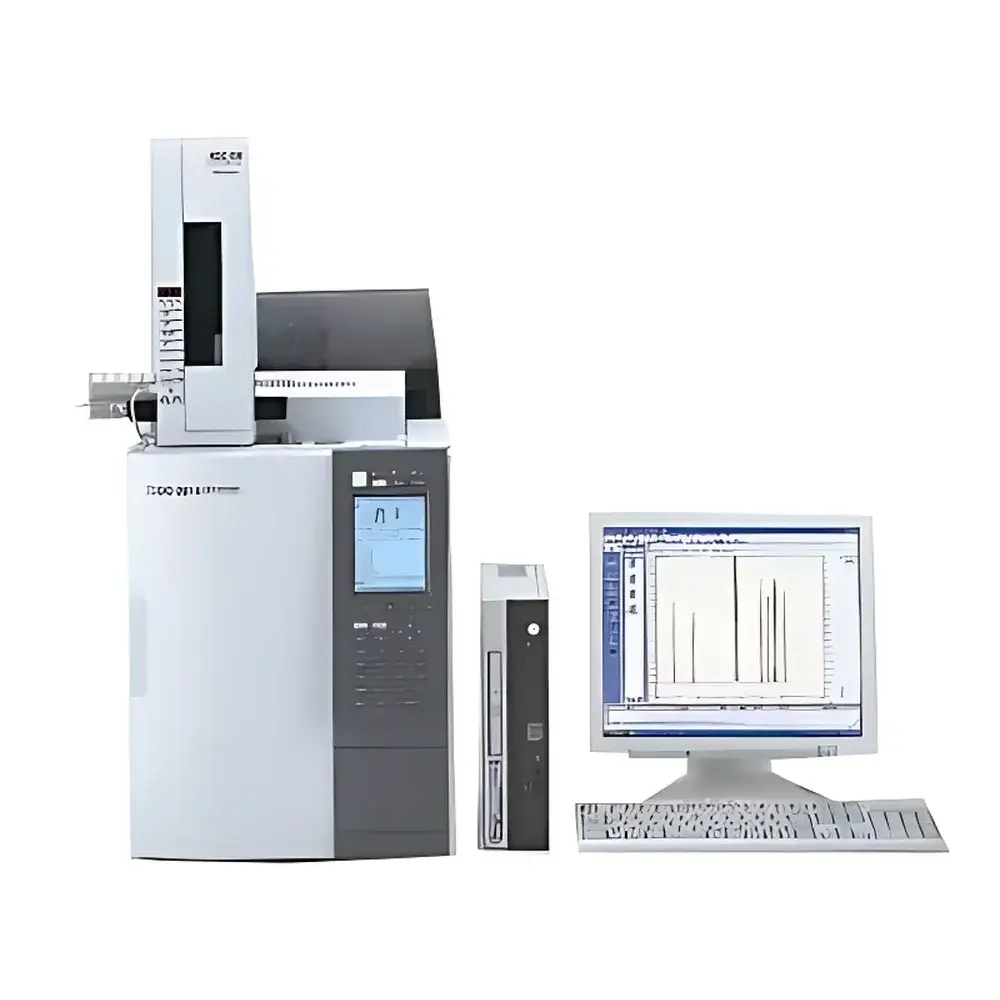
Shimadzu GC-2014 Gas Chromatograph System
| Origin | Japan |
|---|---|
| Manufacturer Type | Authorized Distributor |
| Origin Category | Imported |
| Model | GC-2014 |
| Price Range | USD 21,000 – 28,000 |
| Instrument Type | Laboratory Gas Chromatograph |
| Application Scope | General-Purpose |
| Oven Temperature Range | Ambient +10°C to 420°C (–50°C to 420°C with liquid CO₂ cooling) |
| Maximum Ramp Rate | 250°C/min |
| Cooling Rate | 300°C → 50°C in <6 min |
| Carrier Gas Flow Range & Control | 0–1250 mL/min |
| Carrier Gas Pressure Range & Control | 0–1035 kPa |
| Injector Max Operating Temperature | 420°C |
| Injector Pressure Setting Range | 0–1035 kPa |
| Injector Total Flow Setting Range | 0–1250 mL/min |
| Oven Program Segments | Up to 20 (including cooling ramps) |
| Injector Simultaneous Installation | Up to 3 units |
| Detector Simultaneous Installation | Up to 4 units |
| Detector Compatibility | FID, TCD, ECD, FPD, FTD (capillary & packed column variants) |
| Display | 240 × 320-pixel graphical LCD (30 chars × 60 lines) |
| Dimensions (GC Main Unit) | 400 × 690 × 607 mm (W × H × D) |
| Weight | 48 kg (GC-2014AF configuration) |
| Power Supply | AC 200 V, 1800 VA, 50/60 Hz |
Overview
The Shimadzu GC-2014 is a robust, general-purpose laboratory gas chromatograph engineered for precision, reliability, and method flexibility across diverse analytical workflows. Based on the proven architecture of the GC-2010 platform, it integrates advanced electronic pressure and flow control (EPFC) technology—originally developed for high-resolution capillary analysis—into both capillary and packed-column configurations. This dual-capability design ensures consistent retention time reproducibility, accurate peak integration, and stable baseline performance under variable ambient conditions. The system operates on fundamental gas chromatographic principles: sample volatilization in a temperature-controlled injector, separation within a thermally regulated column (via partitioning between mobile and stationary phases), and detection via selective physicochemical response (e.g., ionization in FID, thermal conductivity in TCD). Its modular hardware layout supports seamless integration into multi-instrument laboratories and serves as a validated core platform for regulated environments requiring trace-level quantitation, purity assessment, or method transfer.
Key Features
- High-Performance Oven System: Precision-engineered column oven with 15.8 L internal volume, ambient +10°C to 420°C operating range (extendable to –50°C using liquid CO₂ cooling), and programmable ramp rates from –250°C/min to +250°C/min. Thermal stability is maintained at 0.01°C per 1°C ambient fluctuation, minimizing retention time drift.
- Multi-Injector Configuration: Supports up to three independently controlled injection ports—compatible with split/splitless, packed-column, and dual-packed configurations—each with full digital pressure and flow regulation (0–1035 kPa; 0–1250 mL/min) and temperature control up to 420°C.
- Modular Detector Architecture: Accommodates up to four detector modules simultaneously, including flame ionization (FID), thermal conductivity (TCD), electron capture (ECD), flame photometric (FPD), and nitrogen-phosphorus (FTD) detectors—each with independent temperature control (up to 420°C for FID/TCD/FTD; up to 400°C for ECD/FPD) and 1°C resolution setting.
- Digital Flow & Pressure Management: All carrier, makeup, and auxiliary gas flows are regulated via mass flow controllers (MFCs) with real-time feedback, eliminating mechanical flowmeters and enabling precise method reproducibility across instruments and laboratories.
- Intuitive Graphical Interface: 240 × 320-pixel backlit LCD display provides real-time monitoring of oven temperature, injector/detector status, pressure profiles, and method progress—without requiring external PC connectivity for routine operation.
Sample Compatibility & Compliance
The GC-2014 accommodates a broad spectrum of volatile and semi-volatile analytes—from hydrocarbons and solvents to pesticides, residual monomers, and environmental contaminants—across matrices including petrochemicals, pharmaceuticals, food extracts, and environmental water/soil samples. Its hardware design complies with ISO/IEC 17025 requirements for testing laboratories, and its operational parameters align with ASTM D3606 (benzene/toluene in gasoline), USP (chromatography), and EPA Method 8021B (halogenated organics). When paired with compliant data acquisition software (e.g., LabSolutions GC ver. 5.x or later), the system supports audit trails, electronic signatures, and 21 CFR Part 11–compliant data integrity frameworks suitable for GLP and GMP-regulated quality control labs.
Software & Data Management
Control and data processing are managed through Shimadzu’s LabSolutions GC software suite, which provides method development tools, automated calibration curve generation, peak deconvolution, and customizable reporting templates. The software supports raw data export in open formats (e.g., .cdf, .csv) and integrates with LIMS via standard OPC-UA or ODBC protocols. Built-in self-diagnostic routines monitor detector baseline noise, column bleed, leak integrity, and pressure sensor calibration status—logging events with timestamps for traceability. All instrument parameters—including temperature programs, flow profiles, and detector settings—are stored as encrypted method files, ensuring version-controlled method deployment across multiple GC-2014 systems in networked lab environments.
Applications
- Residual solvent analysis in pharmaceutical active ingredients (ICH Q3C compliance)
- Fatty acid methyl ester (FAME) profiling in biodiesel and edible oils (AOAC 996.06)
- Hydrocarbon group-type analysis (PIONA) in refinery streams (ASTM D5134)
- Pesticide residue screening in fruits and vegetables (EU SANTE/11312/2021)
- Volatile organic compound (VOC) quantification in indoor air and workplace monitoring (ISO 16000-6)
- Monomer purity verification in polymer manufacturing (e.g., vinyl chloride, styrene)
FAQ
Is the GC-2014 compatible with both capillary and packed columns?
Yes—the system supports all major column formats, including fused-silica capillaries and stainless-steel/glass packed columns, with dedicated inlet and detector modules optimized for each.
Does the GC-2014 support unattended overnight operation?
Yes—its robust thermal management, leak-tight fluidic architecture, and integrated self-diagnostics enable reliable multi-run sequences without manual intervention.
Can the GC-2014 be upgraded to include an autosampler?
Yes—Shimadzu AOC-20i or AOC-20s liquid autosamplers integrate natively via RS-232 or USB, supporting up to 162 vials and programmable injection volumes from 0.1–100 µL.
What regulatory documentation is provided for validation?
Shimadzu supplies IQ/OQ documentation packages, factory calibration certificates traceable to NIST standards, and a comprehensive instrument qualification guide aligned with ASTM E2500 and EU Annex 15.
Is remote monitoring supported?
Yes—LabSolutions GC includes web-based remote access (via secure HTTPS) for real-time status viewing, method upload, and basic run control when deployed on a local intranet or VLAN.





