
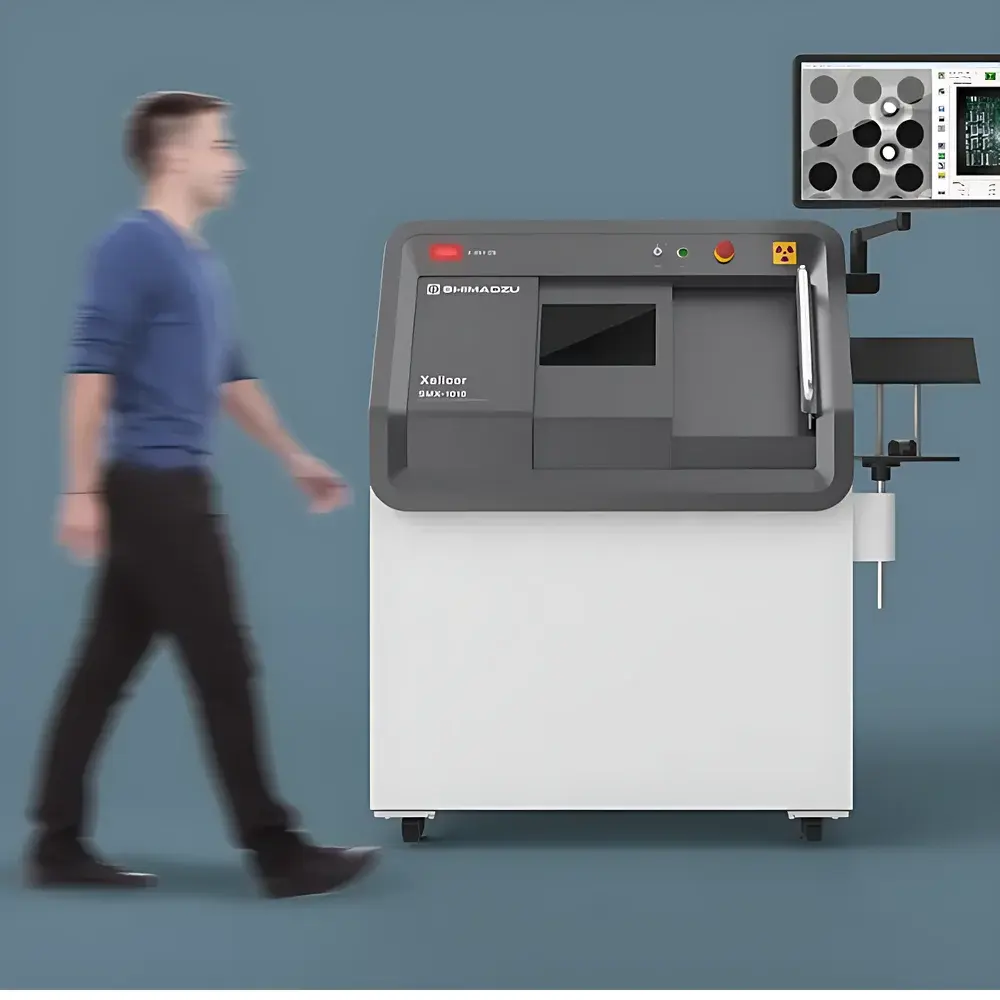
Shimadzu Xslicer SMX-1010 Microfocus X-ray Inspection System
| Brand | Shimadzu |
|---|---|
| Origin | Japan |
| Manufacturer Type | Original Equipment Manufacturer (OEM) |
| Origin Category | Imported |
| Model | Xslicer SMX-1010 |
| Pricing | Upon Request |
Overview
The Shimadzu Xslicer SMX-1010 is a high-resolution microfocus X-ray inspection system engineered for non-destructive internal structural analysis of industrial components, electronic assemblies, and advanced materials. Operating on the principle of transmission X-ray imaging with a sealed-tube microfocus source (typically ≤ 5 µm focal spot size), the system generates high-contrast, real-time radiographic and computed tomography (CT)-capable images without sample destruction. Its compact benchtop architecture integrates a precision manipulator stage, high-dynamic-range flat-panel detector, and optimized geometric magnification—enabling sub-micron-level feature resolution in projection mode and isotropic voxel reconstruction down to ~1–2 µm in CT mode. Designed for routine QC/QA laboratories and R&D environments, the Xslicer SMX-1010 supports both 2D radiography and 3D volumetric reconstruction workflows under controlled environmental conditions.
Key Features
- Microfocus X-ray source with stable output (typically 40–130 kV, 0.1–0.5 mA), delivering high spatial resolution and low geometric unsharpness.
- Motorized XYZθφ sample stage with programmable positioning accuracy ≤ ±1 µm and repeatability < ±2 µm—ensuring precise alignment and multi-angle acquisition.
- Large-area, high-sensitivity amorphous silicon flat-panel detector (e.g., 1536 × 1536 pixels, 75 µm pixel pitch) supporting real-time image acquisition at >30 fps in low-noise mode.
- Integrated CT reconstruction engine compliant with standard FDK and iterative algorithms (e.g., SART, SIRT), enabling quantitative density mapping and defect segmentation.
- Rugged, lead-shielded cabinet meeting IEC 61000-6-3 (EMC) and IEC 61000-6-4 emission standards; interlocked safety system certified per IEC 61010-1 and local radiation safety regulations (e.g., FDA 21 CFR 1020.40, JIS Z 4501).
- Modular software architecture supporting ASTM E1441 (computed tomography), ISO 17025-compliant calibration traceability, and optional GLP/GMP audit trail modules.
Sample Compatibility & Compliance
The Xslicer SMX-1010 accommodates samples up to Ø100 mm × H100 mm (standard configuration), with optional extended stages supporting larger or irregular geometries. It is routinely deployed for inspecting solder joints, wire bonds, voids in encapsulants, porosity in castings, delamination in laminates, and internal geometry verification of MEMS devices. The system complies with international NDT standards including ASTM E2737 (digital radiographic imaging), ISO 5579 (radiographic testing of metallic materials), and EN 1435 (weld inspection). Radiation shielding and operational protocols are aligned with national regulatory frameworks such as Japan’s Industrial Safety and Health Act (ISHA), U.S. NRC guidelines, and EU Directive 2013/59/Euratom.
Software & Data Management
Control and analysis are executed via Shimadzu’s proprietary “inspeXio” software suite—designed for intuitive workflow navigation, automated batch acquisition, and standardized reporting. Key capabilities include ROI-based grayscale analysis, dimensional metrology (traceable to NIST-certified phantoms), porosity quantification (per ASTM E505), and defect classification using threshold-based segmentation. Raw projection data and reconstructed volumes are stored in DICOM 3.0 and TIFF formats, with metadata embedding per ASTM E2339. For regulated environments, optional 21 CFR Part 11 compliance packages provide electronic signatures, user access controls, and immutable audit logs. Data export supports CSV, STL (for reverse engineering), and VTK (for third-party visualization tools like Avizo or VGStudio MAX).
Applications
- Electronics: Detection of BGA voids, solder bridging, tombstoning, and interconnect integrity in PCBAs and power modules.
- Automotive & Aerospace: Porosity analysis in aluminum die-castings, turbine blade cooling channel verification, and composite layup inspection.
- Medical Devices: Validation of hermetic sealing in implantable housings, catheter lumen continuity, and polymer weld integrity.
- Research & Materials Science: In situ dynamic imaging of battery electrode degradation, foam cell structure characterization, and additive manufacturing defect evolution studies.
- Quality Assurance: First-article inspection, process capability assessment (Cp/Cpk), and failure analysis root-cause correlation across cross-sectional slices.
FAQ
What is the minimum detectable feature size under standard operating conditions?
Typical resolution in high-magnification radiography mode is ≤ 5 µm; CT voxel resolution depends on sample size and scan parameters but routinely achieves 1–2 µm isotropic in optimized small-sample acquisitions.
Does the system support automated defect recognition (ADR)?
Yes—optional AI-assisted ADR modules integrate trained convolutional neural networks (CNNs) for classification of common defects (e.g., voids, cracks, inclusions) in production-line environments, with configurable sensitivity thresholds and false-positive suppression logic.
Can the Xslicer SMX-1010 be integrated into an automated production line?
It supports Ethernet/IP and Modbus TCP interfaces for PLC synchronization, trigger input/output signals, and SECS/GEM protocol compatibility—enabling seamless integration with factory MES and SPC systems.
Is calibration traceable to national standards?
Yes—system geometry and intensity calibration are traceable to NIST, PTB, or AIST reference standards; annual performance verification follows Shimadzu’s ISO/IEC 17025-accredited service protocol.
What training and technical support options are available?
Shimadzu provides on-site installation qualification (IQ), operational qualification (OQ), and user training covering basic operation, CT reconstruction, metrology, and regulatory documentation—delivered by certified application engineers with domain expertise in electronics, metals, and medical device QA.
Related Products



