
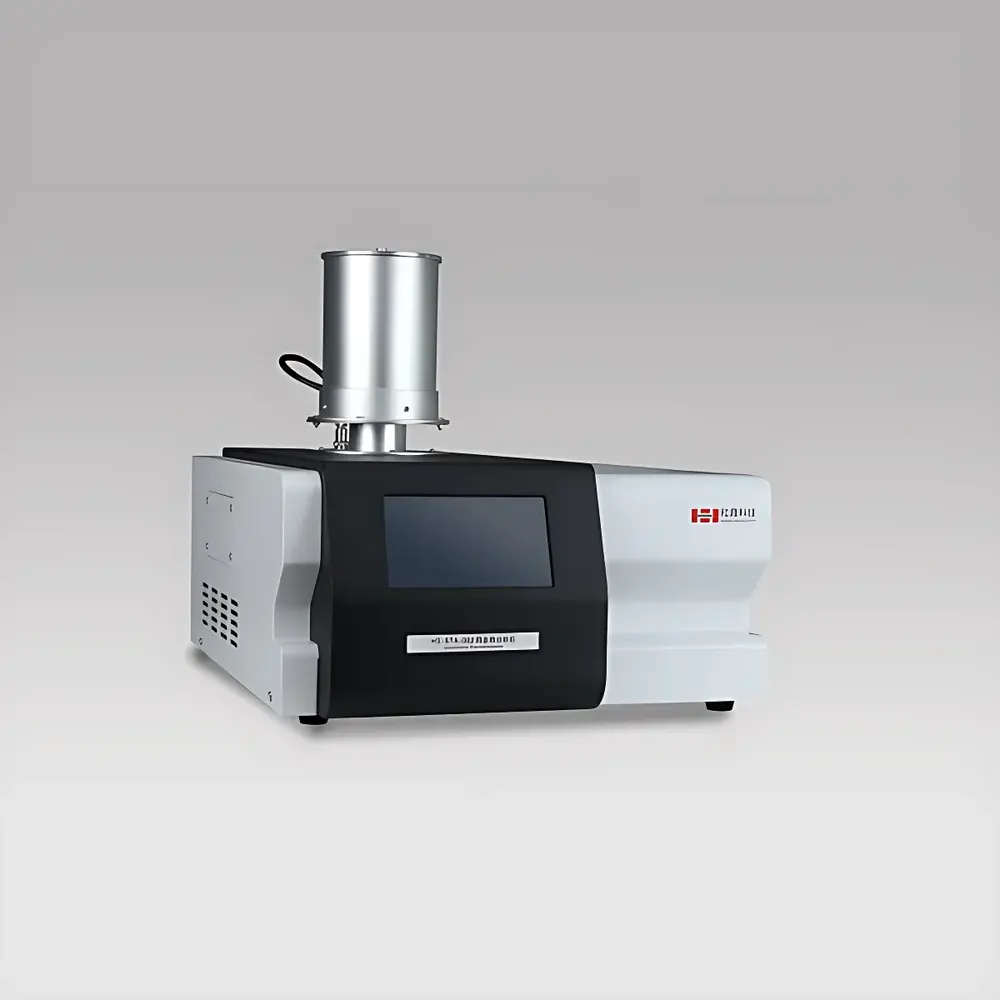
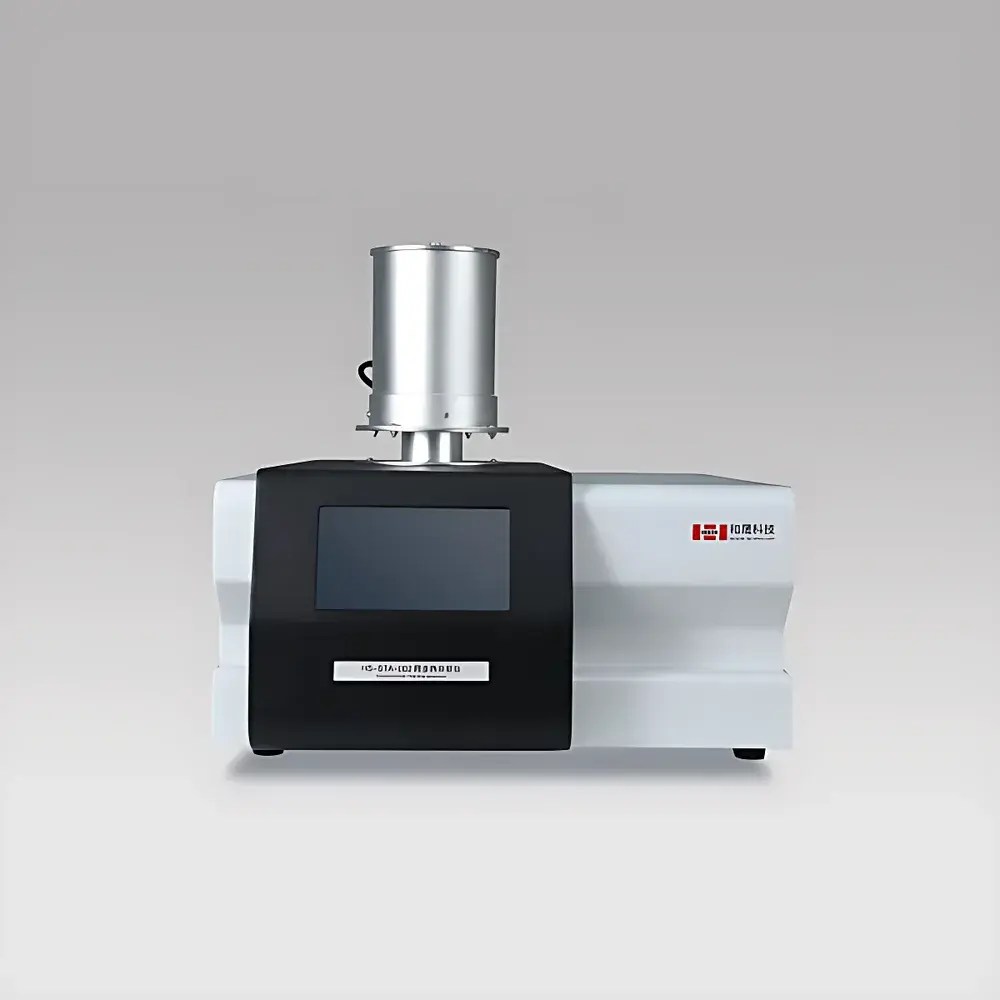
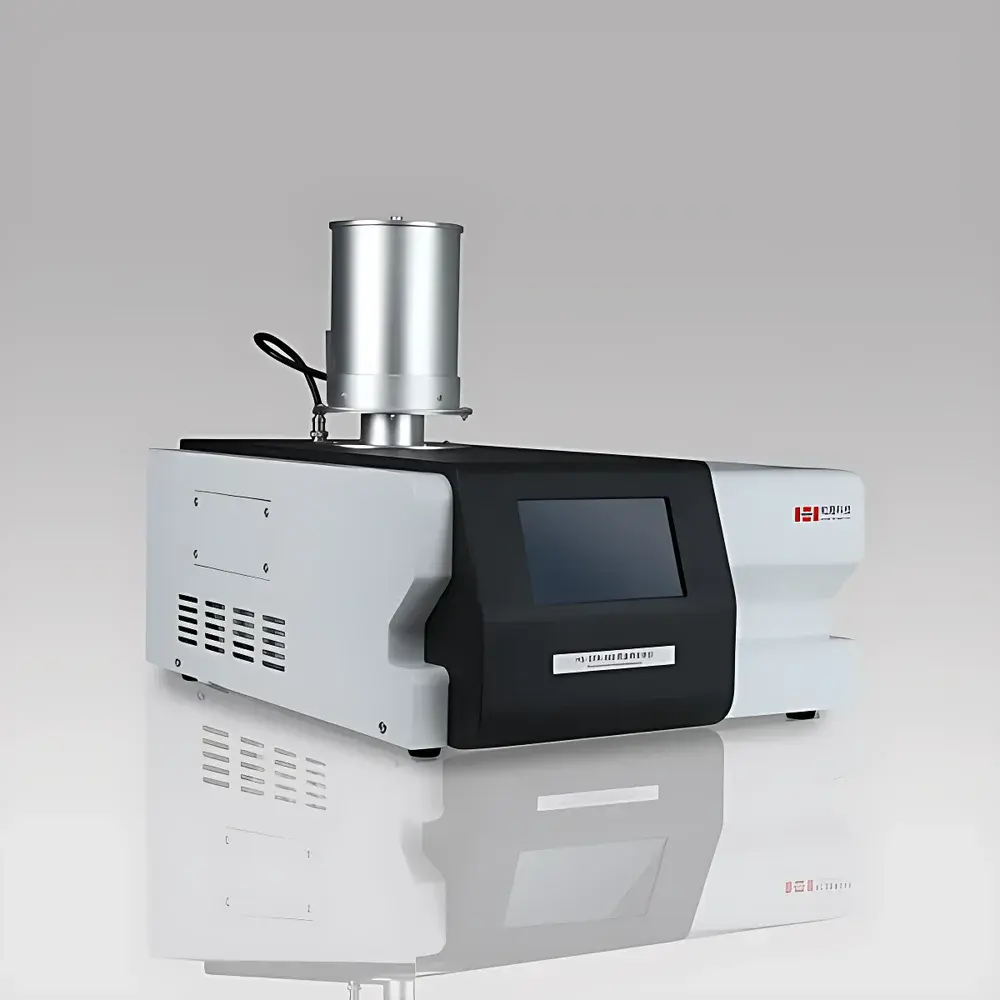
HESON HS-STA-002 Simultaneous Thermal Analyzer (TG-DSC)
| Brand | HESON |
|---|---|
| Origin | Shanghai, China |
| Manufacturer Type | Direct Manufacturer |
| Product Category | Domestic |
| Model | HS-STA-002 |
| Coupling Technique | Thermogravimetry–Differential Scanning Calorimetry (TG-DSC) |
| Heating Rate | 0.1–80 °C/min |
| Temperature Range | Ambient to 1150 °C |
| Temperature Stability | ±0.1 °C |
| Maximum Sample Mass | 2 g (expandable to 30 g) |
| Atmosphere Control | Dual-gas channel with automatic switching (N₂ standard) |
| Flow Rate | 0–300 mL/min |
| TG Resolution | 10 µg |
| TG Dynamic Range | 1 mg–2 g |
| DSC Range | ±700 mW |
| DSC Sensitivity | 0.001 mW |
| Temperature Resolution | 0.01 °C |
| Temperature Accuracy & Repeatability | ±0.1 °C |
| Cooling Time (1000 °C → 100 °C) | 15 min |
| Control Modes | Programmable heating, isothermal hold, and cooling |
| Data Interface | Standard USB |
| Power Supply | AC 220 V / 50 Hz |
| Dimensions (L×W×H) | 470 × 580 × 460 mm |
| Display | 7-inch 24-bit color LCD touchscreen |
| Core Processor | 32-bit ARM Cortex-M3 |
| ADC | 24-bit, 4-channel synchronous sampling for TG, DSC, and T signals |
Overview
The HESON HS-STA-002 Simultaneous Thermal Analyzer integrates thermogravimetric analysis (TG) and differential scanning calorimetry (DSC) into a single instrument platform, enabling concurrent measurement of mass change and heat flow from one sample under identical thermal and atmospheric conditions. Based on the principle of simultaneous dual-signal detection—where a high-stability microbalance records mass loss/gain while a heat-flux sensor quantifies endothermic or exothermic transitions—the HS-STA-002 delivers intrinsically correlated thermal event data. This architecture eliminates inter-test variability caused by sample heterogeneity, furnace calibration drift, gas flow inconsistency, or sequential measurement misalignment. The system operates across a broad temperature range (ambient to 1150 °C), with programmable heating rates from 0.1 to 80 °C/min and thermal stability maintained within ±0.1 °C. Its design supports rigorous materials characterization in academic research, quality control laboratories, and industrial R&D environments where phase transitions, decomposition kinetics, oxidative stability, and compositional purity must be evaluated with metrological traceability.
Key Features
- High-precision dual-sensor architecture: Separately optimized platinum-rhodium alloy furnace windings and a corrosion-resistant nickel-chromium sample pan sensor ensure long-term thermal uniformity and signal fidelity at elevated temperatures.
- Thermally isolated mechanical design: Water-cooled chassis housing decouples the furnace assembly from the microbalance and electronics, minimizing thermal drift and vibration-induced noise in both TG and DSC channels.
- Top-opening furnace configuration: Enables rapid, non-invasive sample loading without vertical displacement of the sample rod—reducing mechanical stress and preserving sensor integrity over extended operational cycles.
- Dedicated embedded control system: ARM Cortex-M3 32-bit processor with synchronized 24-bit, 4-channel analog-to-digital conversion ensures real-time acquisition of TG, DSC, and temperature signals at sub-millisecond resolution.
- Modular furnace compatibility: Optional furnace modules (e.g., extended-range or inert-atmosphere variants) can be integrated per application-specific requirements without hardware redesign.
- Intuitive human-machine interface: 7-inch full-color LCD touchscreen provides direct access to method setup, real-time curve visualization, parameter logging, and export-ready data formatting.
Sample Compatibility & Compliance
The HS-STA-002 accommodates solid, powdered, and granular samples up to 2 g (extendable to 30 g with optional configuration), supporting routine analysis of polymers, ceramics, pharmaceuticals, battery cathode materials, catalysts, and carbonaceous adsorbents. Dual-gas manifold enables automated switching between inert (N₂), oxidative (air/O₂), or reducing atmospheres with precise flow control (0–300 mL/min) and pressure regulation (≤0.5 MPa). All thermal protocols comply with ASTM E1131, ISO 11357-1, and USP <1151> for thermal analysis methodology. Data acquisition meets GLP/GMP documentation standards, including time-stamped audit trails, user-access controls, and electronic signature readiness for FDA 21 CFR Part 11–aligned workflows.
Software & Data Management
Instrument control and post-acquisition analysis are managed via HESON’s proprietary STA Analysis Suite, a Windows-based application supporting baseline correction, peak deconvolution, kinetic modeling (e.g., Kissinger, Ozawa-Flynn-Wall), and enthalpy integration referenced to instantaneous sample mass—not initial mass—ensuring accuracy in reaction heat quantification. Raw data export formats include ASCII, CSV, and universal .tdf for third-party interoperability with OriginLab, MATLAB, or Thermo Scientific™ OMNIC™. USB interface allows direct transfer to networked lab systems; no proprietary dongles or cloud dependencies required. Firmware updates are delivered via signed binary packages with SHA-256 verification.
Applications
- Decomposition onset and residue quantification in flame-retardant polymers and composite matrices.
- Hydration/dehydration behavior and crystallinity evolution in pharmaceutical hydrates and excipients.
- Oxidative induction time (OIT) assessment of polyolefins per ASTM D3895.
- Carbonization kinetics and pore-formation mechanisms in biomass-derived activated carbons.
- Phase transition mapping in shape-memory alloys and ferroelectric ceramics.
- Thermal stability profiling of lithium-ion battery electrode materials under controlled N₂ purge.
- Reaction enthalpy determination in catalytic polymerization systems (e.g., Pickering emulsion-based acrylic synthesis).
FAQ
What is the difference between simultaneous TG-DSC and sequential TG + DSC measurements?
Simultaneous measurement ensures identical thermal history, gas environment, and sample positioning for both signals—eliminating cross-run artifacts and enabling direct correlation of mass loss events with corresponding thermal effects.
Can the HS-STA-002 operate under air or oxygen atmospheres?
Yes—the dual-gas manifold supports automatic switching between N₂, air, O₂, or custom gas mixtures with adjustable flow and pressure settings.
Is the instrument compliant with regulatory data integrity requirements?
Yes—data files include embedded timestamps, operator IDs, method parameters, and calibration logs; software supports 21 CFR Part 11–compatible audit trails and electronic signatures.
How is thermal mass correction handled during DSC enthalpy calculation?
The system continuously references DSC signal integration to real-time TG mass values, not initial mass—critical for accurate ΔH calculation in decomposing or evolving samples.
What maintenance intervals are recommended for long-term stability?
Annual calibration verification using certified reference materials (e.g., indium, zinc, alumina) is advised; furnace and sensor inspection every 500 operating hours.



