
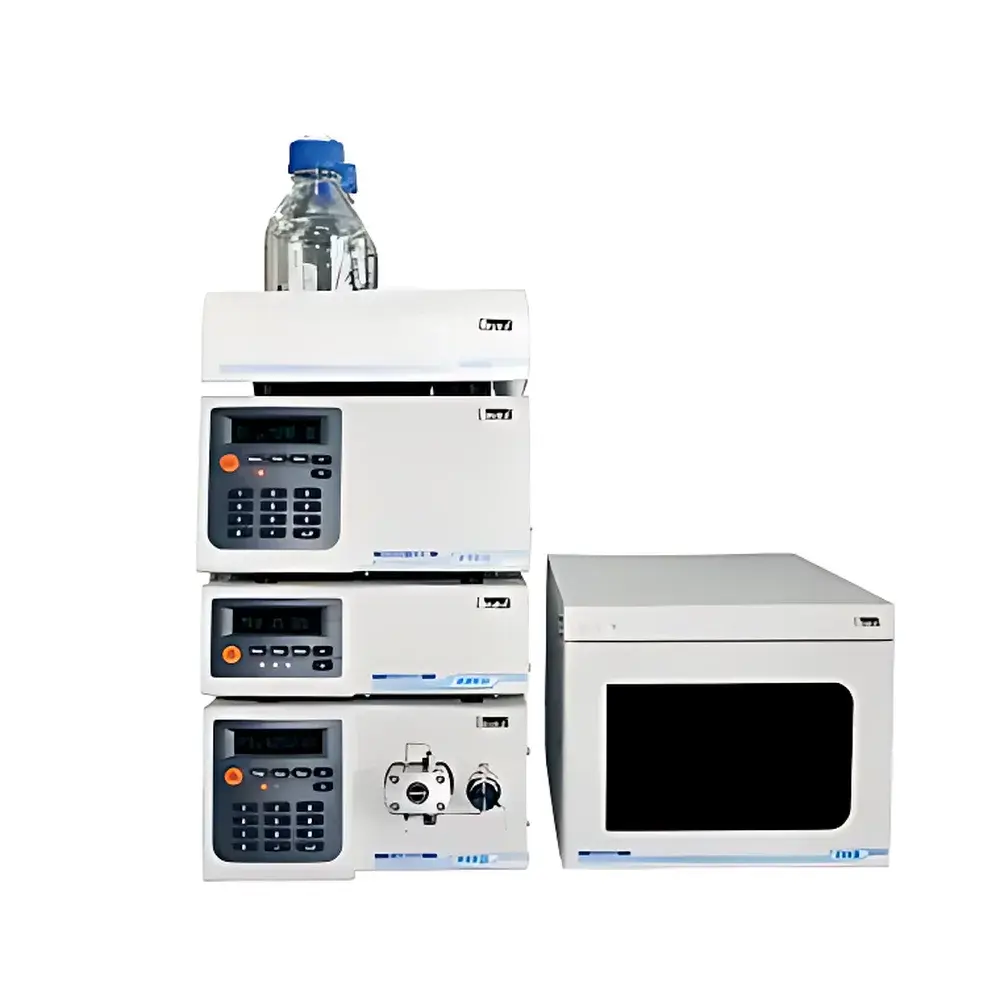
Elite P3100-Based Melamine Analysis System for HPLC Compliance with GB/T 22388–2008 and GB 22388–2016
| Brand | Elite |
|---|---|
| Origin | Liaoning, China |
| Manufacturer Type | Direct Manufacturer |
| Regional Classification | Domestic (China) |
| Model | Melamine-Specific HPLC System |
| Price Range | USD 14,000 – 28,000 |
| Instrument Type | Conventional High-Performance Liquid Chromatograph (HPLC) |
| Application Scope | General-Purpose Melamine Quantification in Food & Feed Matrices |
| Wavelength Range | Not Applicable (Fixed 240 nm UV Detection per Standard Method) |
| Data Acquisition Rate | Not Specified |
Overview
The Elite P3100-Based Melamine Analysis System is a purpose-engineered high-performance liquid chromatography (HPLC) platform optimized for the quantitative determination of melamine in dairy products, infant formula, animal feed, and related food matrices. Designed in full alignment with Chinese national standards GB/T 22388–2008 and GB 22388–2016—methods validated for regulatory compliance—the system implements reversed-phase HPLC separation coupled with fixed-wavelength ultraviolet detection at 240 nm, the analytically optimal wavelength for melamine’s π→π* transition. Unlike generic HPLC configurations, this system integrates method-specific hardware components—including the Elite MSP C18 melamine-dedicated column, P3100 high-pressure constant-flow pump, and UV3100 dual-beam UV-Vis detector—to ensure chromatographic resolution of melamine from structurally analogous triazines (e.g., ammeline, ammelide) and matrix interferences such as lactose, casein peptides, and residual extraction solvents. Its architecture supports isocratic elution under defined mobile phase conditions (e.g., 10 mM citric acid–10 mM sodium octanesulfonate, pH 3.0), eliminating gradient complexity while maintaining reproducibility across laboratories.
Key Features
- Pre-validated, standards-compliant configuration: Fully aligned with GB/T 22388–2008 and GB 22388–2016 for official testing labs and QC departments.
- Dedicated separation chemistry: Elite MSP C18 column (5 µm, 250 × 4.6 mm) featuring end-capping and enhanced acidic stability to withstand low-pH mobile phases and resist silanol-induced tailing.
- Robust isocratic performance: P3100 dual-plunger reciprocating pump delivers flow stability ≤ ±0.2% RSD over 25 min runs, critical for retention time reproducibility in routine screening.
- UV3100 detector with 240 nm fixed-wavelength mode: Optimized photometric sensitivity (LOD = 0.016 mg/kg in milk powder, based on 1 g sample + 50 mL extraction), 10 mm path-length flow cell, and real-time baseline correction.
- Integrated thermal control: O3100 column oven maintains ±0.2 °C stability at 40 °C—standard temperature for melamine elution—to minimize retention drift caused by ambient fluctuations.
- Modular scalability: Optional DG3100 online degasser and S3100 autosampler enable unattended batch analysis (up to 120 injections) without compromising method fidelity.
Sample Compatibility & Compliance
The system accommodates solid, semi-solid, and liquid samples following standardized pretreatment protocols: protein precipitation (trichloroacetic acid), cation-exchange solid-phase extraction (HyperSep Retain-CX, 60 mg/3 mL), and membrane filtration (0.22 µm nylon or PVDF). It meets analytical requirements for ISO/IEC 17025:2017 accreditation when operated under documented SOPs, including calibration traceability to NIST-traceable melamine reference standard (CAS 108-78-0, ≥99.0%). All hardware and software components support audit-ready documentation per GLP principles; data integrity is preserved through W5100 workstation’s electronic signature capability and immutable raw-data archiving. While not FDA 21 CFR Part 11–certified out-of-the-box, the system architecture permits validation of electronic records under internal GMP frameworks.
Software & Data Management
The W5100 Chromatographic Data Workstation provides method development tools, peak integration with tangent skim and valley-to-valley algorithms, calibration curve fitting (linear and quadratic), and report generation compliant with CNAS-CL01:2018 reporting clauses. Raw data files (.w5d) are stored in proprietary but exportable ASCII formats (CSV, TXT) for third-party statistical analysis. Audit trails record user logins, method modifications, integration parameter changes, and print events—with timestamps and operator IDs. Batch processing supports automatic calculation of recovery rates (spike levels: 0.5×, 1×, 2× MRL), relative standard deviation (RSD < 5% for replicate injections), and limit-of-quantitation verification per ICH Q2(R2).
Applications
- Regulatory testing of powdered infant formula and liquid dairy products for melamine contamination per China’s National Food Safety Standard.
- QC release testing in dairy ingredient manufacturing facilities, including whey protein isolates and lactose powders.
- Feed safety monitoring in compound feed mills—particularly for soybean meal and corn gluten meal adulteration screening.
- Research applications involving melamine migration studies from melamine-formaldehyde tableware into food simulants (e.g., 3% acetic acid, 10% ethanol).
- Method transfer between central reference labs and satellite testing sites due to hardware standardization and documented system suitability criteria (tailing factor ≤ 2.0, resolution ≥ 2.5, plate count ≥ 5,000).
FAQ
What regulatory standards does this system validate against?
GB/T 22388–2008 and GB 22388–2016 are fully supported; method parameters—including mobile phase composition, flow rate (1.0 mL/min), column temperature (40 °C), and detection wavelength (240 nm)—are pre-configured.
Is the system compatible with other triazine analytes beyond melamine?
Yes—when paired with method revalidation, it separates ammeline and ammelide using modified pH gradients; however, dedicated melamine quantification uses isocratic conditions for throughput and robustness.
Can the W5100 software generate 21 CFR Part 11–compliant reports?
The base software supports electronic signatures and audit trails; full Part 11 compliance requires site-specific validation documentation and administrative controls (e.g., role-based access, password policies).
What is the typical analysis time per sample?
Under standard GB conditions, total run time is ≤25 minutes, including equilibration, injection, separation, and post-run re-equilibration.
Does the system include validation documentation?
A comprehensive IQ/OQ protocol package is supplied, covering pump flow accuracy, detector linearity (0.1–100 µg/mL melamine), column backpressure stability, and system precision (n=6 injections at 2 mg/kg level).





