
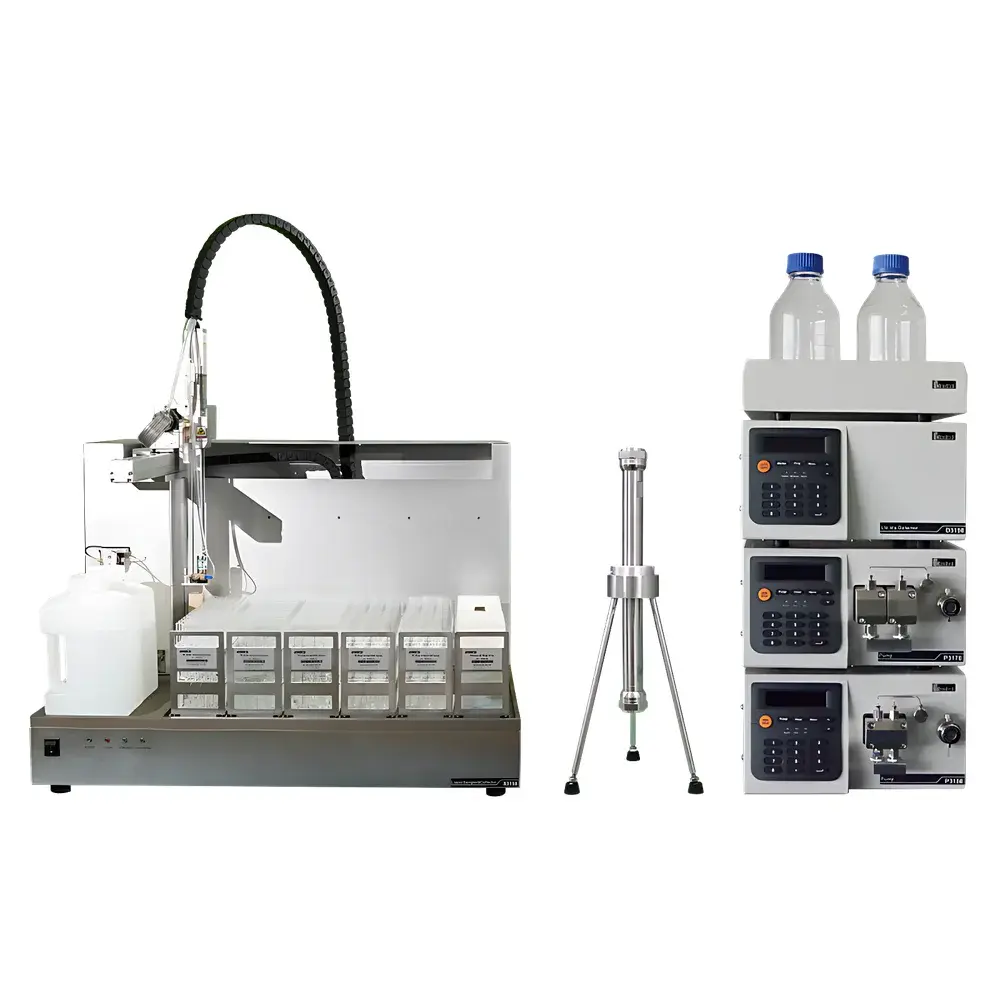
Elite EClassical3150 Analytical-Preparative High-Performance Liquid Chromatography System
| Brand | Elite |
|---|---|
| Origin | Liaoning, China |
| Manufacturer Type | Direct Manufacturer |
| Instrument Class | Domestic |
| Model | EClassical3150 |
| Application Level | Laboratory-Grade |
| Instrument Type | High-Pressure Preparative HPLC |
| Flow Rate Range | 1–100 mL/min |
| Flow Accuracy | ±1.0% |
| Flow Precision (RSD) | ≤0.5% |
| Maximum Operating Pressure | 21 MPa |
Overview
The Elite EClassical3150 is a dual-mode, analytical-preparative high-performance liquid chromatography (HPLC) system engineered for laboratory-scale separation, purification, and quantitative analysis of small- to medium-molecular-weight compounds. Built on a unified platform architecture, it integrates analytical resolution with preparative throughput—eliminating the need for separate instruments while maintaining method transfer fidelity between development and scale-up stages. The system operates on standard reversed-phase, normal-phase, and ion-exchange chromatographic principles, supporting gradient and isocratic elution modes. Its 21 MPa maximum pressure rating enables use with sub-2 µm and wide-pore stationary phases, facilitating high-resolution separations across diverse compound classes including pharmaceutical intermediates, natural product extracts, synthetic oligomers, and chiral molecules. Designed for robust daily operation in QC, R&D, and pilot-scale purification workflows, the EClassical3150 conforms to fundamental design expectations for GLP-compliant laboratories, including mechanical stability, pressure pulse dampening, and temperature-stable flow delivery.
Key Features
- Dual-function architecture: seamless transition between analytical method development (≤5 mL/min, <5 µL injection) and preparative purification (up to 100 mL/min, 25 mL loop capacity), minimizing method revalidation overhead.
- High-capacity, servo-driven autosampler with maintenance-free linear slide mechanism—engineered for >500,000 injection cycles without lubrication or recalibration.
- Independent fluidic pathways for sample introduction and fraction collection—physically isolating inlet and outlet manifolds to suppress carryover below 0.01% (measured via standard USP test protocols).
- Configurable trigger interface: digital TTL and analog voltage inputs support synchronization with UV-Vis, ELSD, CAD, and MS detectors from third-party vendors.
- Intelligent fraction collection: programmable by time window, peak threshold (absorbance or conductivity), first/second derivative (slope), or forced collection—each mode fully controllable via software command set.
- Integrated leak detection circuitry with real-time solvent-level monitoring at critical junctions (pump head, injector valve, column oven manifold), triggering audible/visual alerts and automatic pump shutdown upon anomaly detection.
- Modular rack system: single tray base accommodates 12×75 mm, 16×100 mm, 24×150 mm, and 48×13 mm tube formats—no mechanical adapters required.
Sample Compatibility & Compliance
The EClassical3150 supports a broad range of sample matrices—including aqueous buffers, organic solvents (acetonitrile, methanol, THF), and corrosive mobile phases (e.g., 0.1% TFA, 10 mM ammonium acetate). Column compatibility spans 4.6–50 mm internal diameter, with recommended lengths from 50–250 mm. All wetted parts are constructed from 316L stainless steel, PEEK, and sapphire—ensuring resistance to pH 1–12 and common HPLC solvents. The system meets mechanical and electrical safety requirements per IEC 61010-1:2010 and electromagnetic compatibility standards EN 61326-1:2013. While not pre-certified for 21 CFR Part 11, its audit trail logging, user access control, and electronic signature readiness enable validation under GMP/GLP frameworks when deployed with compliant LIMS or CDS platforms.
Software & Data Management
Control and data acquisition are managed via Elite ChromaLink v3.x—a Windows-based chromatography data system (CDS) supporting full instrument reverse control, sequence scheduling, peak integration (EMG, Gaussian, valley-to-valley), and custom report generation (PDF, CSV, XML). Raw data files adhere to ANDI/NetCDF format for cross-platform compatibility. The software includes built-in method validation templates aligned with ICH Q2(R2) guidelines and supports export of metadata compliant with ASTM E1948-22 (Standard Practice for Chromatographic Data Exchange). Audit trails record all parameter changes, user logins, and fraction collection events with timestamp and operator ID—enabling retrospective review during regulatory inspections.
Applications
- Purification of synthetic peptides and oligonucleotides (2–5 kDa) using C18 and ion-pairing gradients.
- Isolation of active constituents from botanical extracts prior to NMR or HRMS characterization.
- Chiral resolution of racemic APIs using polysaccharide-based columns (e.g., Chiralpak AD-H, OD-H) at 20–50 mL/min flow rates.
- Process impurity profiling and forced degradation product isolation in pharmaceutical stability studies.
- Lab-scale catalyst recovery and ligand screening in organometallic chemistry workflows.
FAQ
What is the maximum injection volume supported in preparative mode?
Up to 25 mL using optional large-loop configuration—compatible with standard 20-port high-pressure switching valves.
Can the system be integrated into an existing LIMS or ELN infrastructure?
Yes—via OPC UA or RESTful API endpoints provided in ChromaLink’s developer toolkit; validated integrations exist with LabVantage, Thermo SampleManager, and Benchling.
Is column oven temperature control available as a factory option?
Yes—integrated column compartment with ±0.5 °C stability over 5–80 °C is offered as an accessory module (Order Code: ECOV-3150).
Does the system support gradient delay volume compensation?
Yes—software-based dwell volume correction is configurable per method, with default values calibrated for standard 0.25 mm ID capillary routing.
What documentation is supplied for IQ/OQ validation?
Factory-provided protocols include Installation Qualification checklists, Operational Qualification test scripts (flow accuracy, pressure linearity, detector linearity), and calibration certificates traceable to NIST standards.
Related Products





