
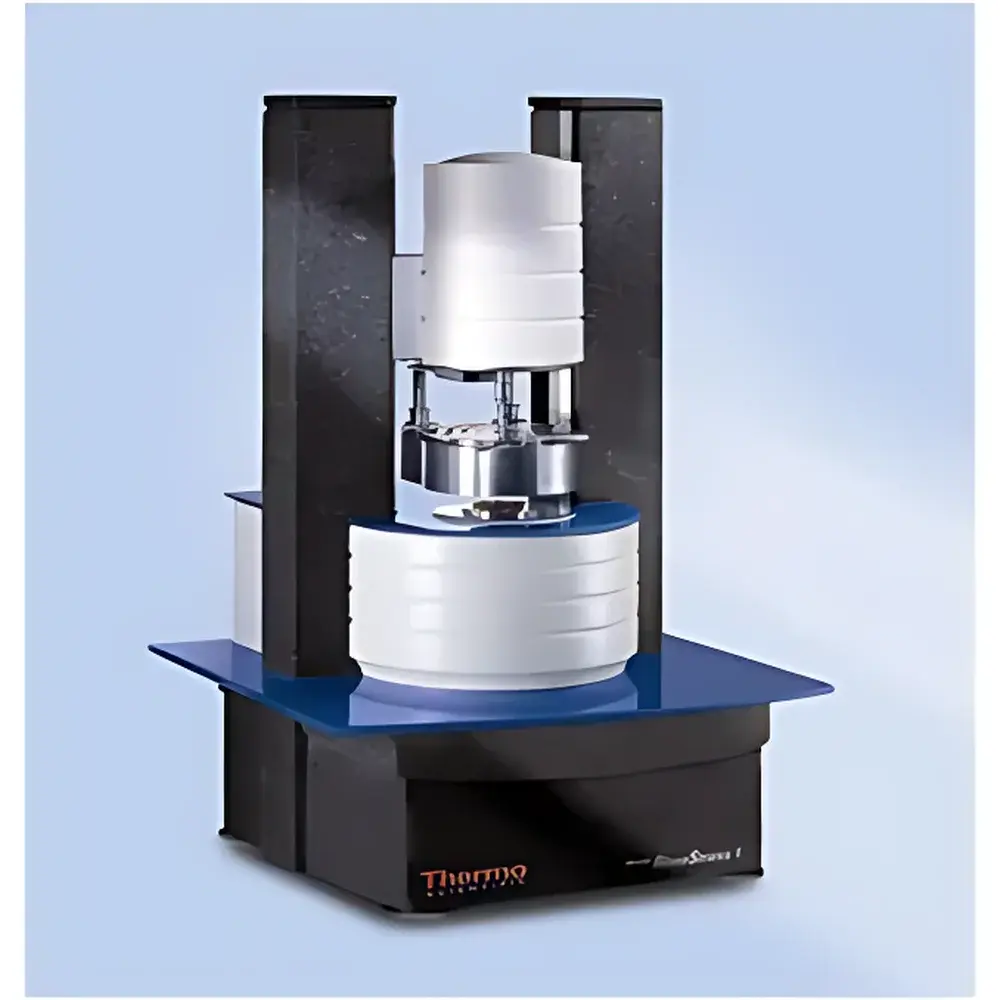
HAAKE RS 1 Advanced Air-Bearing Rotational Rheometer
| Brand | Thermo Fisher Scientific |
|---|---|
| Origin | Germany |
| Manufacturer | Thermo Fisher Scientific |
| Type | Benchtop Controlled-Stress/Controlled-Rate Rotational Rheometer |
| Model | RS 1 |
| Drive System | Air-bearing motor |
| Minimum Rotational Speed | 1.0 × 10⁻³ rpm |
| Maximum Rotational Speed | 1200 rpm |
| Angular Frequency Range (Oscillatory Mode) | 1.0 × 10⁻⁴ – 100 rad/s |
| Maximum Torque | 100 mN·m |
| Torque Resolution | 5 nN·m |
| Angular Displacement Resolution | 0.012 µrad |
| Motor Inertia | 11 µN·m·s² |
| Normal Force Range | Not specified |
| Normal Force Resolution | Not specified |
| Temperature Control Options | Peltier (–40 to +180 °C), Electric Heating (+20 to +200 °C), Liquid Circulator (–40 to +180 °C) |
| Optional Accessories | Star Geometry, SHRP Asphalt Testing System, Anti-Slip System |
Overview
The HAAKE RS 1 is a high-precision, air-bearing rotational rheometer engineered for demanding research and industrial quality control applications in polymer science, pharmaceutical formulation, food science, coatings, and asphalt technology. It operates on the principle of controlled-stress (CS), controlled-rate (CR), and controlled-strain (CD) rheometry, enabling comprehensive characterization of complex fluid and soft-solid viscoelastic behavior—including steady shear viscosity, yield stress, thixotropy, linear viscoelastic region (LVR), storage and loss moduli (G′, G″), and frequency sweeps. Its ultra-low torque detection capability (5 nN·m resolution) and exceptional angular resolution (0.012 µrad) support highly sensitive measurements of weakly structured systems—such as dilute biopolymer solutions, low-viscosity solvents, or thermosensitive emulsions—without mechanical interference from conventional ball or magnetic bearings.
Key Features
- Air-bearing motor drive ensures near-frictionless rotation, eliminating bearing hysteresis and enabling reproducible measurements across the full dynamic range—from ultra-slow creep tests (down to 1.0 × 10⁻³ rpm) to high-speed transient responses (up to 1200 rpm).
- Wide oscillatory frequency coverage (1.0 × 10⁻⁴ – 100 rad/s) supports both deep-time relaxation analysis and high-frequency dynamic response profiling, critical for time–temperature superposition (TTS) and master curve construction.
- Integrated thermal management architecture accommodates three interchangeable temperature control modules: Peltier-based (-40 to +180 °C), electric heating (+20 to +200 °C), and liquid-circulated systems (-40 to +180 °C), ensuring compatibility with ISO 6721, ASTM D4440, and EN 13398 test protocols.
- RheoWin software suite provides full compliance with GLP/GMP data integrity requirements, including electronic signatures, audit trails, and 21 CFR Part 11–compliant user access controls and data archiving.
- Snapshot mode and RheoWizard expert system automate initial sample assessment—recommending optimal geometry, gap setting, and measurement protocol based on real-time torque and normal force feedback—reducing operator dependency and method development time.
Sample Compatibility & Compliance
The RS 1 accommodates a broad spectrum of sample types via interchangeable measuring geometries—including parallel plates, cone-and-plate, concentric cylinders, and specialized accessories such as the SHRP-compliant asphalt testing system and star rotors for high-solids suspensions. Its modular design supports ASTM D2196 (viscosity of paints), ISO 3219 (rheological properties of polymer solutions), USP (rheology of semisolid dosage forms), and EN 13398 (bituminous binders). All hardware and firmware comply with IEC 61000-6-3 (EMC) and CE safety directives. Calibration traceability follows ISO/IEC 17025 standards through Thermo Fisher’s certified service network.
Software & Data Management
RheoWin 4.x delivers a validated, workflow-driven interface for method creation, real-time monitoring, automated report generation (PDF/CSV/XLSX), and advanced post-processing—including Cox-Merz equivalence validation, van Winkle analysis, and Weissenberg–Rabinowitsch correction for non-Newtonian shear rate calculation. Raw data files are stored in vendor-neutral HDF5 format, enabling third-party integration with MATLAB, Python (via h5py), or LIMS platforms. Audit trail logs record all parameter changes, user actions, instrument status events, and calibration history—fully supporting FDA and EMA regulatory submissions.
Applications
- Polymer melt processing: Melt elasticity, die swell prediction, and extensional viscosity estimation via LAOS (Large Amplitude Oscillatory Shear).
- Pharmaceutical suspensions and gels: Yield stress mapping, syringeability assessment, and stability evaluation under simulated storage conditions.
- Food texture engineering: Gelation kinetics, starch retrogradation, and fat crystal network formation under controlled thermal ramps.
- Coatings and inks: Sag resistance, leveling behavior, and pigment dispersion stability via time-sweep and recovery experiments.
- Asphalt binder grading: Performance Grade (PG) classification per AASHTO M320 using dynamic shear rheometer (DSR)-equivalent protocols with SHRP-certified fixtures.
FAQ
What temperature control options are available for the RS 1, and how do they differ in operational range?
The RS 1 supports three independent thermal modules: Peltier (–40 to +180 °C), electric heating (+20 to +200 °C), and liquid circulation (–40 to +180 °C). Selection depends on required cooling capacity, ramp rate, and compatibility with volatile or high-boiling-point media.
Is the RS 1 compliant with 21 CFR Part 11 for regulated pharmaceutical environments?
Yes—RheoWin software includes role-based access control, electronic signatures, immutable audit trails, and secure data export features fully aligned with FDA 21 CFR Part 11 requirements.
Can the RS 1 perform LAOS (Large Amplitude Oscillatory Shear) measurements?
Yes—the instrument’s high-speed digital signal processing, combined with its 100 rad/s upper frequency limit and sub-microradian angular resolution, enables robust LAOS acquisition and Fourier Transform Rheology (FT-Rheology) analysis.
What is the significance of air-bearing technology in rheological accuracy?
Air bearings eliminate static friction and mechanical hysteresis inherent in rolling-element bearings, ensuring true zero-torque baseline stability and enabling reliable measurement of weak elastic signals in low-modulus materials.
Does Thermo Fisher provide ISO/IEC 17025–accredited calibration services for the RS 1?
Yes—factory and field calibration services are offered globally through Thermo Fisher’s ISO/IEC 17025–accredited metrology laboratories, with documented uncertainty budgets and NIST-traceable reference standards.



