
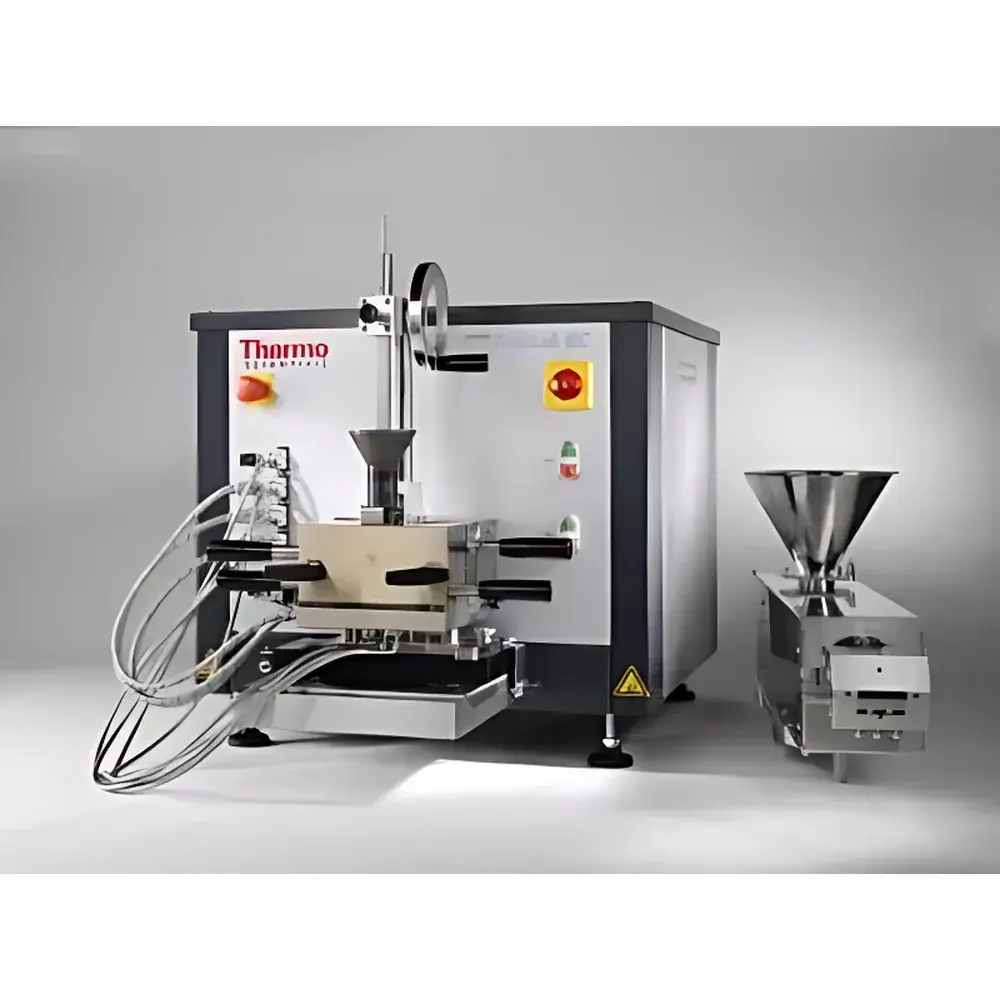
Thermo Fisher HAAKE PolyLab QC Modular Torque Rheometer
| Brand | Thermo Fisher |
|---|---|
| Origin | Germany |
| Manufacturer | Thermo Fisher Scientific |
| Product Type | Imported |
| Model | PolyLab QC |
| Instrument Category | Torque Rheometer |
| Drive Bearing | Single-screw configuration |
| Minimum Speed | 1 rpm |
| Frequency Range | 1–21 rad/s |
| Maximum Speed | 200 rpm |
| Maximum Torque | 300 N·m |
| Torque Resolution | 0.1 N·m |
| Torque Accuracy | ±0.15% of full scale |
| Temperature Range | Up to 450 °C (heating via electric cartridge heaters |
| Screw Material | Nitrided stainless steel (DIN 1.8550) |
| Chamber Material | Stainless steel (DIN 1.4301) |
| Mixer Chamber Volume | 120 cm³ or 625 cm³ |
| Screw Diameter | 19.05 mm (single-screw unit) / 31.8 mm & 20 mm (conical counter-rotating twin-screw unit) |
| Screw L/D Ratio | 25 |
| Screw Length | 300 mm |
| Gear Ratio | 3:2 |
| Maximum System Pressure | 700 bar |
| Power Rating | 4 kW |
| Control Interface | USB or optional Ethernet (LAN) |
| Software Platform | HAAKE PolySoft v7.x (Windows-based) |
Overview
The Thermo Fisher HAAKE PolyLab QC Modular Torque Rheometer is an engineered platform for precise, reproducible rheological and processing characterization of thermoplastics, elastomers, composites, and reactive polymer systems under realistic shear and thermal conditions. Operating on the principle of controlled torque measurement in a rotating mixing or extrusion geometry, the system quantifies material resistance to deformation by monitoring real-time torque, temperature, pressure, and rotational speed—enabling direct correlation between viscoelastic behavior and processability. Designed for laboratory-scale compound development, formulation screening, and quality control, the PolyLab QC integrates seamlessly with interchangeable processing modules—including internal mixers, single-screw extruders, and conical counter-rotating twin-screw extruders—allowing users to simulate industrial compounding, extrusion, and melt blending operations without requiring separate dedicated instruments.
Key Features
- Modular architecture supporting plug-and-play integration of mixer, single-screw, and conical twin-screw extrusion units—ensuring full hardware reuse across application domains;
- Backward compatibility with legacy HAAKE internal mixers and extruders (e.g., MiniLab II, RheoMix series), protecting prior capital investment;
- High-torque drive system delivering up to 300 N·m with 0.1 N·m resolution and ±0.15% full-scale accuracy—critical for detecting subtle viscosity changes in filled or nanocomposite systems;
- Wide operational speed range from 1 to 200 rpm (equivalent to angular frequency of 1–21 rad/s), enabling both low-shear stability assessment and high-shear melt homogenization studies;
- Robust thermal management: electric cartridge heating with forced-air cooling, supporting stable operation up to 450 °C in all modules;
- Flexible mechanical configuration—available in benchtop or floor-standing variants—to accommodate space-constrained labs or high-throughput pilot environments;
- Real-time multi-parameter acquisition: synchronized logging of torque, temperature (±0.5 °C), pressure (up to 700 bar), motor current, and screw rotation—captured at ≥10 Hz sampling rate.
Sample Compatibility & Compliance
The PolyLab QC accommodates a broad spectrum of polymeric and composite feedstocks—including virgin and recycled thermoplastics (PP, PE, PC, PA, PBT), thermoplastic elastomers (TPEs), filled compounds (CaCO₃, talc, glass fiber), conductive masterbatches, and reactive formulations (e.g., peroxide-cured EPDM, silane-grafted PE). All wetted components—including mixer rotors, extruder screws, and barrels—are fabricated from nitrided stainless steel (DIN 1.8550) and chamber housings from corrosion-resistant DIN 1.4301 stainless steel, ensuring long-term dimensional stability and chemical inertness during aggressive processing. The system supports compliance workflows aligned with ISO 6721 (plastics—dynamic mechanical properties), ASTM D3835 (extrusion plastometer), and ISO 11443 (injection molding and extrusion flow behavior). Data integrity meets GLP/GMP expectations through audit-trail-enabled software logging and time-stamped parameter records traceable to instrument ID and operator login.
Software & Data Management
HAAKE PolySoft v7.x serves as the unified control and analysis environment—built natively on Microsoft Windows 10/11 for intuitive navigation, contextual help, and seamless integration with standard office tools. The software provides preconfigured test methods (e.g., “Melt Flow Index Equivalent”, “Torque Curve Ramp”, “Steady-State Mixing”), automated sequence scripting, and offline batch execution—reducing manual intervention and enhancing inter-operator reproducibility. All raw data are stored in vendor-neutral CSV and HDF5 formats, supporting third-party statistical analysis (e.g., JMP, MATLAB, Python pandas). Optional LAN connectivity enables centralized data archiving via network-attached storage (NAS) or LIMS integration. Full 21 CFR Part 11 compliance is achievable with enabled electronic signatures, role-based access control, and immutable audit trails—including modification history for all method parameters and calibration events.
Applications
- Formulation optimization of polymer blends and masterbatches—quantifying dispersion quality, filler-matrix interaction, and thermal degradation onset;
- Process window mapping for extrusion and injection molding—determining optimal screw speed, barrel zone temperatures, and residence time distributions;
- Quality assurance of incoming resin lots—comparing torque curves and energy consumption profiles against reference standards;
- Development of reactive extrusion processes—monitoring real-time viscosity evolution during grafting, crosslinking, or condensation reactions;
- Small-batch pilot production of specialty compounds—using optional downstream modules (pelletizer, melt pump, capillary die) to generate test samples for mechanical or rheological validation;
- Teaching and training in polymer engineering curricula—demonstrating structure–property–process relationships with hands-on, scalable experiments.
FAQ
Can the PolyLab QC be upgraded from a basic mixer-only configuration to include extrusion modules later?
Yes. The system’s modular design allows field-installation of single-screw or conical twin-screw extrusion units at any time, using existing base frame, drive, and control infrastructure.
Is it possible to perform capillary rheometry using this system?
Yes—via the optional capillary extrusion rheology module, which integrates a precision die, pressure transducer, and piston-driven melt delivery system compliant with ISO 11443.
What level of temperature uniformity is maintained across the mixing chamber or barrel zones?
Each heated zone achieves ±1.5 °C axial uniformity under steady-state operation, verified per DIN EN 61000-4-30 thermal stability protocols.
Does the system support automatic calibration of torque and temperature sensors?
Torque calibration is performed using traceable dead-weight standards; temperature sensor verification is supported via external PT100 reference probes—both procedures documented within PolySoft’s calibration manager.
Are there validated methods available for regulatory submissions (e.g., FDA filings)?
While instrument qualification (IQ/OQ/PQ) documentation is provided, method validation must be conducted by the end user per ICH Q2(R2) guidelines—PolySoft exports fully traceable raw data required for such submissions.



