
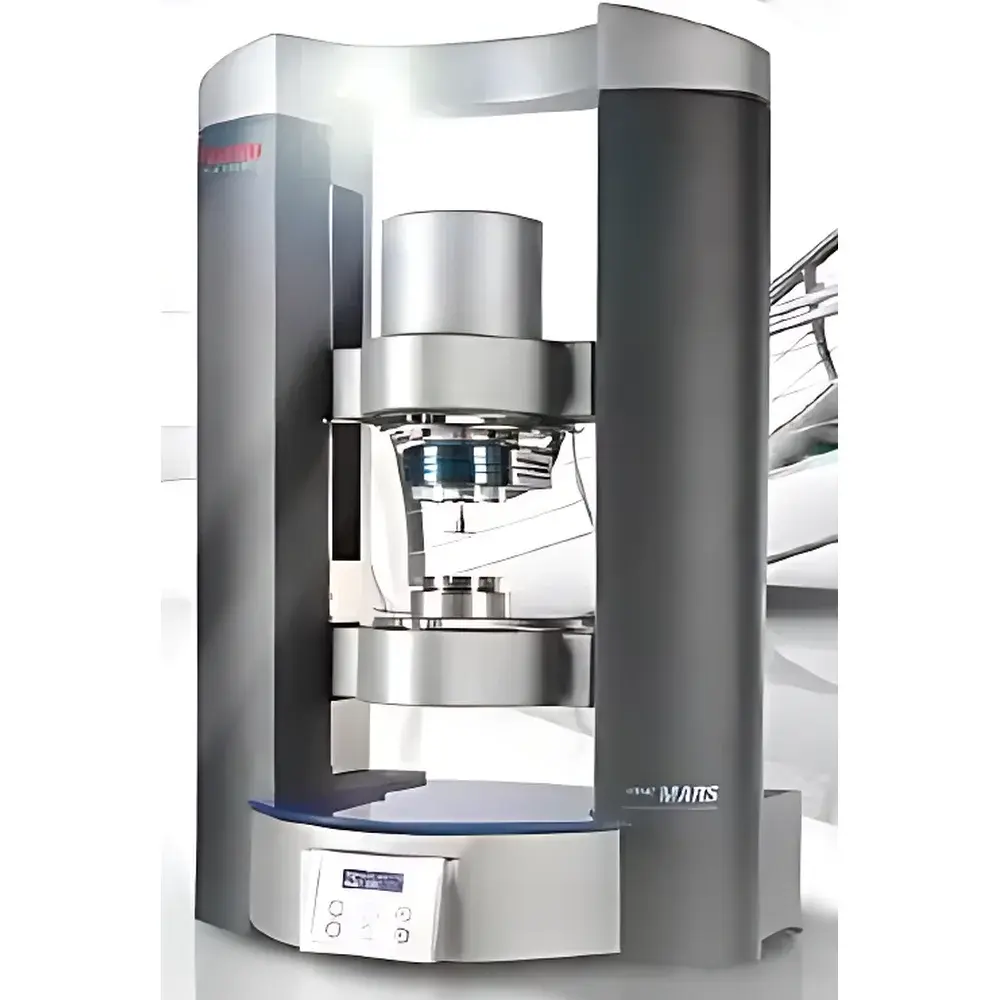
HAAKE MARS III Modular Rheometer Workstation
| Brand | HAAKE |
|---|---|
| Origin | Germany |
| Model | MARS III |
| Minimum Torque | 0.003 µN·m |
| Maximum Torque | 200 mN·m |
| Torque Resolution | 0.1 nN·m |
| Angular Displacement Resolution | 0.012 µrad |
| Motor Inertia | 10 µN·m·s² |
| Minimum Rotational Speed | 1.0×10⁻⁸ rpm |
| Maximum Rotational Speed | 1500 rpm (4500 rpm optional) |
| Minimum Oscillation Frequency | 1.0×10⁻⁶ Hz |
| Maximum Oscillation Frequency | 100 Hz |
| Normal Force Range | 0.01–50 N |
| Normal Force Resolution | 0.001 N |
| Temperature Control Range (Peltier) | −60 to 200 °C |
| Temperature Control Range (Electric Heater) | 30 to 300 °C |
| Temperature Control Range (Liquid Circulator) | −40 to 180 °C |
| Temperature Control Range (CTC Radiation/Convection Furnace) | −150 to 600 °C |
| Bidirectional Normal Force Measurement | Yes |
Overview
The HAAKE MARS III Modular Rheometer Workstation is a high-precision, research-grade rotational rheometer engineered for advanced viscoelastic characterization across academic, pharmaceutical, polymer, and materials science laboratories. Based on Couette and cone-plate rheological principles, the MARS III employs a direct-drive air-bearing motor and high-resolution optical encoder to deliver exceptional torque sensitivity and angular fidelity. Its dual-column mechanical architecture provides structural rigidity and long-term dimensional stability—critical for time-sweep experiments, low-shear-rate viscosity profiling, and oscillatory measurements under variable thermal conditions. Designed for future-proof scalability, the platform supports seamless integration of advanced modules without hardware retrofitting, ensuring continuity from legacy HAAKE RheoStress instrumentation while enabling next-generation experimental capabilities.
Key Features
- Dual-column frame design delivering enhanced mechanical stability and minimized torsional deflection during high-torque or long-duration tests
- Ultra-low torque detection limit of 0.003 µN·m and resolution of 0.1 nN·m—enabling accurate measurement of weak gels, dilute polymer solutions, and biological macromolecules
- Angular displacement resolution of 0.012 µrad supports precise strain-controlled oscillation and creep recovery analysis
- Bidirectional normal force sensing (±0.01–50 N) with 1 mN resolution for real-time sample compression monitoring and gap control in soft solids and pastes
- Multi-modal temperature control compatibility: Peltier (−60 to 200 °C), electric heating (30 to 300 °C), liquid circulation (−40 to 180 °C), and radiation-convection furnace (−150 to 600 °C)
- Modular expansion interface supporting synchronized hyphenated techniques including RheoScope (optical microscopy), SER (melt extensional rheology), Rheonaut (FTIR-rheology coupling), and UV-curing modules
Sample Compatibility & Compliance
The MARS III accommodates a broad spectrum of sample states—from low-viscosity Newtonian liquids and shear-thinning suspensions to highly elastic melts, thermosets, hydrogels, and particle-laden pastes. Standard geometries include cone-and-plate, parallel-plate, concentric cylinder, and vane fixtures; optional accessories extend functionality to asphalt (SHRP-compliant testing), solid bending/torsion, high-pressure/high-temperature sealed cells (Hastelloy variants available), and tribological interfaces. The system complies with ISO 6721 (plastics—determination of dynamic mechanical properties), ASTM D4440 (standard test method for dynamic mechanical properties of plastics), and supports GLP/GMP workflows via audit-trail-enabled software. Full traceability of instrument parameters, environmental conditions, and user actions meets FDA 21 CFR Part 11 requirements when configured with electronic signature and secure data archiving.
Software & Data Management
Thermo Scientific™ RheoWin software provides intuitive experiment sequencing, real-time parameter visualization, and automated protocol execution. It supports multi-step test programs—including amplitude sweeps, frequency sweeps, temperature ramps, and time sweeps—with built-in models for Cross, Carreau-Yasuda, and Maxwell fitting. Raw torque, strain, stress, and normal force data are stored in vendor-neutral HDF5 format, facilitating post-processing in MATLAB, Python (via h5py), or third-party analytics platforms. Version-controlled method templates ensure inter-laboratory reproducibility, while role-based access control and encrypted database storage align with ISO/IEC 17025 documentation standards.
Applications
- Structure-property relationships in thermoplastic melts and elastomers under processing-relevant shear and extensional flows
- Yield stress and thixotropic recovery kinetics in pharmaceutical suspensions and topical formulations
- Crosslinking kinetics of UV-curable resins monitored in situ via integrated UV module
- Low-frequency viscoelastic response of battery electrode slurries and ceramic pastes
- Mechanical degradation of biopolymer networks under large-amplitude oscillatory shear (LAOS)
- High-temperature rheology of aerospace composites and metal alloys using CTC furnace configuration
FAQ
Is the MARS III compatible with legacy HAAKE RheoStress accessories?
Yes—the MARS III maintains full mechanical and electrical backward compatibility with all RheoStress temperature controllers, transducers, and geometry sets.
Can the system perform both rotational and oscillatory measurements simultaneously?
No—it operates in either controlled-stress or controlled-strain mode per test sequence, but hybrid waveforms (e.g., superimposed oscillation on steady shear) are supported via custom scripting in RheoWin.
What cooling options are required to achieve −150 °C with the CTC furnace?
A liquid nitrogen supply or closed-cycle cryocooler is necessary; standard laboratory chillers cannot reach this temperature range.
Does the bidirectional normal force sensor support automatic gap optimization?
Yes—RheoWin includes AutoGap routines that use real-time normal force feedback to establish and maintain optimal sample thickness during thermal ramps or yield stress determination.
Is FTIR-rheology coupling (Rheonaut) validated for quantitative chemical kinetics studies?
The Rheonaut module enables time-resolved spectral acquisition synchronized to rheological events; quantitative interpretation requires calibration against reference standards and is subject to Beer-Lambert limitations at high absorbance.



