
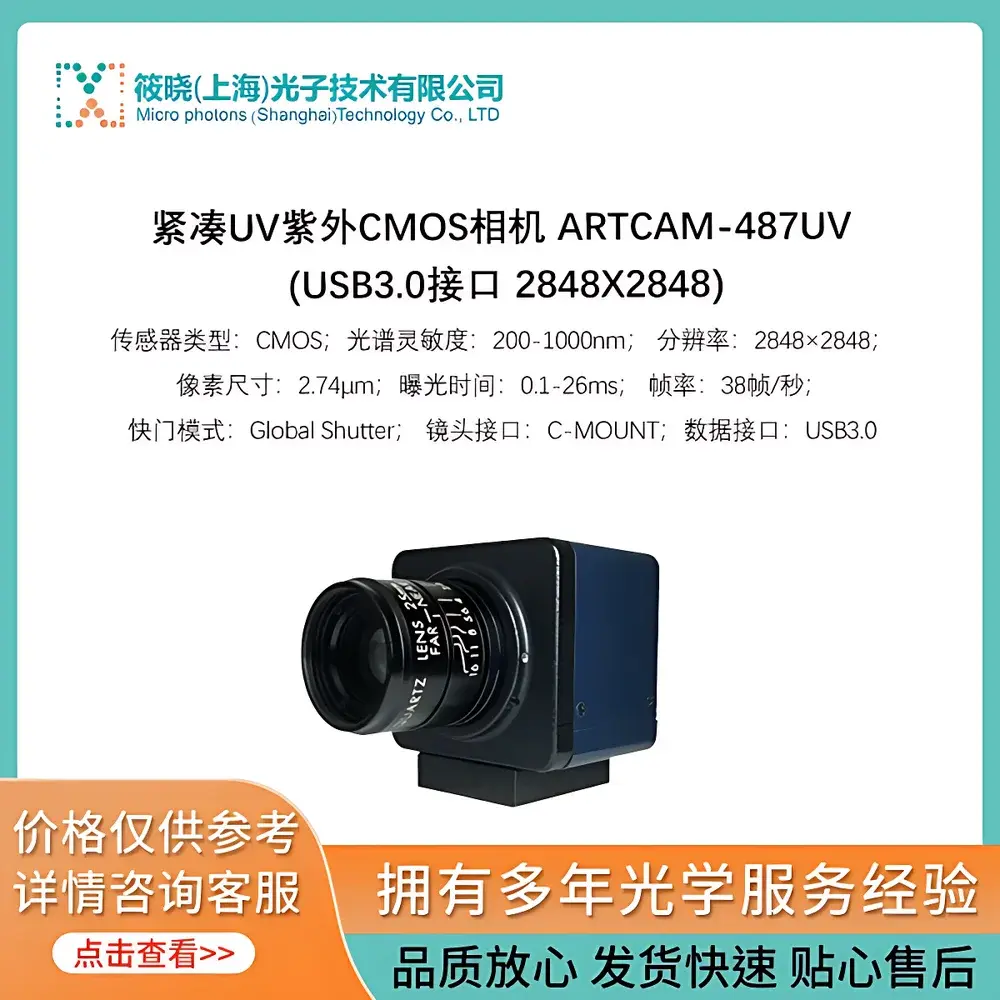
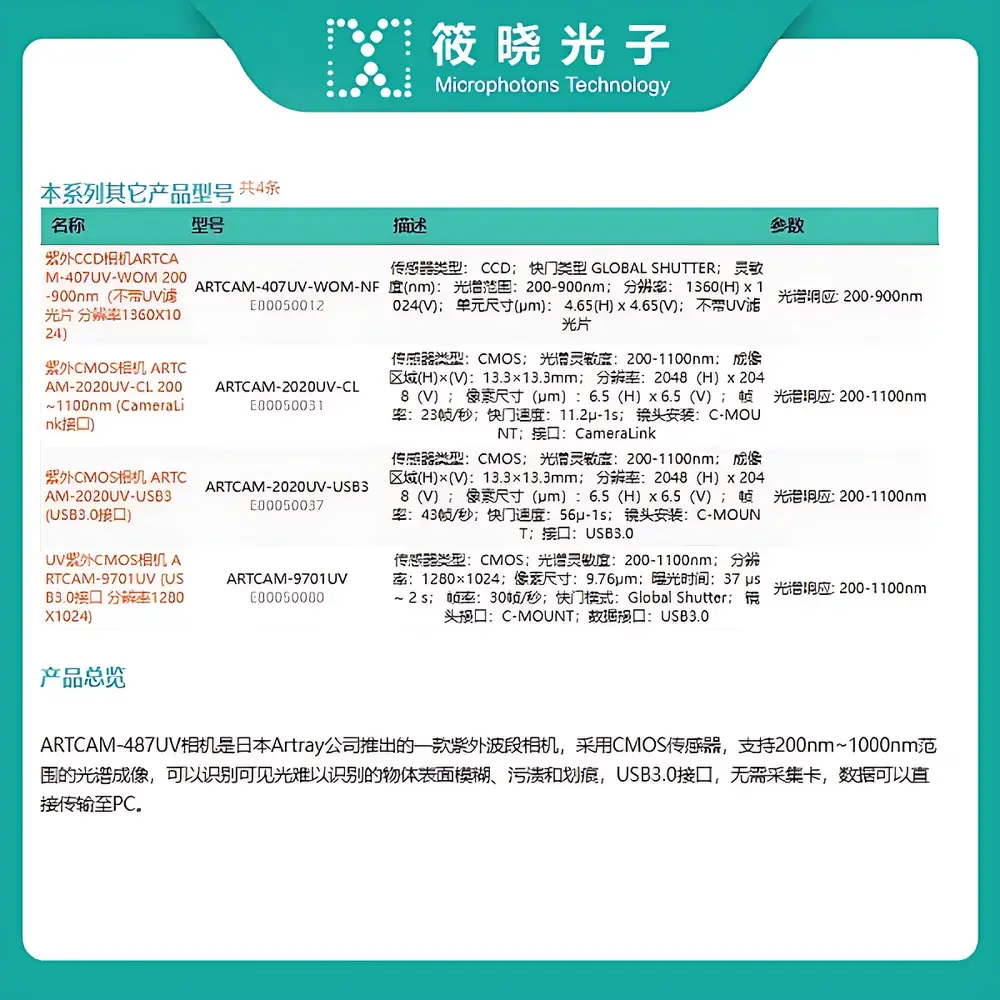
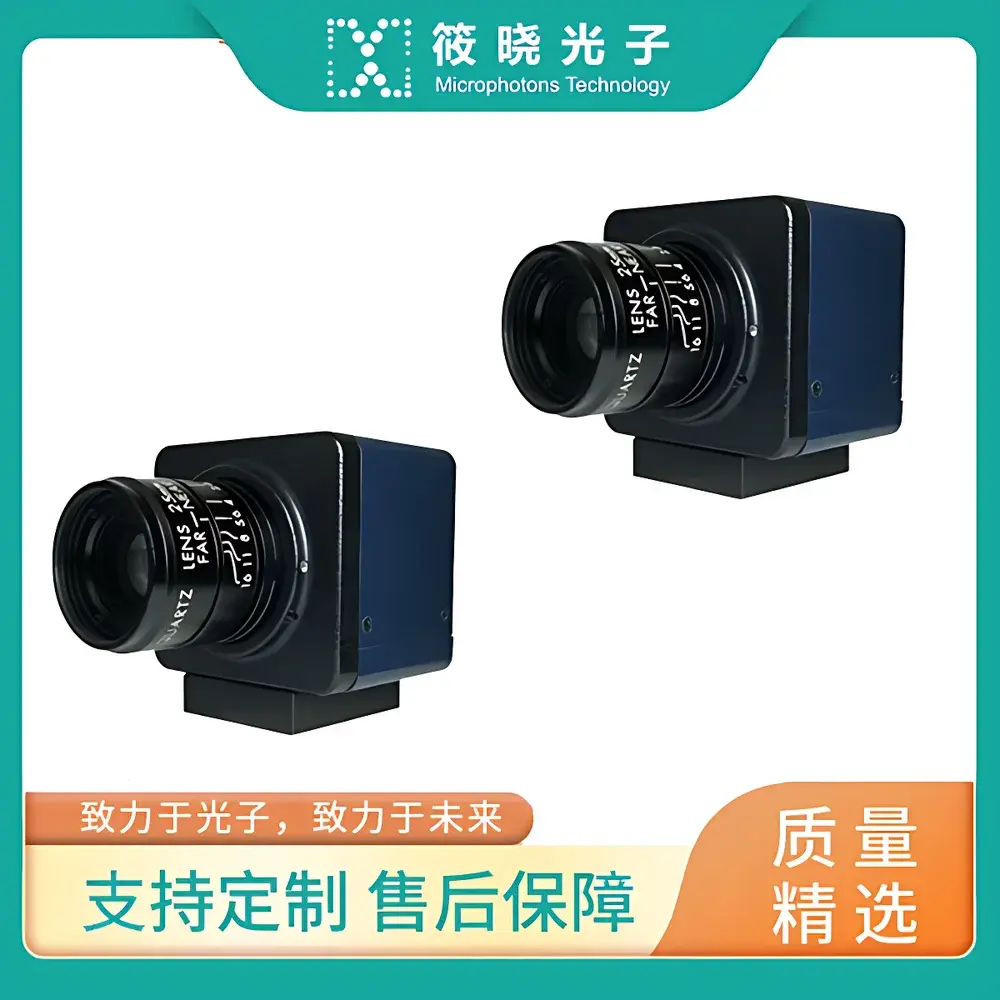
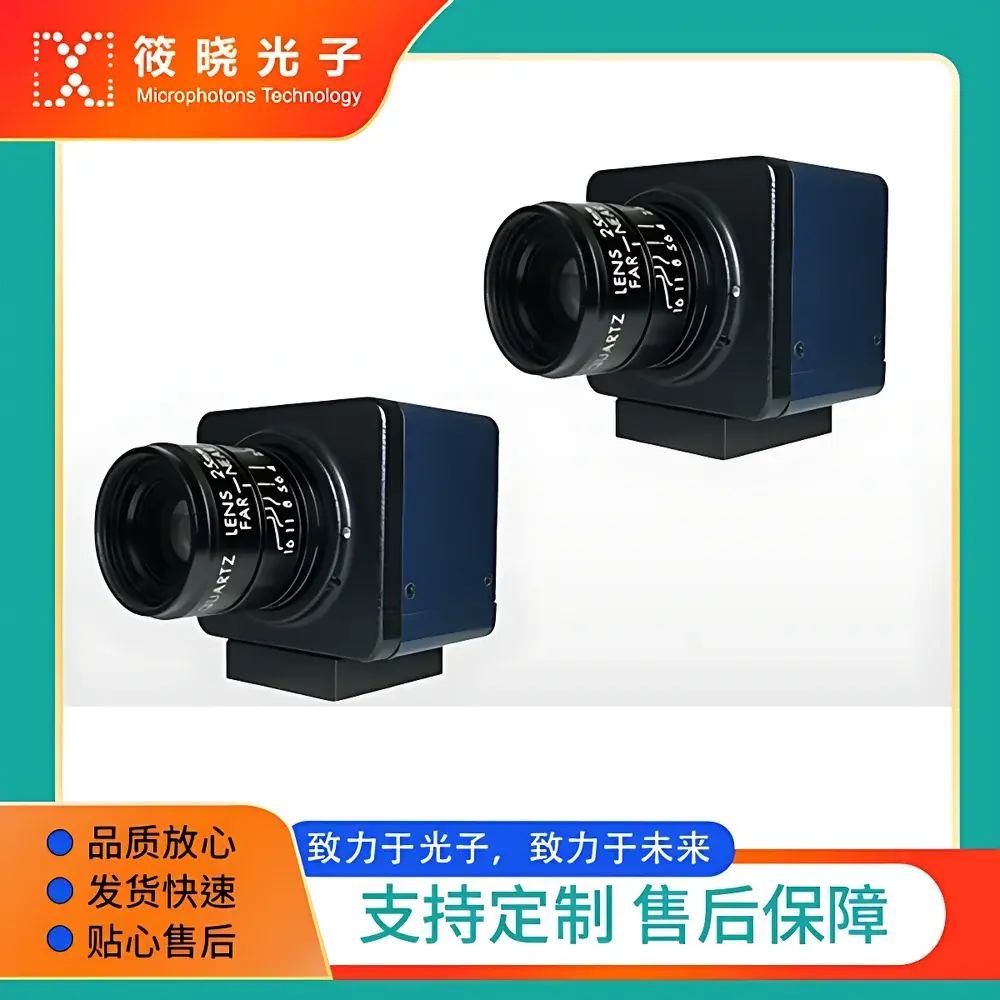
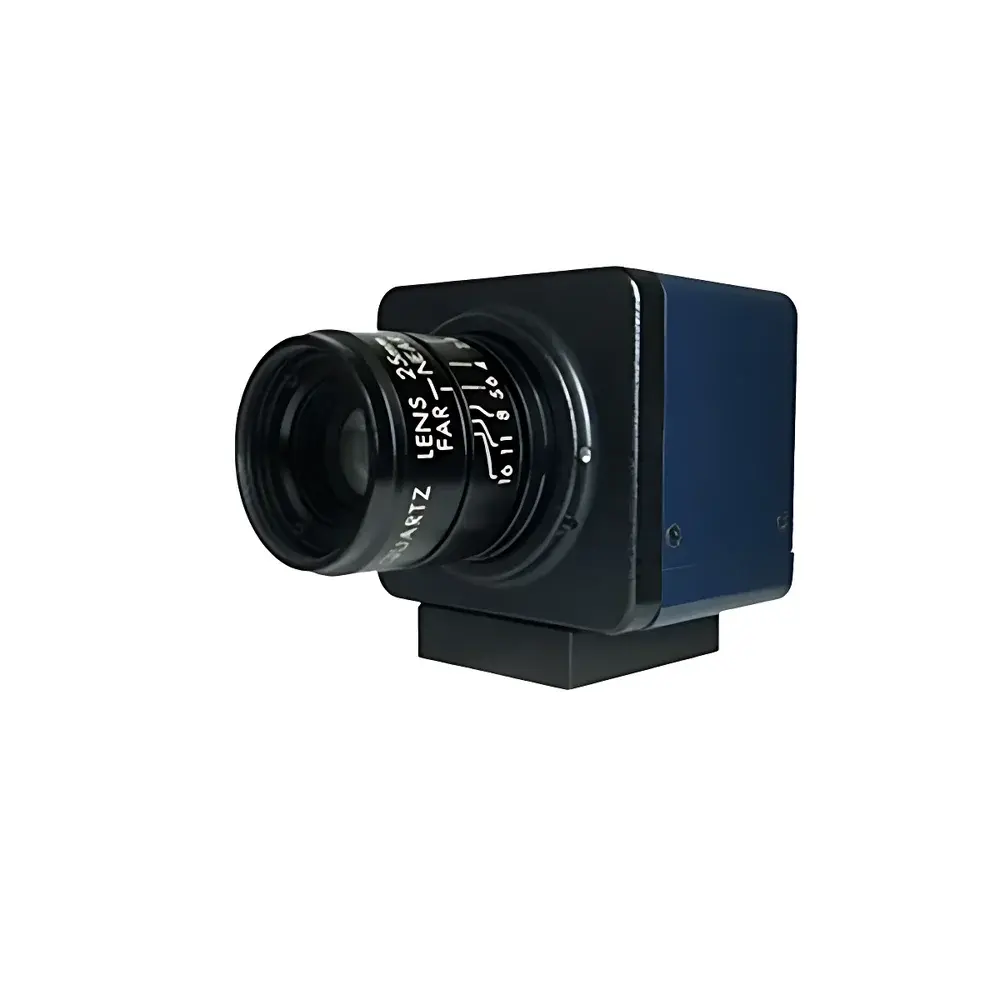
Artray ARTCAM-487UV UV-Enhanced CMOS Imaging Camera
| Brand | Artray |
|---|---|
| Origin | Japan |
| Model | ARTCAM-487UV |
| Sensor Type | CMOS |
| Resolution | 2848 × 2848 |
| Pixel Size | 2.74 µm |
| Spectral Range | 200 nm – 1000 nm |
| Frame Rate | 38 fps |
| Interface | USB 3.0 |
| Shutter Mode | Global Shutter |
| ADC Resolution | 12 bit |
| Exposure Time | 0.1 ms – 26 ms |
| Lens Mount | C-Mount |
| Power Supply | 5 VDC |
| Operating Temperature | 0 °C – +35 °C |
| Dimensions (W×H×L) | 50 mm × 47 mm × 42.7 mm |
| Weight | 130 g |
Overview
The Artray ARTCAM-487UV is a high-resolution, UV-optimized scientific imaging camera engineered for precision ultraviolet and broadband spectral acquisition in demanding optical metrology, fluorescence inspection, semiconductor wafer defect analysis, and forensic document examination. Built around a Sony back-illuminated CMOS sensor, the ARTCAM-487UV delivers exceptional quantum efficiency across the deep-UV to near-infrared range (200–1000 nm), enabling reliable detection of sub-micron surface anomalies—including latent fingerprints, organic residues, ink alterations, and micro-cracks—that remain invisible under visible illumination. Its global shutter architecture ensures temporal fidelity and eliminates motion-induced distortion—critical for synchronized pulsed UV illumination systems or high-speed inspection lines. Unlike legacy CCD-based UV cameras, the ARTCAM-487UV leverages native USB 3.0 connectivity to eliminate external frame grabbers, reducing system complexity while maintaining deterministic data throughput up to 38 full-resolution frames per second.
Key Features
- 8.1-megapixel resolution (2848 × 2848) with 2.74 µm pixel pitch for high spatial sampling density and fine-detail capture
- Back-illuminated CMOS sensor optimized for quantum efficiency >60% at 254 nm and >40% at 200 nm—enabling low-noise imaging under weak UV excitation
- Global electronic shutter with programmable exposure from 0.1 ms to 26 ms, supporting both continuous and strobed UV illumination schemes
- 12-bit analog-to-digital conversion with on-chip correlated double sampling (CDS) to minimize read noise and fixed-pattern artifacts
- Compact, fanless mechanical design (50 × 47 × 42.7 mm; 130 g) suitable for integration into OEM optical enclosures, microscope adapters, and portable field instruments
- USB 3.0 Vision-compliant interface with GenICam support, ensuring interoperability with HALCON, OpenCV, MATLAB Image Acquisition Toolbox, and LabVIEW IMAQdx
Sample Compatibility & Compliance
The ARTCAM-487UV is compatible with standard C-mount optics—including UV-transmitting fused silica lenses, reflective objectives, and bandpass filters centered at 254 nm, 365 nm, or 405 nm. Its spectral response has been validated against NIST-traceable UV radiometric standards and conforms to ISO 15739:2013 (imaging system noise measurement) and ISO 12233:2017 (spatial frequency response). The camera meets CE marking requirements for electromagnetic compatibility (EN 61326-1) and safety (EN 62368-1). While not certified for Class I medical devices or explosion-proof environments, its robust thermal management and low-power operation (5 VDC, <2.5 W) make it suitable for GLP-compliant laboratory instrumentation and industrial QA/QC workflows requiring audit-ready image provenance.
Software & Data Management
Artray provides a Windows-native SDK (C/C++, .NET, Python bindings) supporting full control of exposure, gain, ROI, binning, and trigger modes—including hardware-level synchronization via TTL input/output. All captured images include embedded metadata (timestamp, exposure, sensor temperature, firmware version) compliant with TIFF/BigTIFF and HDF5 formats. For regulated environments, optional firmware enables timestamped audit logs and write-once image storage to prevent post-acquisition modification—aligning with FDA 21 CFR Part 11 principles for electronic records and signatures when deployed in pharmaceutical packaging inspection or materials certification labs.
Applications
- UV fluorescence imaging of biological specimens, electrophoresis gels, and thin-layer chromatography plates
- Non-destructive evaluation (NDE) of polymer degradation, adhesive bond integrity, and coating uniformity
- Forensic trace evidence documentation—including latent fingerprint development using cyanoacrylate fuming or DFO reagents
- Semiconductor photomask inspection and wafer-level defect mapping under 248 nm or 365 nm illumination
- UV-curable resin monitoring in additive manufacturing process control
- Optical component characterization, including UV lens MTF testing and filter transmission profiling
FAQ
Does the ARTCAM-487UV require an external power supply or cooling system?
No—it operates exclusively from bus-powered USB 3.0 (5 VDC) and features passive thermal regulation. Active cooling is unnecessary for continuous operation within the specified 0–35 °C ambient range.
Can the camera be used with standard machine vision lenses designed for visible light?
Standard visible-light lenses exhibit strong UV absorption and chromatic aberration below 350 nm. For optimal performance below 365 nm, fused silica or calcium fluoride C-mount lenses are recommended.
Is GenICam support included in the standard SDK?
Yes—the SDK implements full GenICam v2.3 compliance, enabling seamless integration with third-party vision software without proprietary drivers.
What is the maximum sustained data bandwidth over USB 3.0 at full resolution and frame rate?
At 2848 × 2848 × 12-bit, the theoretical bandwidth is ~320 MB/s; the camera maintains stable 38 fps transfer using USB 3.0’s 400 MB/s nominal bandwidth, with typical host-side utilization below 85% on modern xHCI controllers.
Are calibration files (flat-field, dark-frame, spectral response) provided with the unit?
Each unit ships with factory-acquired dark-frame libraries and relative spectral responsivity curves (200–1000 nm, ±2 nm step). Flat-field correction matrices are available upon request for OEM integration.




