
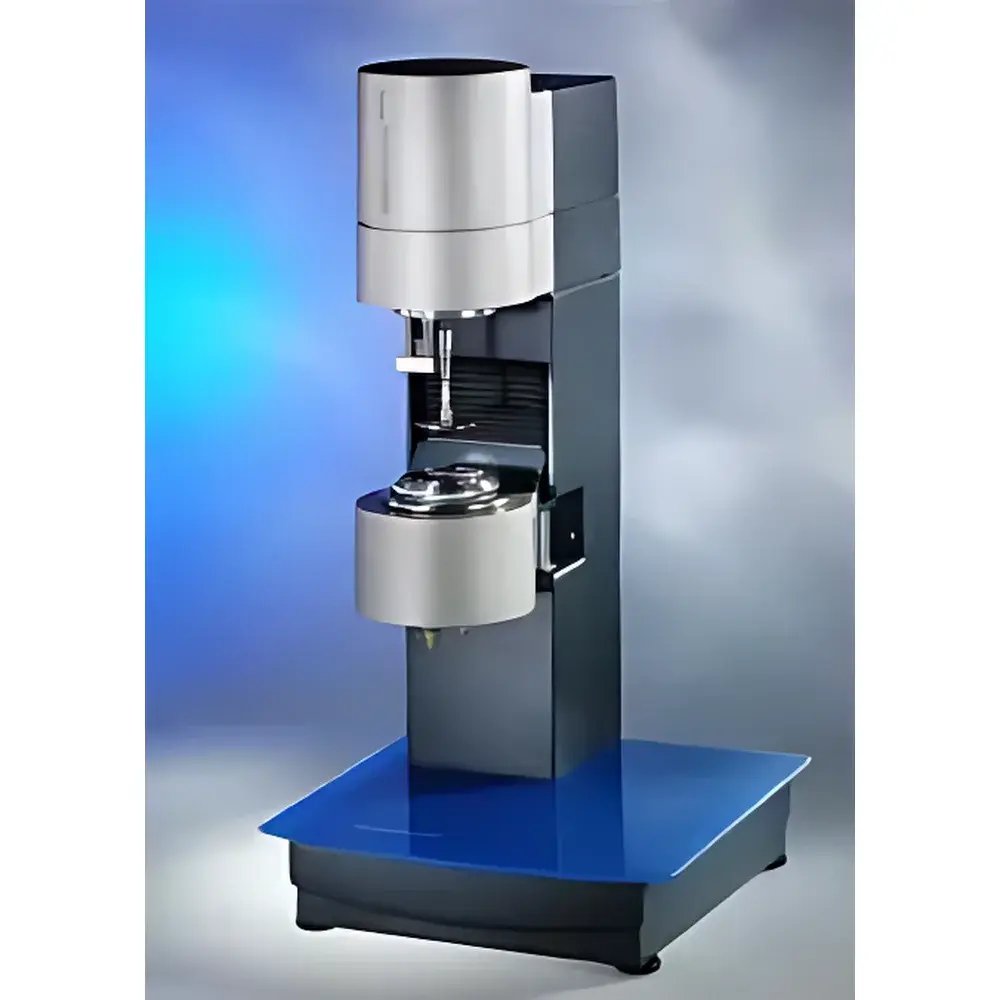
HAAKE RS6000 Modular Universal Rheometer
| Brand | HAAKE |
|---|---|
| Origin | Germany |
| Model | RS6000 |
| Motor Technology | 4th-generation vector-controlled motor |
| Torque Range | 0.005 µN·m (min) to 200 mN·m (max) |
| Torque Resolution | 0.5 nN·m |
| Angular Displacement Resolution | 0.012 µrad |
| Rotational Speed Range | 1.0×10⁻⁷ – 1500 rpm (up to 4500 rpm optional) |
| Oscillation Frequency Range | 1.0×10⁻⁵ – 100 Hz |
| Normal Force Range | ±0.01–50 N |
| Normal Force Resolution | 0.001 N |
| Temperature Control | Peltier (−60 to 200 °C), Electric Heater (30 to 300 °C), Liquid Circulator (−40 to 180 °C) |
| Data Acquisition Rate | 2.5 ms per point |
| Compliance | ASTM D4402, ISO 6721-10, ISO 3219, USP <911>, FDA 21 CFR Part 11-ready software architecture |
Overview
The HAAKE RS6000 Modular Universal Rheometer is a high-precision rotational rheometer engineered for advanced viscoelastic characterization across research, quality control, and industrial development laboratories. Based on the proven architecture of the HAAKE MARS platform, the RS6000 integrates fourth-generation vector-controlled motor technology to deliver true simultaneous control of stress, strain, and rate—enabling rigorous implementation of controlled-stress (CS), controlled-rate (CR), and controlled-strain (CD) measurement protocols. Its core measurement principle relies on Couette or parallel-plate geometry-based torque transduction under defined shear or oscillatory deformation, with real-time normal force detection enabling quantitative assessment of elastic recovery, yield behavior, and interfacial normal stresses. The instrument supports full time–temperature–shear superposition analysis and is calibrated traceably to national metrology standards (e.g., PTB, NIST). Designed for reproducibility-critical environments—including pharmaceutical formulation labs, polymer R&D centers, and asphalt materials testing facilities—the RS6000 meets the mechanical and thermal stability requirements essential for GLP-compliant and GMP-aligned workflows.
Key Features
- Vector-controlled motor with sub-microradian angular resolution (0.012 µrad) and ultra-low inertia (10 µN·m·s²), ensuring rapid response and minimal signal lag during transient measurements.
- High-dynamic-range torque sensor (0.005 µN·m minimum detectable torque; 200 mN·m maximum) with 0.5 nN·m resolution, optimized for both dilute polymer solutions and highly filled composites.
- Dual-directional normal force transducer (±0.01–50 N, 0.001 N resolution) supporting quantitative evaluation of first and second normal stress differences in complex fluids.
- Multi-modal temperature control system: Peltier stage (−60 to 200 °C), electric heater (30 to 300 °C), and external liquid circulator interface (−40 to 180 °C), each with independent PID tuning and real-time thermal mapping capability.
- 2.5 ms data acquisition interval enables accurate capture of fast relaxation processes, including thixotropic recovery, gelation onset, and UV-cure kinetics.
- Modular hardware architecture compliant with ISO/IEC 17025 mechanical calibration protocols; all critical components—transducers, encoders, and thermal sensors—are individually certified and field-replaceable without recalibration downtime.
Sample Compatibility & Compliance
The RS6000 accommodates diverse sample forms—including melts, gels, suspensions, emulsions, pastes, and thermosetting resins—via interchangeable measuring geometries (cone-plate, parallel-plate, concentric cylinder, vane, and three-point bending fixtures). Optional accessories include SHRP-compliant asphalt test systems (AASHTO T315), UV-curing stages with wavelength-selectable LED arrays (365 nm, 385 nm, 405 nm), and high-pressure cells rated to 200 bar with Hastelloy C-276 wetted parts for corrosive or reactive media. The system complies with ASTM D4402 (asphalt binder viscosity), ISO 6721-10 (dynamic mechanical analysis of polymers), ISO 3219 (rotational viscosity of polymer solutions), and USP (rheological characterization of semisolid dosage forms). Full audit trail, electronic signature, and 21 CFR Part 11–compliant user access controls are embedded in the Thermo Scientific RheoWin software suite.
Software & Data Management
RheoWin 4.x provides a validated, Windows-based environment for method definition, real-time visualization, automated sequence execution, and ISO 10012-aligned uncertainty propagation reporting. All raw torque, normal force, temperature, and displacement data are stored in vendor-neutral HDF5 format with embedded metadata (sample ID, operator, timestamp, environmental conditions, calibration history). Batch processing scripts support automated master curve generation, Cox-Merz validation, and Williams-Landel-Ferry (WLF) parameter fitting. Data export modules comply with ASTM E1461 and ISO/IEC 17025 documentation requirements, including full traceability of instrument configuration parameters and sensor drift compensation logs.
Applications
- Characterization of polymer melts and solutions: zero-shear viscosity, melt elasticity (Deborah number), extensional viscosity via filament stretching rheometry (FSR) add-on.
- Pharmaceutical formulation development: yield stress profiling of topical gels, temperature-dependent modulus mapping of injectable depots, and shear-thinning behavior of oral suspensions.
- Asphalt binder performance grading: complex modulus (G*), phase angle (δ), and rutting resistance (G*/sinδ) per AASHTO M320 and EN 13587.
- Curing kinetics of thermosets: real-time monitoring of storage/loss moduli during UV or thermal initiation, with isoconversional analysis support.
- Food texture engineering: breakdown/recovery profiles of starch gels, fat crystal network evolution, and mouthfeel prediction via frequency sweep at physiological temperatures.
- Electro-rheological and magneto-rheological fluid development: field-dependent yield stress and structural hysteresis quantification using integrated field-generator interfaces.
FAQ
What temperature control options are available, and how do they integrate with rheological measurements?
The RS6000 supports three independent thermal management paths: Peltier (−60 to 200 °C), electric heating (30 to 300 °C), and external liquid circulation (−40 to 180 °C). Each mode features active thermal feedback synchronized with torque and normal force acquisition at 2.5 ms intervals, enabling precise time–temperature superposition without interpolation artifacts.
Is the RS6000 suitable for regulatory submissions in pharmaceutical or food applications?
Yes. When operated with RheoWin 4.x under configured 21 CFR Part 11 mode—including role-based access, electronic signatures, and immutable audit trails—the system satisfies data integrity requirements for FDA, EMA, and Health Canada submissions.
Can the instrument perform both steady shear and dynamic oscillatory tests within a single experiment sequence?
Yes. The vector motor architecture allows seamless transitions between CS, CR, and CD modes without hardware reconfiguration. Predefined multi-step methods can combine creep-recovery, frequency sweeps, and amplitude sweeps in a single run.
What calibration standards and traceability documentation are provided?
Each RS6000 ships with factory calibration certificates traceable to PTB (Germany) or NIST (USA), covering torque, normal force, angular displacement, and temperature sensors. On-site verification kits and ISO/IEC 17025–compliant calibration procedures are available through Thermo Fisher Scientific Service Centers.
How is data security and long-term archival handled?
Raw data files use HDF5 format with embedded SHA-256 checksums and metadata encryption. Optional integration with Thermo Fisher’s SampleManager LIMS enables automated backup, retention policy enforcement, and cross-instrument data federation.



