
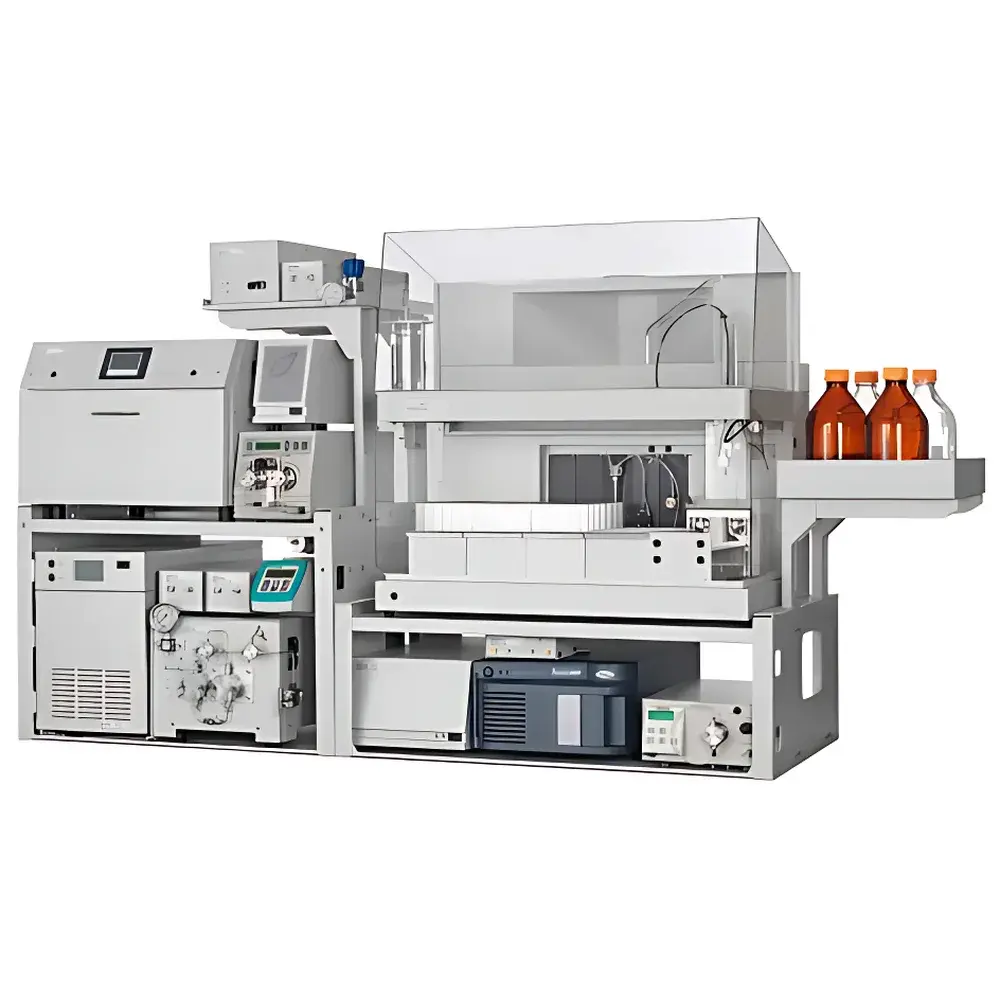
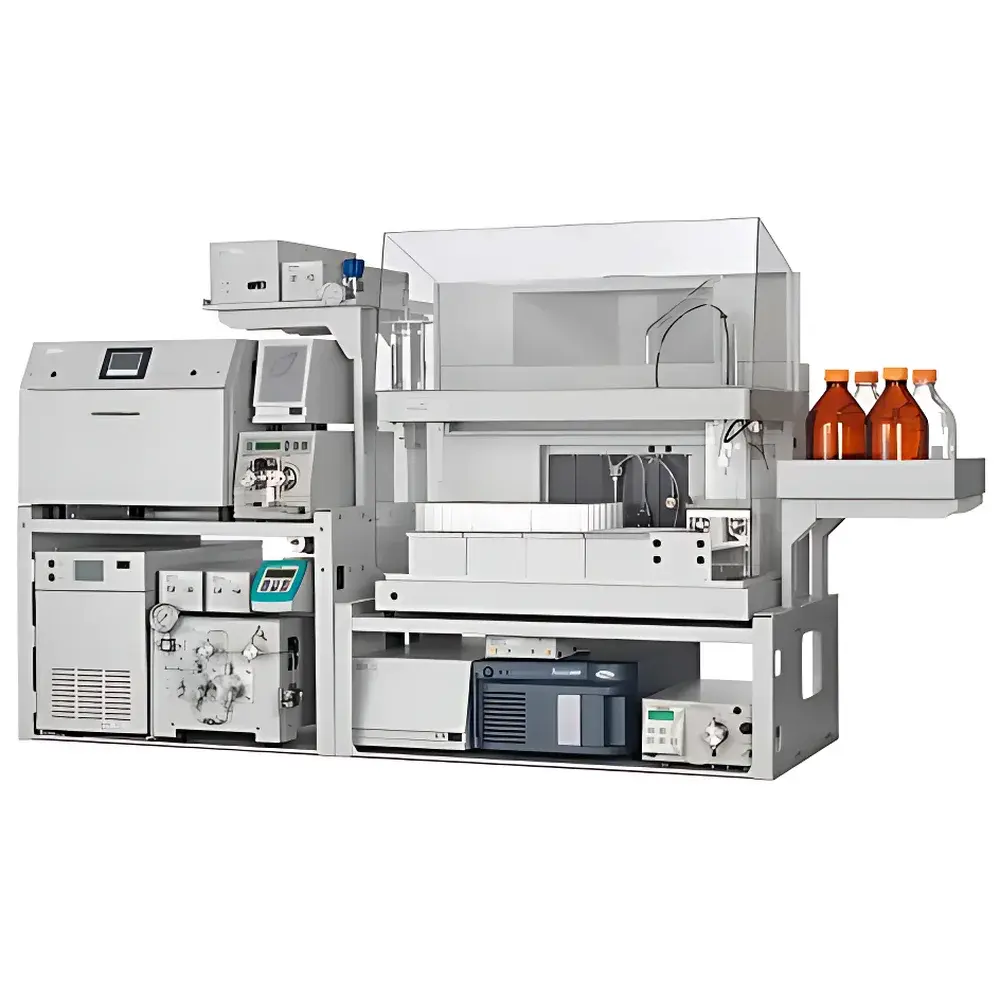
Waters Prep 100q SFC Preparative Supercritical Fluid Chromatography System
| Brand | Waters |
|---|---|
| Origin | USA |
| Model | Prep 100q SFC |
| Application Level | Laboratory Grade |
| Instrument Type | High-Pressure Preparative SFC System |
| Flow Rate Range | Up to 100 mL/min |
| Mobile Phase | CO₂-based supercritical fluid (co-solvent compatible) |
| Fraction Collection | Automated open-loop collection with UV- or MS-triggered modes |
| Compliance | Designed for GLP/GMP-aligned workflows |
| Separation Mode | Chiral and achiral preparative separations |
| Sample Scale | Milligram- to gram-scale purification |
Overview
The Waters Prep 100q SFC is a high-performance preparative supercritical fluid chromatography system engineered for laboratories seeking scalable, environmentally sustainable purification solutions. Unlike conventional preparative liquid chromatography (PLC), the Prep 100q SFC utilizes supercritical carbon dioxide (scCO₂) as the primary mobile phase—offering rapid mass transfer, low viscosity, high diffusivity, and near-zero organic solvent consumption. This physical property profile enables faster elution, sharper peak resolution, and significantly reduced downstream solvent removal burden. The system operates within the supercritical fluid regime (typically >31.1 °C and >73.8 bar for CO₂), where tunable density allows precise control over solvation strength through pressure and temperature modulation. Designed for semi-preparative to preparative throughput (up to 100 mL/min), it bridges the gap between analytical method development and process-scale purification—particularly valuable in pharmaceutical R&D, natural product isolation, and chiral compound refinement.
Key Features
- Proprietary Gas–Liquid Separator (GLS) technology (patent-pending): Enables efficient, real-time CO₂ flash-off and solvent-phase stabilization during open-loop fraction collection—maximizing recovery of volatile and thermally labile compounds without cryogenic trapping or vacuum evaporation.
- Modular architecture: Supports interchangeable detection and collection configurations—including UV-triggered, MS-triggered, or hybrid UV/MS-guided fractionation—ensuring adaptability across diverse purity requirements and compound classes.
- Open-access sample introduction and fraction collection: Accommodates vial-based, rack-based, or loop-injection formats; compatible with standard 13 mm or 16 mm autosampler vials and multi-well plates.
- Integrated back-pressure regulation: Maintains consistent supercritical phase conditions throughout the separation column and post-column flow path, critical for retention time reproducibility and gradient fidelity.
- Robust pressure management: Rated for sustained operation up to 400 bar, supporting high-efficiency columns packed with sub-5 µm particles and enabling high-resolution separations under elevated density conditions.
Sample Compatibility & Compliance
The Prep 100q SFC demonstrates broad compatibility with small-molecule APIs, chiral intermediates, natural product extracts, impurity standards, and compound library members—especially those exhibiting poor solubility or thermal instability in reversed-phase HPLC solvents. Its scCO₂-based methodology aligns with ICH Q5A and USP guidelines for orthogonal purification strategies and supports regulatory submissions requiring green chemistry documentation (e.g., EPA’s Safer Choice criteria). When operated with FractionLynx software, the system provides full electronic record integrity—including user authentication, method versioning, audit trail logging, and electronic signatures—meeting FDA 21 CFR Part 11 and EU Annex 11 requirements for data governance in regulated environments.
Software & Data Management
FractionLynx application software delivers end-to-end workflow automation—from method scouting and gradient optimization to real-time fraction triggering, positional tracking, and post-run report generation. Its method filtering engine allows rapid retrieval of validated protocols from centralized libraries based on compound class, column type, or target resolution criteria. All acquisition parameters, collection events, and detector outputs are time-stamped and stored in a relational database structure, facilitating retrospective analysis, cross-method comparison, and batch traceability. Raw data files conform to Waters’ proprietary .raw format (compatible with Empower and UNIFI platforms), while export options include CSV, PDF, and XML for LIMS integration.
Applications
- Chiral resolution of racemic mixtures using polysaccharide-based or Pirkle-type columns—common in asymmetric synthesis validation and enantiomeric excess determination.
- Purification of synthetic intermediates prior to crystallization or biological assay—reducing carryover of catalysts, ligands, or side-products.
- Isolation of bioactive constituents from plant extracts or fermentation broths—where scCO₂ minimizes oxidative degradation and preserves functional group integrity.
- Rapid cleanup of combinatorial library fractions prior to high-throughput screening—cutting drying time by >80% compared to traditional RP-HPLC workflows.
- Preparative-scale desalting and buffer exchange for peptide and oligonucleotide conjugates—leveraging CO₂’s immiscibility with aqueous phases for gentle phase separation.
FAQ
What types of columns are compatible with the Prep 100q SFC?
Standard 10–30 mm ID preparative columns packed with silica, diol, amino, or chiral stationary phases (e.g., AD-H, AS-H, OD-H, OJ-H) are fully supported. Column oven temperature control (ambient to 80 °C) and active back-pressure regulation ensure optimal performance across varied packing chemistries.
Can the system operate without mass spectrometry?
Yes—the Prep 100q SFC functions independently with UV/Vis detection (200–400 nm range) for wavelength-selective triggering. MS integration is optional and enhances specificity but is not required for routine chiral or achiral purifications.
How does the GLS technology improve recovery yield?
By decoupling CO₂ expansion dynamics from fraction collection mechanics, the GLS prevents aerosol formation and analyte loss during depressurization—enabling quantitative recovery of low-boiling-point compounds (e.g., terpenes, lactones, fluorinated molecules) that would otherwise volatilize or decompose in conventional SFC interfaces.
Is method transfer from analytical SFC possible?
Yes—scaling rules based on constant linear velocity and proportional column volume allow straightforward translation from analytical (4.6 mm ID) to preparative (10–30 mm ID) dimensions, with empirical adjustment of co-solvent gradient slope and flow rate.
What maintenance routines are recommended for long-term reliability?
Daily CO₂ line purging, weekly seal inspection, quarterly pump head cleaning, and annual calibration of pressure transducers and flow sensors are documented in the system’s preventive maintenance guide—aligned with ISO/IEC 17025 laboratory quality standards.





