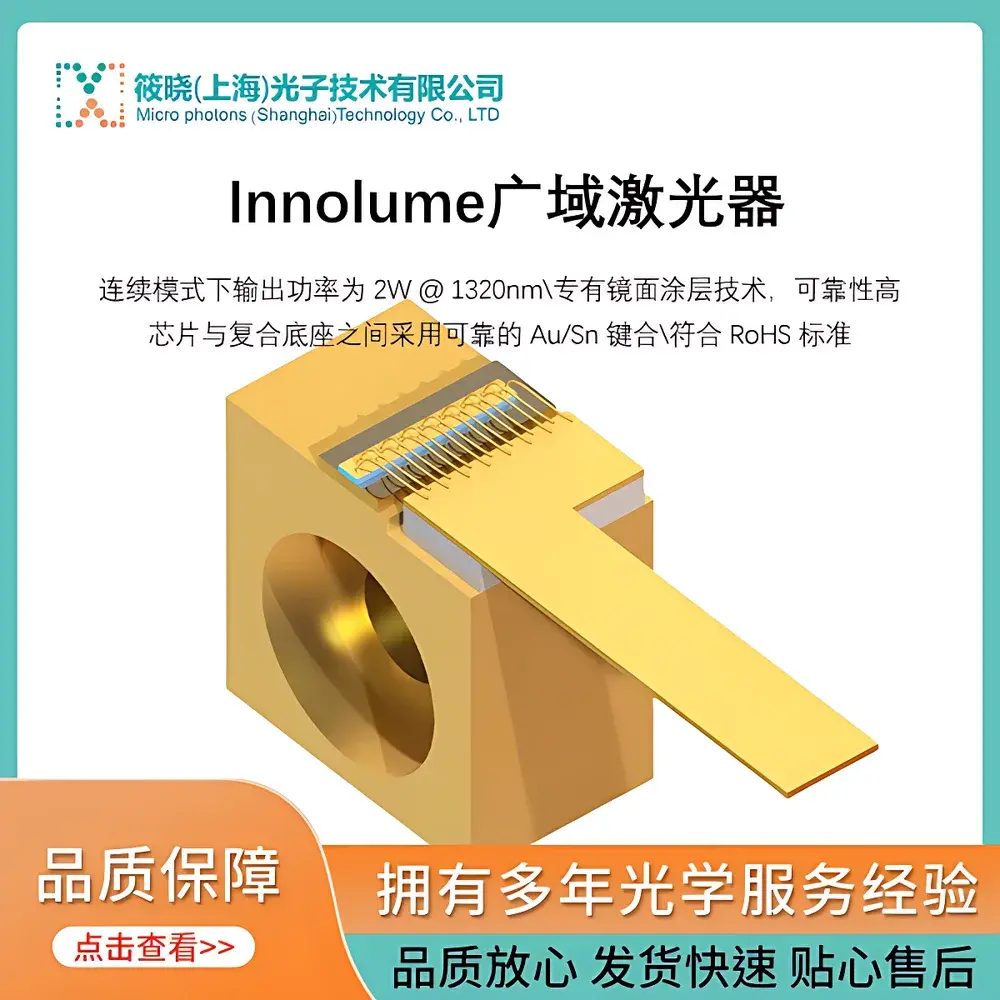
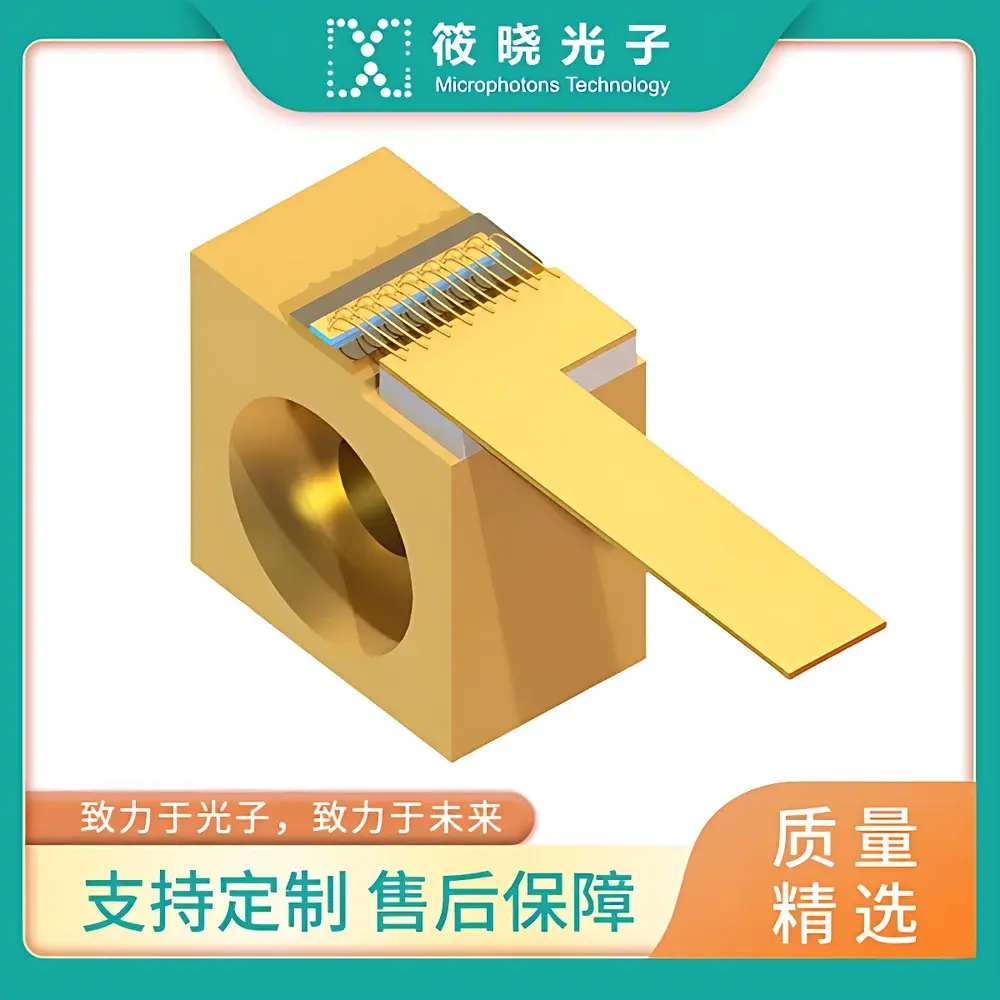
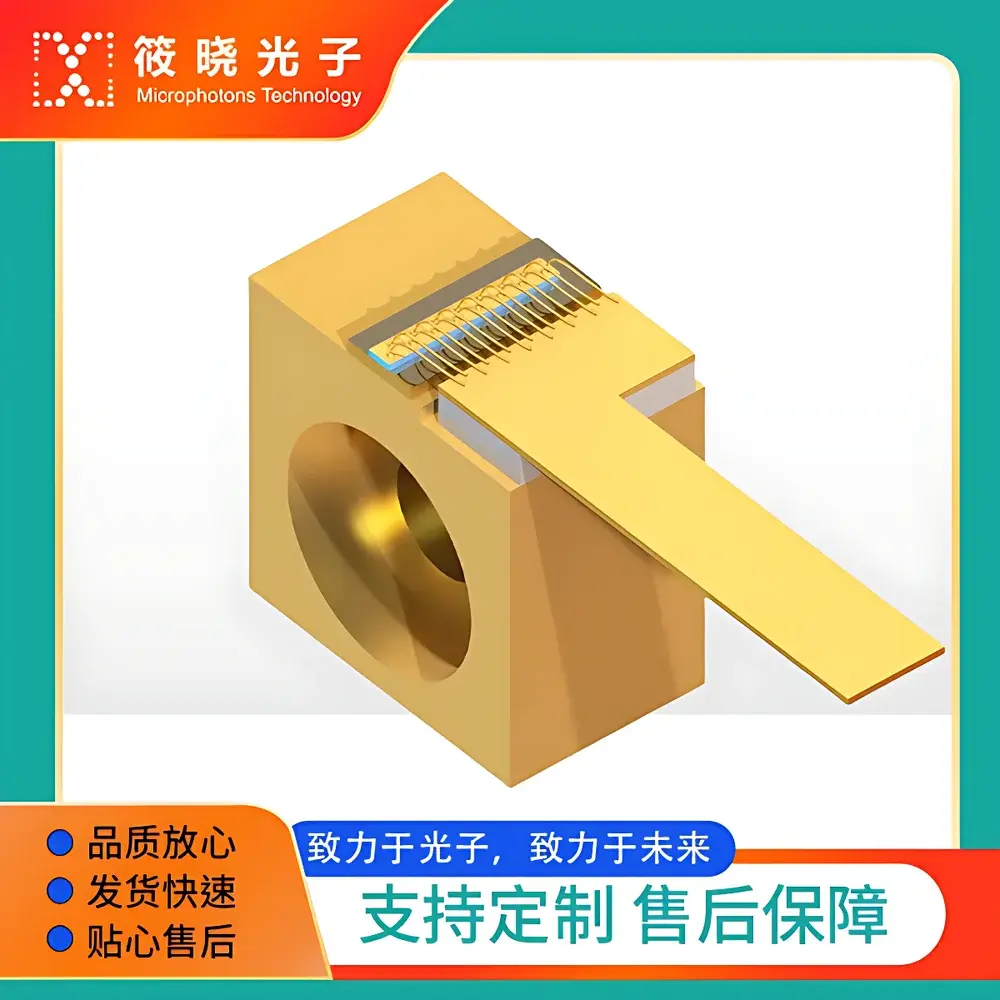
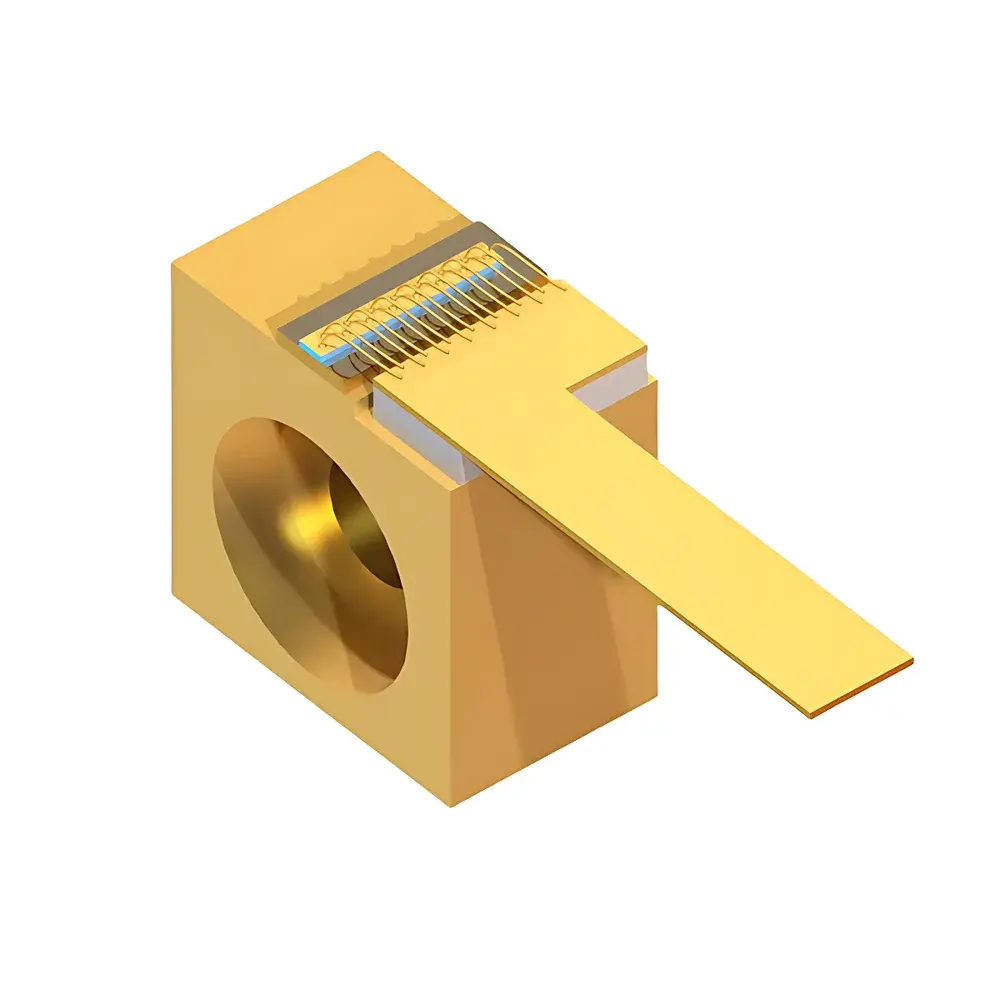
Innolume BAD1180010CM003WXXXX Broad-Area Diode Laser
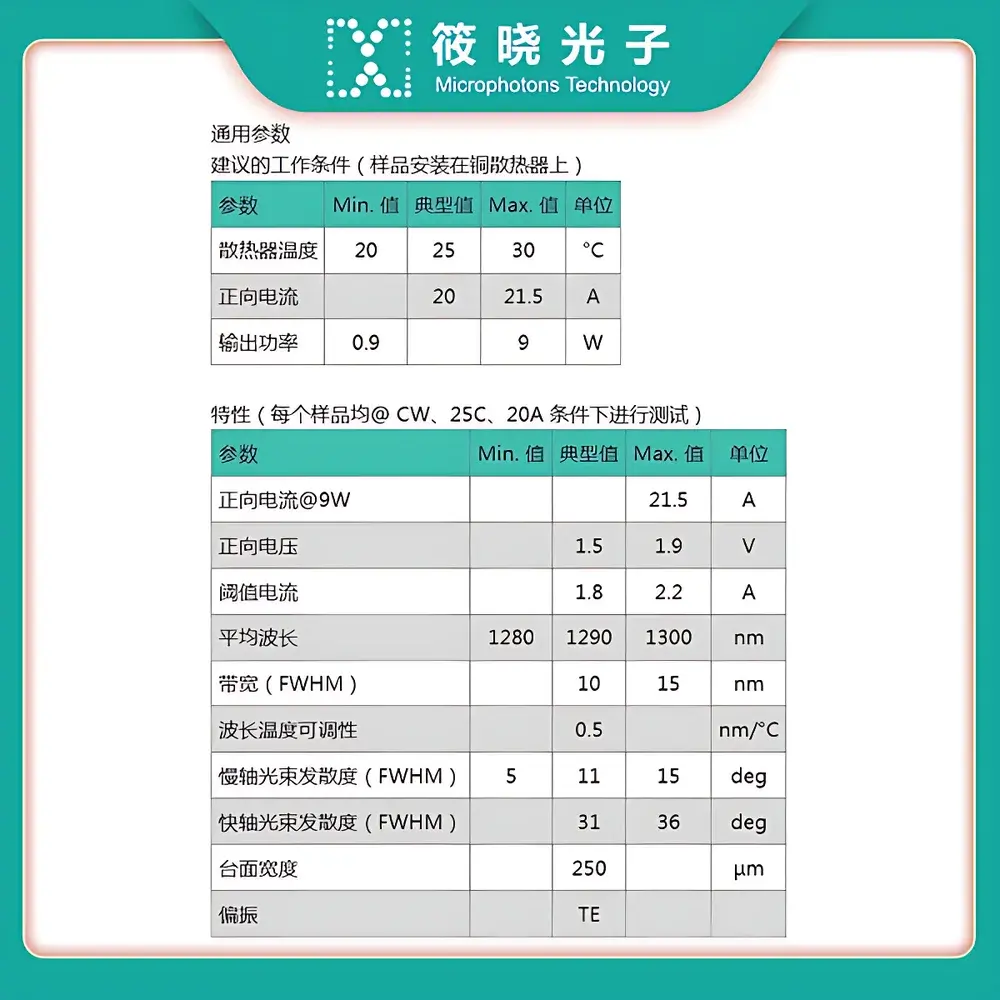
| Brand | Innolume |
|---|---|
| Origin | Germany |
| Model | BAD1180010CM003WXXXX |
| Output Power (CW) | 3 W @ 1180 nm |
| Emission Wavelength | 1170–1190 nm (typ. 1180 nm) |
| Spectral Bandwidth (FWHM) | 10–15 nm |
| Wavelength Tuning Coefficient | 0.5 nm/°C |
| Fast-Axis Divergence (FWHM) | 38–45 deg |
| Slow-Axis Divergence (FWHM) | 4–12 deg |
| Emitter Width | 90 µm |
| Polarization | TE-dominant |
| Forward Voltage | 1.5–1.9 V @ 6 A |
| Threshold Current | 0.5–0.9 A |
| Max. CW Current | 9 A |
| Max. Optical Output Power | 4 W |
| Operating Temperature Range | 5–60 °C (above dew point) |
| Storage Temperature Range | −40–85 °C (above dew point) |
| Bonding | Au/Sn die-attach |
| Mounting | Copper heatsink recommended |
Overview
The Innolume BAD1180010CM003WXXXX is a high-power, broad-area semiconductor diode laser engineered for stable continuous-wave (CW) operation at 1180 nm. Designed using Innolume’s proprietary quantum-well epitaxial structure and advanced facet passivation technology, this device delivers exceptional optical power density and long-term reliability under demanding thermal and electrical conditions. Its emission wavelength resides in the short-wave infrared (SWIR) region—strategically positioned to support applications requiring deep tissue penetration, low water absorption, or compatibility with silicon-based detectors. Unlike conventional edge-emitting lasers optimized for narrow spectral purity, this broad-area emitter prioritizes high radiant flux and robustness over ultra-narrow linewidth, making it suitable for pumping, illumination, and thermal excitation where spectral coherence is secondary to power scalability and operational stability.
Key Features
- 3 W nominal CW output power at 1180 nm when operated at 6 A on a copper heatsink maintained at 25 °C
- Proprietary high-reflectivity/anti-reflectivity (HR/AR) facet coatings engineered for >10,000 hours MTTF under rated conditions
- Au/Sn eutectic bonding between laser chip and submount ensures superior thermal conductivity and mechanical integrity during thermal cycling
- TE-polarized output with >95% polarization extinction ratio across the operating current range
- Controlled wavelength drift of 0.5 nm per degree Celsius, enabling coarse thermal tuning within ±10 nm around the nominal 1180 nm center
- Compliance with EU RoHS Directive 2011/65/EU; lead-free assembly and halogen-free packaging materials
- Defined maximum ratings validated per JEDEC JESD22-A108 stress testing protocols for soldering (250 °C, ≤5 s) and reverse bias (2 V)
Sample Compatibility & Compliance
This laser diode is intended for integration into OEM systems requiring SWIR illumination or pumping sources. It is compatible with standard TO-can, C-mount, or custom micro-optical subassemblies when mounted on thermally conductive substrates such as oxygen-free copper or aluminum nitride. Device qualification includes full environmental stress screening per MIL-STD-883H Method 1015.8 (temperature cycling) and Method 1008.3 (humidity exposure). All units undergo 100% burn-in at 70 °C case temperature for 24 hours prior to shipment. The device meets IEC 60825-1:2014 Class 4 laser safety requirements when properly collimated and enclosed; system-level compliance remains the responsibility of the integrator. No FDA 510(k) or CE medical device certification is provided—end-use regulatory validation must be performed by the final equipment manufacturer.
Software & Data Management
While the BAD1180010CM003WXXXX is a bare die or TO-packaged component without embedded firmware or digital interfaces, its operational parameters are fully characterizable using industry-standard laser diode test systems (e.g., Keysight B1500A, Keithley 2400/2600 series SMUs). Innolume provides comprehensive datasheets including L-I-V curves, spectral plots, near-field/far-field intensity distributions, and thermal resistance metrics (Rth = ΔT / Pdiss) derived from calibrated thermal imaging. Raw test data is delivered in CSV and MATLAB-compatible .mat formats. For traceable calibration and GLP-aligned production environments, users may request NIST-traceable power meter calibration certificates (optional add-on) and full lot-level statistical process control (SPC) reports covering wavelength, threshold current, slope efficiency, and COD (catastrophic optical damage) onset thresholds.
Applications
- Medical Systems: Pump source for thulium-doped fiber lasers used in urology and minimally invasive surgery; tissue coagulation and ablation platforms requiring 1150–1200 nm absorption peaks
- Sensing & Metrology: Gas detection (e.g., CO, NH3, H2O vapor) via tunable diode laser absorption spectroscopy (TDLAS) in open-path or multipass cell configurations
- Scientific Research: Optical parametric oscillator (OPO) pumping, supercontinuum generation in nonlinear fibers, and time-resolved photoluminescence excitation in semiconductor physics labs
- Industrial Processing: Selective heating of polymer films and composites with strong SWIR absorption bands; laser-assisted additive manufacturing preheating stages
FAQ
Is this laser qualified for use in Class I laser systems?
No—this is a Class 4 laser source per IEC 60825-1. Safe integration requires interlocks, beam containment, and administrative controls defined in the end-user system’s laser safety program.
Can the device be operated above 3 W continuously?
The absolute maximum rated optical output is 4 W, but sustained operation beyond 3 W requires active cooling below 20 °C heatsink temperature and derating of forward current to maintain junction temperature below 85 °C.
Does Innolume provide driver reference designs?
Yes—application notes AN-BAD-001 and AN-DRV-004 detail constant-current driver topologies, noise mitigation techniques, and transient suppression circuits optimized for broad-area diodes.
What is the typical slow-axis divergence after fast-axis collimation?
When coupled with a 0.25 NA aspheric lens on the fast axis, residual slow-axis divergence remains 6–10 deg FWHM, necessitating cylindrical correction optics for circularization.
Are wafer-level test reports available?
Lot-specific wafer map data—including binning results for wavelength, threshold, and efficiency—is provided upon request under NDA for volume customers.