
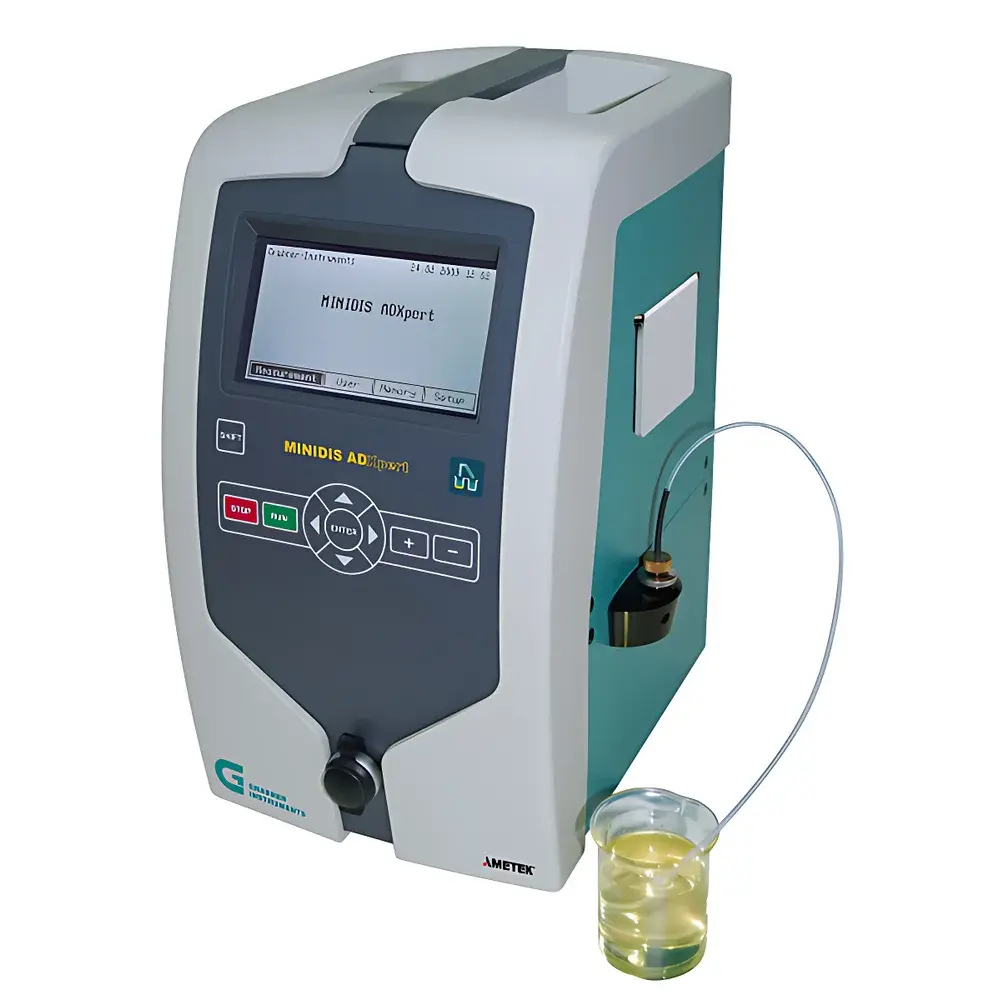
GRABNER MiniDIS ADXpert Automated Micro-Distillation Analyzer
| Brand | GRABNER |
|---|---|
| Origin | Austria |
| Model | MiniDIS ADXpert |
| Temperature Range | 0–400 °C |
| Temperature Accuracy | ±0.1 °C |
| Cold Bath Range | 0–50 °C |
| Distillation Rate | 0–12 mL/min |
| Volume Detection Range | 0–110 mL |
| Volume Resolution | 6 µL |
| Sample Volume | 6 mL |
| Residue Measurement Accuracy | ±0.003 g |
| Dimensions | 200 × 320 × 220 mm |
| Weight | 13 kg |
| Power Supply | 100–240 V AC, 50/60 Hz, 150 W |
| Optional DC Input | 12 V / 10 A |
| Predefined Methods | 10 (ASTM D86 Groups 0–4) |
| Data Storage Capacity | 75 test results |
| Compliance | ASTM D86, ASTM D7344, ISO 3405, IP 123, DIN 51751 |
Overview
The GRABNER MiniDIS ADXpert is an automated micro-distillation analyzer engineered for precise, reproducible, and fully compliant determination of distillation characteristics of petroleum and related liquid hydrocarbons under atmospheric conditions. Based on the fundamental principle of true atmospheric distillation—where vapor pressure equilibration and controlled heating govern phase separation—the MiniDIS ADXpert implements a closed, metal-based distillation cell architecture that eliminates reliance on fragile glassware while maintaining strict adherence to thermodynamic equilibrium requirements defined in ASTM D86 and ASTM D7344. Unlike conventional D86 apparatuses, which require large sample volumes (typically 100 mL), manual assembly, and open-bath cooling, the MiniDIS ADXpert operates with only 6 mL of sample and delivers full distillation curves—including initial boiling point (IBP), 10%, 50%, 90%, and final boiling point (FBP)—in as little as 15 minutes for gasoline-range materials. Its integrated Peltier-cooled condenser, high-resolution volumetric detection system (6 µL resolution), and real-time pressure compensation ensure metrological traceability across volatile and semi-volatile fractions, making it suitable for routine QC, R&D, and field-deployable testing in refinery, pipeline, and mobile laboratory environments.
Key Features
- Fully automated operation: integrated auto-sampling, programmable heating ramp, self-contained cleaning cycle using acetone, and residue quantification via built-in analytical balance (±0.003 g accuracy)
- True atmospheric distillation platform certified to ASTM D7344—the only commercially available instrument meeting this standard for micro-scale distillation
- Robust all-metal distillation chamber eliminating breakage risk, fire hazard, and consumable dependency associated with traditional glass D86 setups
- Compact footprint (200 × 320 × 220 mm) and low power consumption (150 W) enabling benchtop deployment or integration into mobile testing vehicles; optional 12 V DC input supports field use from vehicle batteries
- Ten preconfigured methods aligned with ASTM D86 Groups 0–4, covering gasoline, aviation turbine fuel (Jet A-1), diesel fuels (EN 590), biodiesel blends, solvents, and aromatic hydrocarbons
- Intuitive touchscreen interface with guided workflow navigation—no prior distillation expertise required—and multilingual support (English, German)
- Real-time ambient pressure correction via integrated digital pressure sensor ensures compliance under varying barometric conditions
Sample Compatibility & Compliance
The MiniDIS ADXpert is validated for distillation analysis of light to medium petroleum fractions, including but not limited to: unleaded gasoline (ASTM D439), aviation gasoline (ASTM D910), Jet A/A-1 (ASTM D1655), diesel fuel oils (ASTM D975, EN 590), kerosene (ASTM D3699), biodiesel (ASTM D6751), fatty acid methyl esters (FAME), naphtha, mineral spirits, and contaminated or blended feedstocks. It meets the repeatability (r) and reproducibility (R) criteria specified in ASTM D86, ISO 3405, IP 123, and DIN 51751. As the sole instrument conforming to ASTM D7344—“Standard Test Method for Distillation of Petroleum Products at Atmospheric Pressure Using a Micro Distillation Apparatus”—it provides a scientifically defensible alternative for laboratories seeking reduced sample consumption, enhanced safety, and audit-ready data integrity. All firmware and software modules are designed to support GLP/GMP workflows, with configurable user access levels and electronic signature capability compatible with FDA 21 CFR Part 11 requirements when used with MINIWIN PC software.
Software & Data Management
Control and data acquisition are managed through GRABNER’s MINIWIN PC software, a Windows-based application supporting remote instrument operation, method configuration, real-time monitoring, and LIMS integration via standard RS-232 or USB interfaces. The software enables full audit trail generation—including operator ID, timestamped parameter changes, calibration events, and raw volume/temperature datasets—with export options to CSV, PDF, and XML formats. Up to 75 complete distillation reports can be stored internally, each containing full curve data, statistical summaries (e.g., r/R values against reference standards), and pass/fail flags relative to specification limits. Custom endpoint definitions (e.g., T95.5 or T99.2) are programmable per method, allowing alignment with internal product specifications or regulatory thresholds beyond standard D86 cut points. Data encryption, backup scheduling, and role-based permissions further enhance data governance for regulated environments.
Applications
This analyzer serves critical functions across upstream, midstream, and downstream petroleum operations. In refinery process control labs, it verifies fractionation efficiency and blendstock conformity in real time. Pipeline quality assurance teams deploy it for rapid verification of custody transfer samples—reducing hold times and minimizing off-spec shipments. Mobile laboratories utilize its portability and low-power profile to conduct on-site testing at terminals, depots, or remote well sites. Research institutions apply it to characterize novel biofuels and synthetic hydrocarbons where small sample availability and thermal stability constraints limit applicability of classical D86 systems. Its ability to resolve end-points for heavy ends—including residual material quantification—also supports evaluation of fouling propensity and thermal degradation behavior in lubricants and cracked stocks.
FAQ
Does the MiniDIS ADXpert replace ASTM D86 testing entirely?
Yes—when operated according to its validated methods and calibrated per GRABNER’s protocol, it delivers results statistically equivalent to D86 for Groups 0–4, satisfying regulatory acceptance criteria in most jurisdictions.
Can it analyze highly viscous or residuum-containing samples?
It is optimized for distillates up to Group 4 (diesel range); samples with significant residue (>10% vol) or high carbon residue may require pre-filtration or dilution to avoid clogging the metallic distillation path.
Is method validation required before regulatory submission?
Laboratories must perform in-house verification per ASTM D6299 or ISO/IEC 17025, including bias assessment against certified reference materials and precision studies—GRABNER provides documentation templates and CRM recommendations.
How often does the system require maintenance?
No routine mechanical servicing is needed; only periodic cleaning of the condenser surface and replacement of disposable metal sample cups (cost-effective, non-fragile) every 50–100 runs.
Is remote diagnostics supported?
Yes—MINIWIN includes diagnostic logging and firmware update capability over network connection, with optional GRABNER technical support portal access for troubleshooting assistance.





