FieldLab 58C Portable On-Site Oil Condition Monitoring System
| Brand | Spectro Scientific |
|---|---|
| Origin | USA |
| Model | FieldLab 58C |
| Product Type | Portable Instrument |
| Detection Modules | XRF Elemental Analysis |
| Test Time per Sample | <10 minutes |
| Sample Volume Required | 12 mL |
| Compliance | ASTM D6595, D7690, D7883, D445 |
| Interface | Touchscreen with Embedded Diagnostic Software |
| Power | Rechargeable Battery |
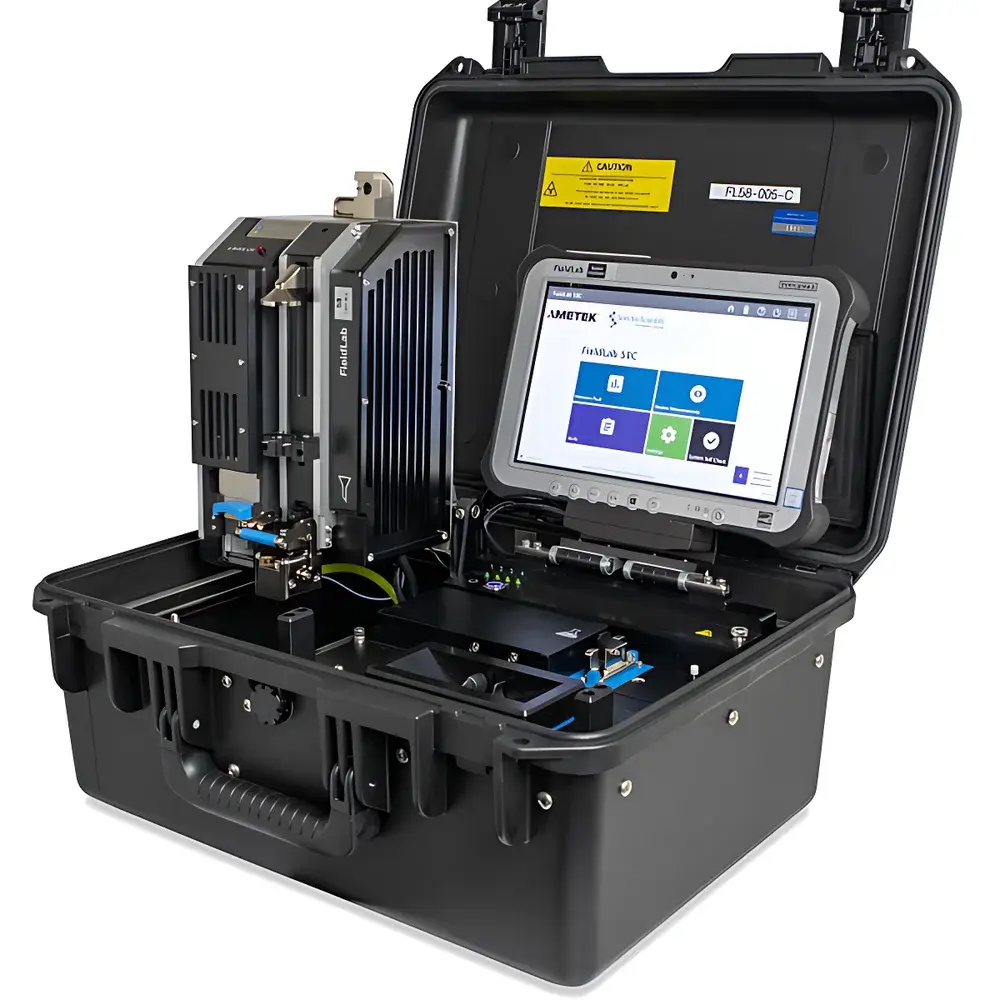
| Enclosure | Ruggedized Transport Case Integrating All Four Modules |
Overview
The FieldLab 58C Portable On-Site Oil Condition Monitoring System is an integrated, battery-powered analytical platform engineered for real-time lubricant condition assessment directly at the point of use—whether on a wind turbine nacelle, marine engine room, or remote mining equipment site. Unlike traditional lab-based oil analysis workflows that introduce delays of days or weeks, the FieldLab 58C employs four complementary, ASTM-compliant analytical modules within a single ruggedized transport case to deliver comprehensive fluid health data in under ten minutes. Its core architecture is grounded in established physical measurement principles: energy-dispersive X-ray fluorescence (EDXRF) for elemental wear metal and additive quantification; differential pressure across a calibrated microfilter membrane for ISO 4406–equivalent particle counting; Fourier-transform infrared (FTIR) spectroscopy for oxidation, nitration, sulfation, glycol contamination, and soot estimation; and capillary viscometry for kinematic viscosity at 40 °C per ASTM D445. This multi-parameter fusion enables early detection of incipient failure modes—including abnormal wear, contamination ingress, thermal degradation, and viscosity drift—supporting predictive maintenance strategies aligned with ISO 55000 and SAE JA1011 frameworks.
Key Features
- Four-in-one modular design housed in a single IP65-rated transport case, enabling rapid deployment without external power or consumables.
- Battery-operated operation (up to 8 hours continuous use), eliminating dependency on site AC infrastructure or generator support.
- No solvents, reagents, or calibration oils required—minimizing operational cost, hazardous waste generation, and regulatory handling burdens.
- Touchscreen interface with embedded guidance videos, context-sensitive help, and step-by-step test sequencing to reduce operator training time and inter-user variability.
- Automated diagnostic engine applying rule-based logic and trend-aware algorithms to generate actionable maintenance recommendations—not just raw data.
- User-configurable alarm thresholds aligned with OEM specifications or internal asset criticality matrices; supports custom limit sets per equipment type, lubricant grade, and service history.
- Onboard storage for >10,000 test records with full audit trail, including operator ID, timestamp, GPS coordinates (optional), and instrument calibration status.
Sample Compatibility & Compliance
The FieldLab 58C is validated for use with mineral, synthetic, and semi-synthetic lubricants across hydraulic fluids, turbine oils, gear oils, engine oils, and compressor lubricants. Each module adheres to recognized international standards: EDXRF performance conforms to ASTM D6595 for wear metal analysis; particle counting meets ASTM D7690 for membrane-based particulate quantification; FTIR methodology follows ASTM D7883 for oxidative degradation metrics; and viscosity measurements comply strictly with ASTM D445. The system supports GLP-compliant data integrity through electronic signatures, user access controls, and tamper-evident audit logs—fully compatible with FDA 21 CFR Part 11 requirements when deployed in regulated manufacturing environments. All firmware and software updates are version-controlled and traceable, facilitating GMP-aligned validation protocols.
Software & Data Management
The embedded FieldLab OS includes a purpose-built oil diagnostics suite supporting offline report generation, historical trend visualization, and cross-fleet comparison. Reports export in PDF and CSV formats, embedding diagnostic conclusions, severity ratings (e.g., “Critical Wear Detected in Journal Bearings”), and prescriptive actions (e.g., “Inspect filter housing for bypass seal integrity”). Data synchronization occurs via secure Wi-Fi or USB to Spectro’s cloud-based FleetSight™ platform, enabling centralized fleet-wide analytics, automated KPI dashboards, and integration with CMMS/EAM systems via RESTful API. All diagnostic logic is transparent and configurable—users may modify decision trees, add new failure mode signatures, or import OEM-specific alert rules without requiring vendor intervention.
Applications
- Condition-based monitoring of rotating machinery in power generation (gas/steam turbines, generators, transformers).
- Preventive maintenance of off-highway equipment (hydraulic excavators, drilling rigs, haul trucks) operating in arid or sub-zero environments.
- Marine propulsion and auxiliary systems where port turnaround time constraints preclude off-site lab submission.
- Aerospace ground support equipment requiring rapid turnaround between flight cycles.
- Wind farm operations where tower climbs must be minimized and diagnostic certainty maximized before dispatching technicians.
- Third-party oil analysis service providers offering on-site triage and tiered reporting (field-level summary + lab-confirmed validation).
FAQ
Does the FieldLab 58C require annual recalibration by the manufacturer?
No—each module features self-diagnostic routines and reference standard checks performed automatically prior to every test sequence. Full metrological verification is recommended every 12 months or after 500 tests, using NIST-traceable calibration kits supplied by Spectro.
Can test data be exported to SAP PM or IBM Maximo?
Yes—via native CSV export or through FleetSight™’s certified EAM connectors supporting direct bidirectional sync with SAP PM, IBM Maximo, Infor EAM, and UpKeep.
Is the system suitable for use in explosive atmospheres (ATEX/IECEx zones)?
The base FieldLab 58C is rated for general industrial use (UL 61010-1). For Zone 1/21 applications, Spectro offers an ATEX-certified variant (FieldLab 58C-ATEX) with intrinsically safe power management and explosion-proof enclosure options.
How does the system handle water contamination detection?
While not a dedicated Karl Fischer module, the FTIR engine detects free and emulsified water above 100 ppm via characteristic O–H stretch absorbance at 3400 cm⁻¹, with quantification traceable to ASTM D7883 Annex A2.
What is the minimum detectable particle size in the filter membrane module?
The differential pressure method provides cumulative counts for particles ≥4 µm(c) and ≥6 µm(c), reported in accordance with ISO 4406:2017 coding conventions.