
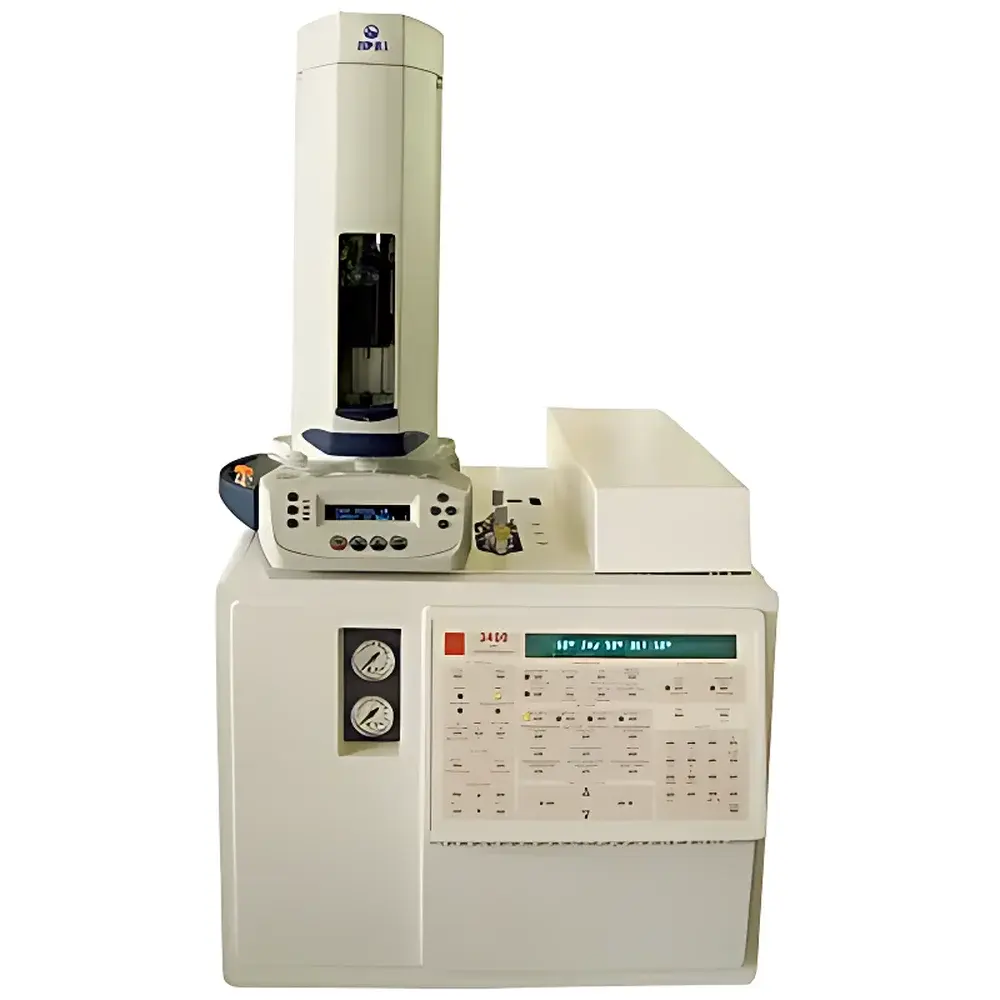
Beifen Ruili SP3400 Gas Chromatograph
| Brand | Beifen Ruili |
|---|---|
| Origin | Beijing, China |
| Model | SP3400 |
| Temperature Control Range | Ambient +12 °C to 420 °C |
| Maximum Oven Ramp Rate | >33 °C/min (100 °C to 200 °C in <3 min) |
| Injector Max Operating Temperature | 420 °C |
| Injector Pressure Setting Range | 0–0.6 MPa |
| Detector Options | TCD, FID, ECD, FPD, TSD |
| Injector Types | Packed Column Injector, Split/Splitless Capillary Injector |
| Method Storage Capacity | 4 methods |
| Compliance | Designed to meet ISO/IEC 17025 operational prerequisites for routine GC analysis |
Overview
The Beifen Ruili SP3400 Gas Chromatograph is a benchtop analytical instrument engineered for precision separation and quantitative detection of volatile and semi-volatile organic compounds. Based on technology originally developed by Varian, Inc. (now part of Agilent Technologies), the SP3400 implements robust gas chromatographic principles—employing temperature-programmed capillary or packed column separation coupled with selective detector response—to deliver high reproducibility in routine laboratory environments. Its modular architecture supports configurable detector and inlet combinations, enabling method flexibility across diverse sample matrices without hardware reconfiguration. The system operates under controlled carrier gas flow dynamics (pressure-regulated mode), with oven temperature programmability optimized for resolution-critical applications in environmental monitoring, petrochemical QA/QC, pharmaceutical impurity profiling, and public health laboratories.
Key Features
- Microprocessor-controlled operation with full keypad interface and real-time status display—eliminating dependency on external PCs for basic acquisition and method execution.
- Comprehensive self-diagnostic subsystem continuously monitors critical parameters including oven temperature stability, detector baseline drift, injector pressure integrity, and power supply voltage; faults are reported with contextual guidance for rapid troubleshooting.
- Programmable detector settings—including range scaling and attenuation time constants—allow optimization of signal-to-noise ratio for trace-level analytes without manual hardware adjustment.
- Automated valve sequencing and detector signal routing enable unattended multi-dimensional or heart-cutting GC configurations, supporting complex mixture analysis workflows such as hydrocarbon group-type analysis or pesticide residue screening.
- Integrated safety protocols include thermal cut-off protection for TCD filaments during carrier gas failure, over-temperature shutdown for both oven and injector zones, and photomultiplier tube (PMT) shielding logic for FPD to prevent damage from ambient light exposure.
- Onboard non-volatile memory stores up to four complete analytical methods—including temperature ramps, detector parameters, and valve timing schedules—enabling immediate recall and execution without software reloading.
Sample Compatibility & Compliance
The SP3400 accommodates a broad spectrum of sample types through interchangeable inlet modules: a packed-column injector for legacy method compatibility and a split/splitless capillary inlet for high-resolution, low-injection-volume applications. Compatible with standard 0.25–0.53 mm ID fused-silica columns and common carrier gases (He, H2, N2), the system meets foundational requirements for ASTM D3606 (gasoline aromatics), EPA Method 8021B (halogenated organics), and USP (chromatography general chapter). While not pre-certified for 21 CFR Part 11, its audit-trail-capable firmware architecture supports implementation of GLP/GMP-compliant data handling when integrated with validated third-party LIMS or CDS platforms.
Software & Data Management
Data acquisition and reporting are performed via embedded firmware with ASCII-exportable peak tables and chromatogram plots (CSV and BMP formats). Raw signal files retain timestamped detector voltage traces at 10 Hz sampling rate, permitting post-run integration parameter optimization. For regulated environments, the instrument’s deterministic control loop design ensures consistent retention time repeatability (<0.02 min RSD, n=10) and peak area precision (<1.5% RSD), fulfilling minimum performance criteria outlined in ISO 17025 Clause 7.7 for equipment verification. Optional RS-232 or USB-to-serial interfaces allow connection to validated chromatography data systems compliant with FDA 21 CFR Part 11 requirements.
Applications
- Petrochemical analysis: Hydrocarbon type distribution (PIONA), benzene/toluene/xylenes (BTX) quantification, and sulfur compound profiling in fuels.
- Environmental testing: Detection of chlorinated pesticides (e.g., DDT, endosulfan), PCB congeners, and volatile organic compounds (VOCs) in soil and water extracts per EPA SW-846 methods.
- Pharmaceutical quality control: Residual solvent analysis (ICH Q3C), assay purity assessment, and extractables/leachables screening in packaging validation studies.
- Public health surveillance: Screening of toxic industrial chemicals (TICs) and chemical warfare agent degradation products in clinical or field-deployable labs.
- Academic research: Method development for novel stationary phases, kinetic studies of thermal degradation pathways, and coupling with pyrolysis or headspace samplers.
FAQ
Does the SP3400 support electronic pressure control (EPC)?
No—the SP3400 uses mechanical pressure regulation via adjustable inlet pressure setpoints (0–0.6 MPa); it does not incorporate solenoid-valve-based EPC modules.
Can the system be operated under GLP conditions?
Yes—when paired with a validated chromatography data system (CDS) and documented procedures, the SP3400 satisfies core instrumentation requirements for GLP compliance, including calibration traceability, method version control, and raw data integrity.
What is the maximum allowable ramp rate for temperature programming?
The oven achieves ≥33 °C/min between 100 °C and 200 °C, with typical maximum programmed ramp rates up to 40 °C/min depending on column dimensions and carrier gas velocity constraints.
Is remote monitoring or network connectivity available?
Not natively—the SP3400 lacks built-in Ethernet or Wi-Fi; however, serial communication (RS-232) enables integration into centralized lab networks via protocol-bridging hardware or middleware.
Which detectors require additional gas supplies beyond carrier gas?
FID requires hydrogen and synthetic air; FPD requires hydrogen and oxygen or air; TSD (thermionic specific detector) requires hydrogen and air. All auxiliary gas lines are equipped with stainless-steel regulators and flow meters calibrated per manufacturer specifications.




