
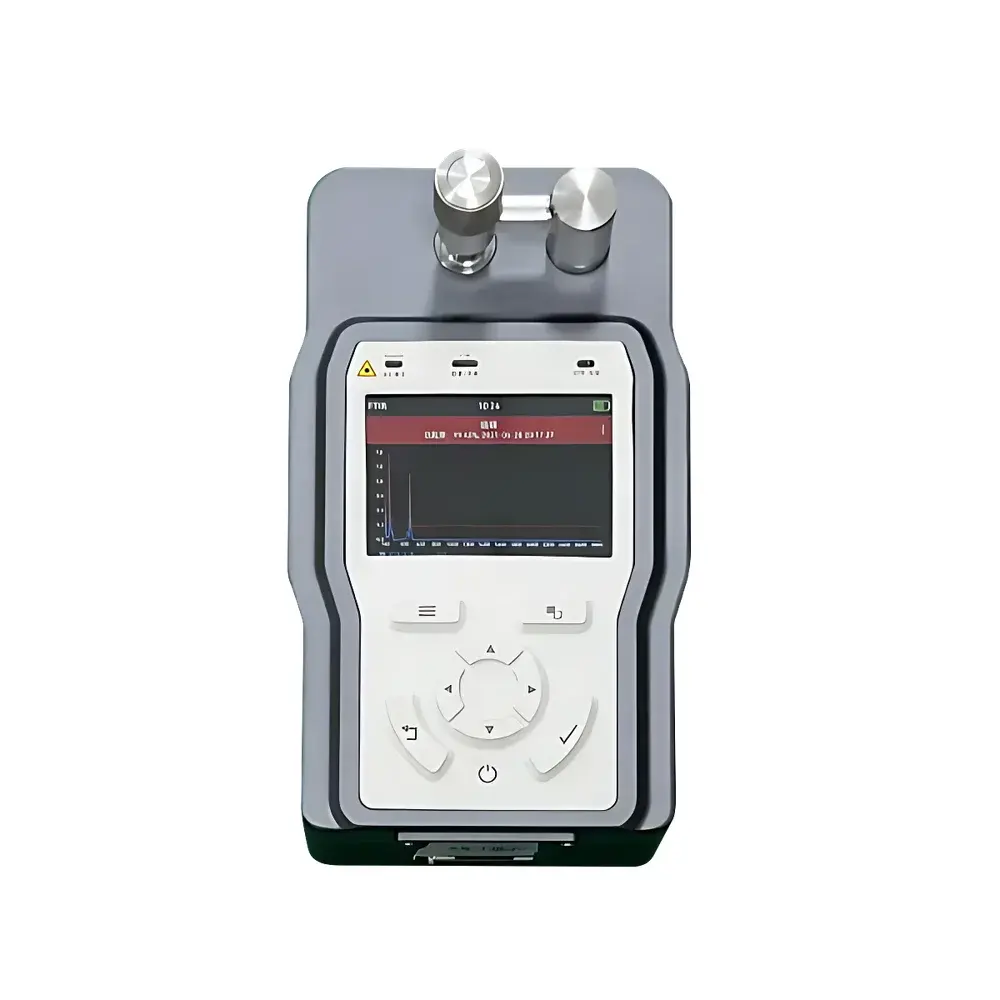
Beifen Ruili FR60 Portable FTIR-Raman Hybrid Spectrometer
| Brand | Beifen Ruili |
|---|---|
| Origin | Beijing, China |
| Model | FR60 |
| Instrument Type | Portable Hybrid FTIR-Raman Spectrometer |
| IR Wavenumber Range | 4200–650 cm⁻¹ |
| Raman Wavenumber Range | 175–2800 cm⁻¹ |
| IR Resolution | < 4 cm⁻¹ |
| Raman Resolution | < 10 cm⁻¹ |
| Scan Speed | Full-spectrum acquisition in ≤ 5 seconds |
| Signal-to-Noise Ratio (SNR) | > 2000:1 (IR, 100 scans) |
| Wavenumber Accuracy | < ±0.1 cm⁻¹ at 2000 cm⁻¹ |
Overview
The Beifen Ruili FR60 Portable FTIR-Raman Hybrid Spectrometer is an integrated, field-deployable analytical instrument engineered for rapid, non-destructive molecular identification of unknown substances under operational constraints. It combines two complementary vibrational spectroscopic modalities—Fourier Transform Infrared (FTIR) spectroscopy and dispersive Raman spectroscopy—within a single handheld platform. FTIR detects absorption transitions arising from changes in molecular dipole moment, while Raman spectroscopy measures inelastic scattering induced by polarizability changes. This dual-mode architecture enables orthogonal verification of spectral signatures, significantly enhancing confidence in qualitative identification—particularly for structurally similar compounds, mixtures, or materials with overlapping IR/Raman activity. Designed for real-time decision support in time-critical environments, the FR60 operates without sample preparation, supports ambient-light operation, and delivers full-spectrum acquisition in under five seconds. Its optical path is sealed and purged to minimize atmospheric CO₂/H₂O interference, ensuring stable baseline performance across variable environmental conditions.
Key Features
- True hybrid design: Simultaneous FTIR and Raman excitation/detection pathways with shared sample interface and synchronized data acquisition
- Compact, ergonomic handheld form factor (≤ 1.8 kg) with integrated battery providing ≥ 4 hours continuous operation
- Dual-wavelength laser excitation (785 nm for Raman; broadband thermal source for FTIR) with automatic power regulation and safety interlocks compliant with IEC 60825-1 Class 1
- Thermoelectrically cooled MCT detector (FTIR) and back-illuminated CCD (Raman) for high sensitivity and low dark current
- Onboard spectral library search engine supporting > 25,000 reference spectra (including narcotics, explosives, chemical warfare agents, pharmaceuticals, and industrial chemicals)
- Automatic mixture deconvolution algorithm capable of resolving and identifying ≥ 3 co-present components in heterogeneous samples (e.g., powders, gels, tablets, residues)
Sample Compatibility & Compliance
The FR60 accommodates diverse physical states—including solids, crystalline powders, liquids, pastes, gels, and thin films—without contact or dilution. Reflectance (ATR-free) and diffuse reflectance modes enable direct analysis of opaque or irregular surfaces. The system complies with ISO/IEC 17025:2017 general requirements for competence of testing and calibration laboratories, and its spectral data output meets ASTM E1421–22 standard practice for describing and exchanging infrared spectral data. Instrument firmware and embedded software adhere to FDA 21 CFR Part 11 requirements for electronic records and signatures, including audit trail logging, user access control, and data integrity safeguards. All spectral libraries are curated against NIST SRM references and validated per USP guidelines for vibrational spectroscopic identification.
Software & Data Management
The FR60 runs Beifen Ruili’s proprietary SpectraField™ v3.2 software, deployed on an embedded Linux OS with real-time kernel optimization. Data acquisition, preprocessing (baseline correction, vector normalization, Savitzky-Golay smoothing), library matching (using correlation coefficient, Euclidean distance, and spectral residual metrics), and mixture analysis occur locally—no cloud dependency or external PC required. Spectral files are exported in JCAMP-DX v6 format with embedded metadata (instrument parameters, operator ID, GPS coordinates, timestamp, environmental conditions). Encrypted SD card storage ensures chain-of-custody integrity. Remote firmware updates and library expansions are supported via secure HTTPS protocol with certificate-based authentication.
Applications
- Border security and customs inspection: Rapid screening of parcels, cargo, and personal effects for illicit drugs, precursors, and hazardous materials
- Law enforcement and forensic response: On-scene identification of unknown white powders, suspicious residues, or clandestine lab materials
- Military CBRN defense: Field verification of chemical agent simulants, degradation products, and decontamination efficacy
- Fire investigation: Detection of accelerants, polymer additives, and combustion by-products in fire debris
- Pharmaceutical quality control: Verification of raw material identity and detection of counterfeits during supply chain audits
- Hazardous materials response (HAZMAT): Identification of unknown industrial chemicals in spill or leak scenarios without exposure risk
FAQ
Does the FR60 require routine calibration with external standards?
No—built-in reference interferograms (for FTIR) and silicon Raman peak (520.7 cm⁻¹) serve as internal wavelength and intensity calibrants. Daily verification is automated during startup.
Can the instrument distinguish between enantiomers or polymorphs?
While not inherently chiral-sensitive, the FR60 can differentiate polymorphic forms via distinct lattice vibration patterns in low-frequency Raman (< 200 cm⁻¹) and far-IR regions when coupled with appropriate sampling geometry.
Is spectral data export compatible with third-party chemometric platforms?
Yes—JCAMP-DX v6 files are natively readable by Unscrambler X, MATLAB, Python (SciPy/NumPy), and commercial LIMS systems supporting ASTM E131-compliant import protocols.
What environmental operating conditions are supported?
Operating temperature range: −10 °C to +50 °C; relative humidity: 10–90% non-condensing; IP54-rated enclosure for dust and splash resistance.
How is data integrity maintained during forensic use?
All acquisitions generate SHA-256 hashes, digitally signed timestamps, and immutable audit logs traceable to individual user credentials—fully aligned with ISO/IEC 17025 and EN 17025-1 forensic evidence handling requirements.





