
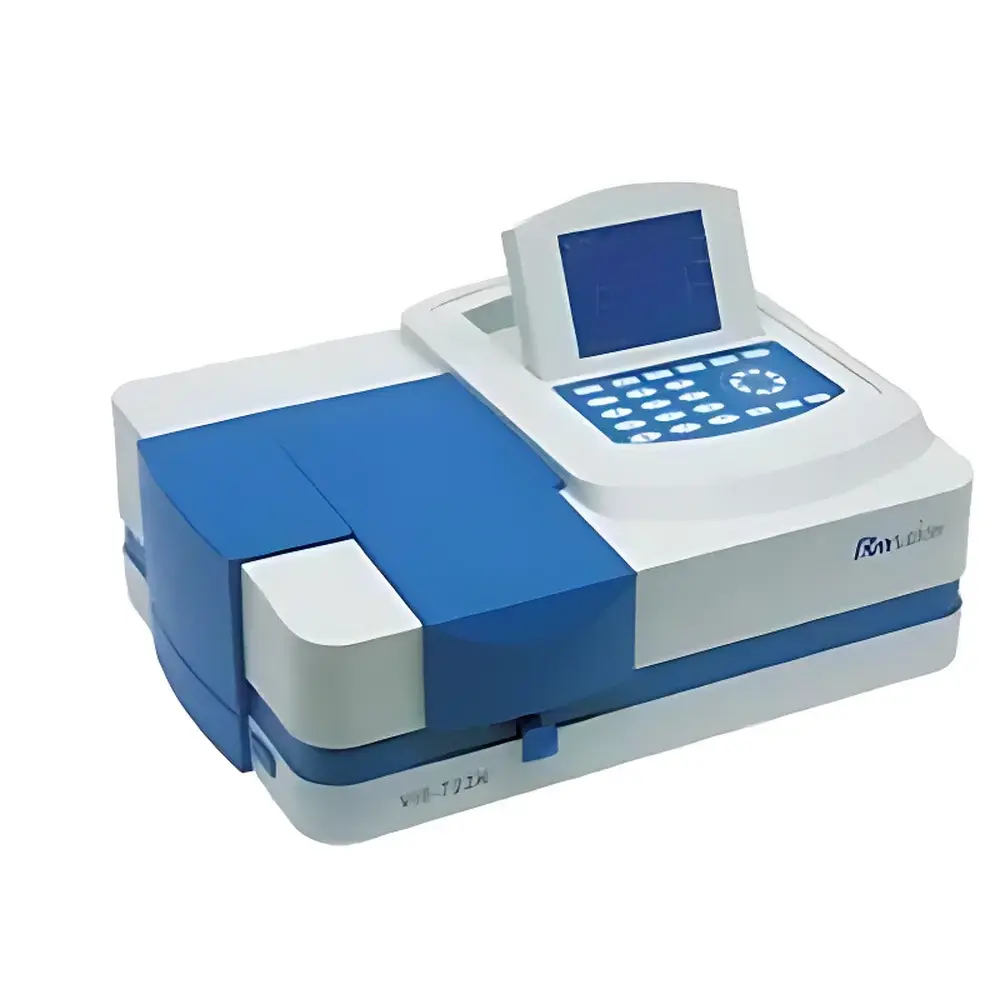
Beifen Ruili VIS-723N Visible Spectrophotometer
| Brand | Beifen Ruili |
|---|---|
| Origin | Beijing, China |
| Model | VIS-723N |
| Optical System | Single-beam |
| Detector | Silicon photodiode array |
| Wavelength Range | 320–1100 nm |
| Wavelength Accuracy | ±0.5 nm |
| Spectral Bandwidth | 1.0, 2.0, or 5.0 nm (user-selectable fixed settings) |
| Stray Light | ≤0.05% T (at 220 nm using NaI solution |
| Wavelength Scanning | Motorized automatic wavelength drive |
| Dimensions | 530 × 420 × 205 mm |
| Weight | 18 kg |
| Power Supply | AC 220 V/50 Hz or 110 V/60 Hz |
| Power Consumption | 140 W |
| Interface Options | RS-232 (RS-485 and USB available on request) |
| Data Storage | Non-volatile memory for method parameters and measurement results |
Overview
The Beifen Ruili VIS-723N Visible Spectrophotometer is a precision single-beam optical instrument engineered for quantitative and qualitative analysis in the visible and near-ultraviolet spectral region (320–1100 nm). It operates on the fundamental principle of Beer–Lambert law-based absorbance measurement, where sample-induced attenuation of monochromatic light is correlated to analyte concentration and path length. Designed for routine laboratory use across academic, industrial, and regulatory environments, the VIS-723N delivers stable photometric performance with traceable wavelength accuracy (±0.5 nm) and low stray light (<0.05% T), ensuring compliance with basic spectrophotometric validation requirements outlined in pharmacopoeial standards including USP and EP 2.2.25.
Key Features
- Fixed-slit spectral bandwidth selection: 1.0 nm, 2.0 nm, and 5.0 nm — pre-aligned at factory to meet application-specific resolution needs, including those specified in Chinese Pharmacopoeia (ChP) and USP monographs for assay and dissolution testing.
- Motorized automatic wavelength scanning mechanism enables reproducible spectral acquisition without manual adjustment, supporting both discrete point measurements and continuous scan profiles.
- Optimized Czerny–Turner monochromator architecture with imported tungsten-halogen lamp and silicon photodiode array detector ensures high signal-to-noise ratio and long-term photometric stability.
- Large-capacity four-position sample holder accommodating cuvettes up to 100 mm path length — ideal for low-absorbance measurements, turbid suspensions, or specialized flow-through cells.
- Integrated non-volatile memory retains calibration parameters, user-defined methods, and measurement history across power cycles — critical for GLP-compliant documentation and audit readiness.
- Standard RS-232 serial interface supports bidirectional communication with external PCs; optional RS-485 and USB interfaces facilitate integration into centralized lab data management systems.
Sample Compatibility & Compliance
The VIS-723N accepts standard 10 mm square quartz or glass cuvettes, as well as custom macro-cells (up to 100 mm path length) for applications requiring extended optical paths or minimal dilution. Its optical design minimizes polarization effects and beam deviation, enabling reliable measurements of colored solutions, enzymatic reaction mixtures, dye formulations, and colloidal suspensions. While not certified for FDA 21 CFR Part 11 compliance out-of-the-box, the instrument’s parameter retention, method locking capability, and timestamped data output provide foundational support for GMP/GLP workflows when deployed with validated third-party software and procedural controls.
Software & Data Management
The VIS-723N operates via front-panel keypad and LCD display for standalone operation. For enhanced functionality, optional PC-based control software provides full remote operation—including wavelength scanning, kinetic time-course acquisition, multi-wavelength quantitation, and derivative spectroscopy (1st–3rd order). All acquired spectra and numerical results are exportable in CSV format for post-processing in Excel, MATLAB, or statistical analysis platforms. Audit-trail functionality (e.g., operator ID tagging, change logs) requires configuration through supplementary software modules aligned with ISO/IEC 17025 documentation practices.
Applications
- Pharmaceutical quality control: Active pharmaceutical ingredient (API) assay, excipient compatibility screening, and dissolution profile monitoring per ChP/USP guidelines.
- Environmental testing: Quantification of nitrate, phosphate, silicate, and heavy metal complexes (e.g., Fe²⁺/1,10-phenanthroline) in water samples.
- Food and beverage analysis: Colorimetric determination of antioxidants (e.g., polyphenols via Folin–Ciocalteu), preservatives (sulfites), and enzymatic activity (e.g., glucose oxidase assays).
- Academic teaching laboratories: Fundamental instruction in spectroscopic principles, calibration curve construction, and error propagation analysis.
- Clinical and public health labs: Hemoglobin estimation, bilirubin quantification, and ELISA endpoint reading in resource-constrained settings.
FAQ
Is the VIS-723N compliant with USP or EP requirements for spectrophotometer qualification?
Yes — its wavelength accuracy (±0.5 nm), stray light performance (≤0.05% T), and selectable 1.0 nm bandwidth enable it to satisfy the system suitability criteria defined in USP and EP 2.2.25 for routine absorbance measurements.
Can the instrument perform kinetic measurements over time?
Yes — the built-in time-scan mode allows sequential absorbance recording at fixed or variable intervals, supporting enzyme kinetics, reaction rate studies, and stability testing protocols.
What types of cuvettes are supported?
Standard 10 mm path-length quartz, glass, or plastic cuvettes; additionally, the four-position holder accommodates macro-cuvettes with path lengths up to 100 mm.
Does the VIS-723N require annual recalibration?
While no mandatory annual recalibration is stipulated, users should verify wavelength accuracy and photometric linearity at least quarterly using NIST-traceable holmium oxide and neutral density filters, in accordance with ISO/IEC 17025 internal quality assurance protocols.
Is GLP-compliant data archiving possible?
Yes — when paired with validated PC software that enforces electronic signatures, audit trails, and secure data storage, the VIS-723N can support GLP-compliant recordkeeping under appropriate SOP governance.




