
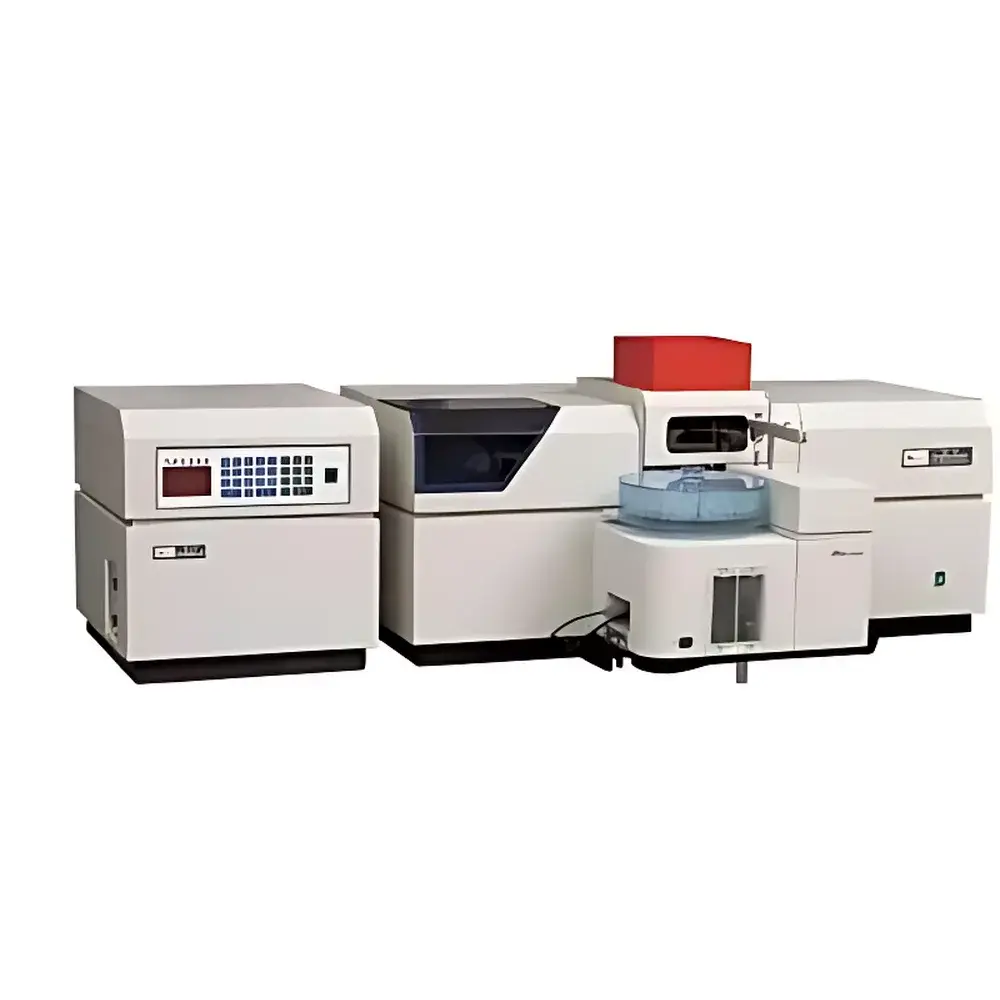
Beifen Ruili WFX-200 Flame and Graphite Furnace Atomic Absorption Spectrometer
| Brand | Beifen Ruili |
|---|---|
| Origin | Beijing, China |
| Model | WFX-200 |
| Instrument Type | Dual-mode Flame/Graphite Furnace AAS |
| Monochromator | Plane Grating |
| Optical System | Single-beam |
| Detector | Photomultiplier Tube (PMT) |
| Spectral Resolution | Resolves Mn 279.5 nm and 279.8 nm doublet with valley energy <36% |
| Sensitivity | Flame mode — Cu: 0.04 µg/mL per 1% absorption |
| Graphite furnace mode — Cd | ≤0.9 pg |
| Precision (RSD) | Flame mode ≤0.9% |
| Detection Limit | Flame mode — Cu: 0.007 µg/mL |
| Graphite furnace mode — Cd | ≤4.0 pg |
Overview
The Beifen Ruili WFX-200 is a dual-mode atomic absorption spectrometer engineered for quantitative elemental analysis in environmental, clinical, pharmaceutical, food safety, and industrial quality control laboratories. It operates on the fundamental principle of atomic absorption spectroscopy (AAS), where ground-state free atoms in a gaseous state absorb characteristic wavelengths of light emitted by hollow cathode lamps. The WFX-200 integrates both flame atomization (FAAS) and electrothermal graphite furnace atomization (GFAAS) into a single platform, enabling trace-level detection (sub-pg range) and routine ppm-level analysis without hardware reconfiguration. Its single-beam optical architecture—featuring a plane grating monochromator and high-gain photomultiplier tube detector—ensures stable baseline performance and robust signal-to-noise ratio across extended measurement cycles. Designed for compliance with ISO/IEC 17025 method validation requirements, the instrument supports rigorous analytical workflows under GLP and GMP-aligned laboratory practices.
Key Features
- Dual-atomization capability: Seamless, software-controlled switching between air-acetylene flame and graphite furnace modes—no manual realignment or mechanical disassembly required.
- Flame emission analysis extension: Interchangeable burner head enables direct flame photometric determination of alkali metals (e.g., K, Na) without external instrumentation.
- Full automation suite: Auto-wavelength scanning and peak search, automatic lamp selection and alignment, dynamic slit width adjustment, and intelligent gas flow regulation for flame ignition and stabilization.
- Advanced graphite furnace thermal control: Hybrid FUZZY-PID optical feedback + constant-voltage dual-curve heating algorithm ensures ≤1% temperature deviation across ramp-hold-cool cycles; pneumatic pressure-locking graphite tube assembly guarantees rapid thermal response and superior temperature reproducibility.
- High-precision autosampler: Integrated XYZ-stage autosampler with ±1% volumetric accuracy, 0.3% positional repeatability, automated calibration curve generation, real-time probe position correction, and adaptive sample cup height tracking.
- Comprehensive safety architecture: Real-time monitoring of fuel gas leakage, air pressure deficiency, flame-out events, graphite furnace coolant flow rate, carrier gas pressure, and furnace overtemperature—with automatic shutdown and audible/visual alerts compliant with IEC 61010-1 safety standards.
Sample Compatibility & Compliance
The WFX-200 accommodates aqueous solutions, acid-digested biological tissues, soil extracts, and diluted industrial effluents. Flame mode supports direct analysis of elements including Ca, Mg, Fe, Zn, Cu, and Mn at concentrations from 0.007 µg/mL (Cu LOD) upward; graphite furnace mode delivers sub-picogram sensitivity for Cd, Pb, As, Se, and Cr in complex matrices. All operational protocols align with ASTM D1688 (copper in water), ISO 11171 (metal impurities in fuels), and USP heavy metals testing. Data integrity safeguards—including electronic audit trails, user access levels, and parameter change logging—support adherence to FDA 21 CFR Part 11 when paired with validated BRAIC software configurations.
Software & Data Management
The BRAIC operating software (Windows-compatible, localized Chinese UI) provides full instrument control, method development, QC charting (Levey-Jennings, Shewhart), and report generation with customizable templates. Raw absorbance/time and absorbance/wavelength data are stored in ASCII-compatible formats for third-party statistical analysis (e.g., JMP, Minitab). Software modules support automatic background correction (D₂ and Zeeman optional), multi-point calibration with forced zero intercept, and drift compensation via internal standard addition. Audit trail functionality records all parameter modifications, run start/stop timestamps, and user login/logout events—essential for regulated environments undergoing GLP audits or ISO 17025 accreditation.
Applications
- Environmental monitoring: Quantification of heavy metals (Pb, Cd, Ni) in drinking water per EPA Method 7000B.
- Clinical toxicology: Blood lead level screening at sub-µg/dL levels using matrix-matched GFAAS calibration.
- Pharmaceutical excipient testing: Verification of catalyst residues (e.g., Pd, Pt) in active pharmaceutical ingredients per ICH Q2(R2).
- Food safety compliance: Detection of arsenic in rice flour and cadmium in cocoa products per EU Commission Regulation (EC) No 1881/2006.
- Geological assay support: Multi-element analysis of rock digests following ASTM D5686 digestion protocols.
FAQ
Does the WFX-200 support Zeeman background correction?
No—the standard configuration uses deuterium arc background correction. Zeeman-equipped variants require factory customization and separate quotation.
Is the BRAIC software compatible with Windows 10 or 11?
The native BRAIC version shipped with the WFX-200 is certified for Windows XP SP3. For modern OS compatibility, Beifen Ruili offers a virtualized deployment package (VMware-based) with validated runtime environment—contact technical support for installation guidance.
What maintenance intervals are recommended for the graphite furnace components?
Graphite tubes should be replaced after 200–300 firings depending on matrix complexity; platform inserts every 500 cycles; and furnace liners inspected quarterly. Full preventive maintenance (optical alignment, gas line leak check, PMT voltage calibration) is advised biannually.
Can the WFX-200 export data directly to LIMS systems?
Yes—via configurable ASCII output files with user-defined delimiters and metadata headers. Custom API integration requires engagement with Beifen Ruili’s Application Engineering team for protocol mapping and validation documentation.
Is method transfer possible from PerkinElmer AA or Thermo iCE instruments?
Wavelengths, lamp currents, and slit widths are cross-platform transferable; however, furnace temperature programs and matrix modifier protocols require empirical re-optimization due to differences in thermal mass and gas dynamics between platforms.





