
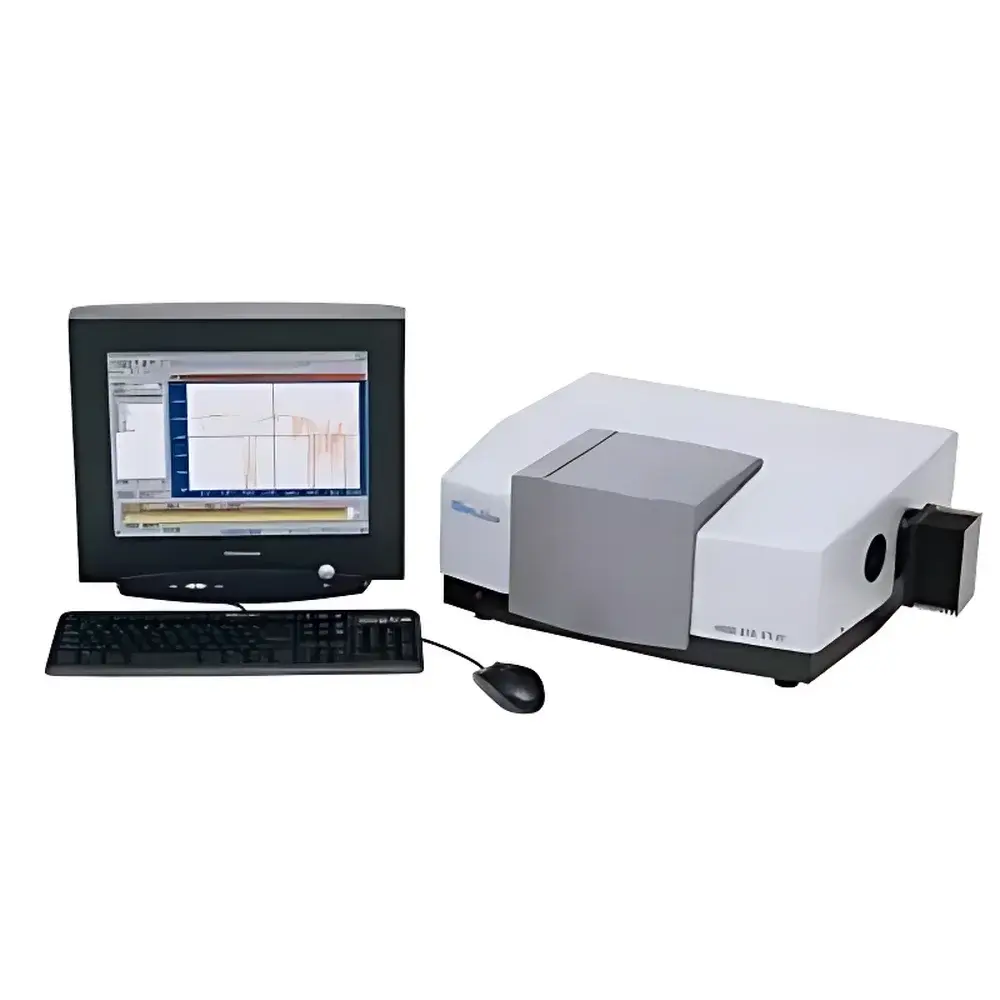
WQF-520 Fourier Transform Infrared (FTIR) Spectrometer
| Origin | Beijing, China |
|---|---|
| Manufacturer Type | Authorized Distributor |
| Origin Category | Domestic (PRC) |
| Model | WQF-520 |
| Pricing | Available Upon Request |
Overview
The WQF-520 Fourier Transform Infrared (FTIR) Spectrometer is a benchtop analytical instrument engineered for high-fidelity mid-infrared spectral acquisition in research, quality control, and routine laboratory applications. Based on the Michelson interferometer principle with corner-cube retroreflector optics, the WQF-520 delivers stable, reproducible interferograms through precise optical path difference (OPD) modulation. Its core architecture employs a dynamically aligned, fully sealed interferometer—designed to minimize thermal drift and mechanical sensitivity—enabling consistent spectral resolution and long-term baseline stability without active realignment. The system operates across the standard mid-IR range (typically 4000–400 cm⁻¹), supporting quantitative and qualitative molecular identification via vibrational absorption spectroscopy. Designed for compliance with fundamental spectroscopic measurement principles outlined in ISO 17025 and ASTM E1421, the WQF-520 serves as a foundational platform for method development in regulated and non-regulated environments.
Key Features
- Proprietary corner-cube Michelson interferometer with monolithic optical design—reducing alignment sensitivity and enhancing mechanical robustness against vibration and thermal perturbation.
- Externally mounted, thermally stabilized infrared source with spherical reflector geometry—ensuring uniform radiant flux distribution and minimizing source-induced baseline artifacts.
- Gold-coated optical components throughout the beam path—including mirrors and beam splitters—to maximize broadband IR reflectivity (>98% in 4000–400 cm⁻¹) and minimize energy loss.
- Hermetically sealed interferometer housing utilizing long-life desiccant and hydrophobic barrier materials—preventing moisture ingress and dust accumulation without requiring periodic purge gas or manual maintenance.
- Digital signal processing architecture featuring programmable gain amplification and 24-bit analog-to-digital conversion—optimized for dynamic range preservation and low-noise spectral acquisition.
- USB 2.0 interface compliant with USB Device Class specifications—enabling plug-and-play connectivity with Windows-based host systems without proprietary drivers.
Sample Compatibility & Compliance
The WQF-520 supports broad sample modality coverage via standardized optical interfaces and modular accessory integration. Compatible configurations include transmission cells (liquid/gas), attenuated total reflection (ATR) accessories with diamond, ZnSe, or Ge crystals, diffuse reflectance (DRIFTS), specular reflectance, and microsampling stages. Optional external beam ports allow connection to FTIR microscopes, fiber-optic probes, or custom-built reaction chambers. All hardware and software operations conform to general laboratory data integrity expectations; while the base system does not include built-in 21 CFR Part 11 audit trail functionality, its raw data format (.SPA, .CSV) and metadata structure support retrospective validation under GLP/GMP frameworks when deployed with validated third-party LIMS or ELN solutions.
Software & Data Management
The instrument is operated via a native Windows application with full Chinese/English bilingual UI support. Core capabilities include real-time interferogram monitoring, apodization selection (e.g., Happ-Genzel, Blackman-Harris), phase correction, zero-filling, and Fourier transformation with user-defined resolution settings. Spectral processing functions encompass baseline correction (Rubberband, Concave Rubberband), smoothing (Savitzky-Golay), peak detection, ratioing, and derivative spectroscopy. Integrated spectral library search supports both commercial databases (e.g., SDBS, Polymer Library) and user-defined collections—with editable metadata fields, spectral annotation tools, and batch-matching algorithms. All acquired spectra are stored with embedded instrument parameters (aperture, scans, resolution, date/time, operator ID), facilitating traceability and method transfer.
Applications
The WQF-520 is routinely deployed in academic laboratories for polymer characterization, pharmaceutical polymorph screening, and environmental contaminant identification. In industrial settings, it supports QC testing of raw materials (e.g., excipients, solvents), finished product verification (coating uniformity, blend homogeneity), and failure analysis (degradation products, residual catalysts). Regulatory-relevant use cases include USP excipient identity testing, EPA Method 320 for organic vapor analysis, and ASTM D7217 for additive quantification in lubricants. Its adaptability to ATR and DRIFTS makes it especially suitable for in situ analysis of solid-phase samples—such as forensic evidence, agricultural biomass, or composite material cross-sections—without extensive sample preparation.
FAQ
Is the WQF-520 compliant with FDA 21 CFR Part 11?
The base software does not provide electronic signature capability or automated audit trails; however, raw spectral files and associated metadata are structured for integration into validated enterprise systems meeting Part 11 requirements.
What spectral resolution options are available?
Standard configuration supports user-selectable resolution from 0.5 cm⁻¹ to 8 cm⁻¹, with typical default operation at 4 cm⁻¹ for routine analysis.
Can the instrument be upgraded with an external detector module?
Yes—the external beam port is optically compatible with liquid nitrogen-cooled MCT detectors and DTGS detectors with integrated preamplifiers, subject to mechanical and electrical interface verification.
Does the system support automated sample changers?
While no OEM autosampler is bundled, the USB command protocol and SDK documentation enable third-party robotic integration via TTL or RS-232 trigger signals.
What is the expected lifetime of the infrared source?
The high-intensity globar source is rated for ≥10,000 hours of continuous operation under nominal thermal load conditions, with field-replaceable design and no recalibration required post-replacement.




