
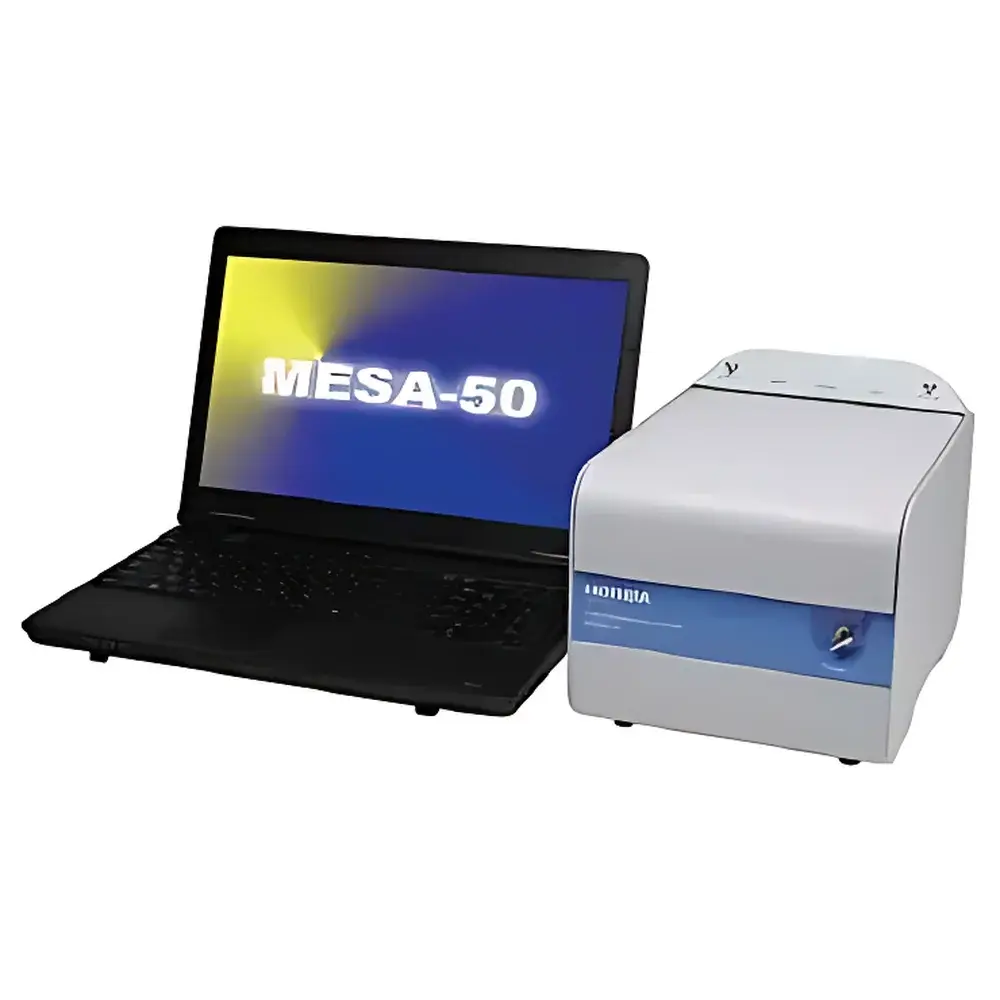
HORIBA MESA-50 Energy Dispersive X-Ray Fluorescence Spectrometer
| Brand | HORIBA |
|---|---|
| Origin | Japan |
| Model | MESA-50 |
| Detector Type | Silicon Drift Detector (SDD) |
| Excitation Source | Micro-focus X-ray Tube |
| Analytical Spot Sizes | 0.1 mm, 0.3 mm, and 1.2 mm |
| Minimum Detection Limit (MDL) | ≤2 ppm for Pb, Cd, Hg, Cr, Br |
| Measurement Time | Typically 60–300 s per point |
| Sample Viewing | Integrated High-Resolution CCD Camera with 30× Optical Zoom |
| Operating Environment | Ambient air (no vacuum or helium required) |
| Software Interface | Multilingual (English/Chinese), Excel-compatible data export |
| Compliance Support | RoHS Directive 2011/65/EU, WEEE Directive 2012/19/EU, ELV Directive 2000/53/EC, China RoHS II (SJ/T 11364-2014), JEITA EG0201, ASTM F2617-23 |
Overview
The HORIBA MESA-50 is a benchtop energy dispersive X-ray fluorescence (EDXRF) spectrometer engineered for regulatory-compliant elemental analysis of electronic components and materials. It operates on the fundamental principle of X-ray fluorescence spectroscopy: a micro-focus X-ray tube irradiates the sample, causing inner-shell electron ejection; subsequent relaxation emits characteristic secondary X-rays whose energies are element-specific and intensities quantitatively proportional to concentration. Unlike wavelength-dispersive systems, the MESA-50 employs a high-resolution silicon drift detector (SDD) coupled with HORIBA’s proprietary Digital Pulse Processor (DPP), enabling real-time spectral deconvolution, peak fitting, and matrix correction without cryogenic cooling. Designed explicitly for environmental compliance screening, it delivers rapid, non-destructive, and operator-safe quantification of restricted substances—Pb, Cd, Hg, Cr(VI), and Br (as brominated flame retardants)—in accordance with global directives including EU RoHS, WEEE, ELV, China RoHS II, and JEITA EG0201.
Key Features
- High-Sensitivity SDD Detection: The large-area SDD (≥25 mm² active area) provides superior count-rate capability (>100,000 cps) and energy resolution (<125 eV at Mn Kα), enabling reliable detection down to 2 ppm for key regulated elements—even in air atmosphere.
- Multi-Aperture Collimation System: Three interchangeable collimators (0.1 mm, 0.3 mm, and 1.2 mm) allow precise targeting of microstructures—such as solder joints, PCB traces, wire coatings, or connector pins—without signal dilution from adjacent materials.
- Integrated Visual Targeting: A high-magnification CCD camera with 30× optical zoom and real-time overlay of the excitation spot ensures accurate positioning on heterogeneous or miniaturized samples, eliminating spatial misregistration errors common in bulk EDXRF.
- Zero-Cryogen, Zero-Vacuum Operation: Eliminates dependency on liquid nitrogen dewars or mechanical vacuum pumps—reducing operational overhead, footprint, and downtime. All measurements are performed under ambient air conditions with automatic background subtraction and scatter correction.
- Portable Benchtop Architecture: Compact dimensions (294 × 208 × 205 mm) and 12 kg mass enable deployment in QA labs, production floors, or field inspection stations. Internal rechargeable Li-ion battery supports up to 6 hours of continuous operation, ideal for mobile auditing.
Sample Compatibility & Compliance
The MESA-50 accommodates solid, flat, or irregularly shaped samples up to 100 mm × 100 mm × 50 mm (W × D × H), including printed circuit boards (PCBs), plastic housings, metal alloys, cables, connectors, and coated substrates. Its air-path geometry eliminates absorption artifacts associated with light elements (e.g., Cl, S, P), while the DPP-enabled spectrum processing applies empirical and fundamental parameter (FP) algorithms to correct for matrix effects (e.g., absorption, enhancement) across polymer, ceramic, and metallic matrices. The instrument is validated per ASTM F2617–23 for RoHS screening and supports full audit trails compliant with ISO/IEC 17025:2017 requirements. Data integrity features include user access control, electronic signatures, and time-stamped measurement logs—aligning with GLP and pre-GMP documentation expectations for supplier qualification and internal compliance reporting.
Software & Data Management
MESA-50 is operated via HORIBA’s dedicated Quant’X software, available in English and Simplified Chinese interfaces. The software implements automated calibration verification using certified reference materials (CRMs), drift correction routines, and multi-point mapping functionality for heterogeneous assemblies. Quantitative results are exported directly to Microsoft Excel via standardized .csv or .xlsx templates—including raw counts, net intensities, corrected concentrations (ppm/wt%), uncertainty estimates, and pass/fail flags against user-defined regulatory thresholds. All spectral files (.qxd) retain full metadata (instrument ID, operator, date/time, collimator setting, live time, tube voltage/current), ensuring traceability for internal audits or third-party certification reviews.
Applications
- Routine screening of incoming electronic components for RoHS-conformance prior to assembly
- Failure analysis of non-compliant lots during manufacturing quality control
- Supplier material declarations (SDoC) verification and eco-audit support
- Legacy product requalification under updated regulatory limits (e.g., RoHS recast Annex II amendments)
- Research-grade elemental mapping of layered structures (e.g., plating thickness + composition)
- Support for corporate ESG reporting frameworks requiring substance-level supply chain transparency
FAQ
Does the MESA-50 require external cooling or vacuum infrastructure?
No. It operates exclusively in ambient air with no liquid nitrogen, Peltier coolers, or vacuum pumps—significantly reducing maintenance complexity and total cost of ownership.
Can it quantify chromium(VI) specifically, or only total chromium?
The MESA-50 measures total Cr content. Speciation of Cr(VI) requires complementary wet-chemical methods (e.g., EN ISO 3613 or EPA 3060A) per RoHS compliance protocols.
Is the instrument suitable for analyzing powders or liquids?
It is optimized for solid, homogeneous, and flat-surface samples. Powders and liquids require pelletization or specialized sample cups with Mylar film backing to maintain geometry and prevent contamination.
How is measurement reproducibility ensured across operators and shifts?
Through built-in daily performance checks using a Cu/Zn/Fe reference standard, auto-calibration routines, and operator-level permission settings that restrict method modification without supervisor approval.
What regulatory documentation is provided with the system?
Each unit ships with a Factory Calibration Certificate, CE Declaration of Conformity, RoHS Test Report per IEC 62321-5:2013, and software validation summary aligned with ASTM E2919-22 for analytical instrument qualification.





