
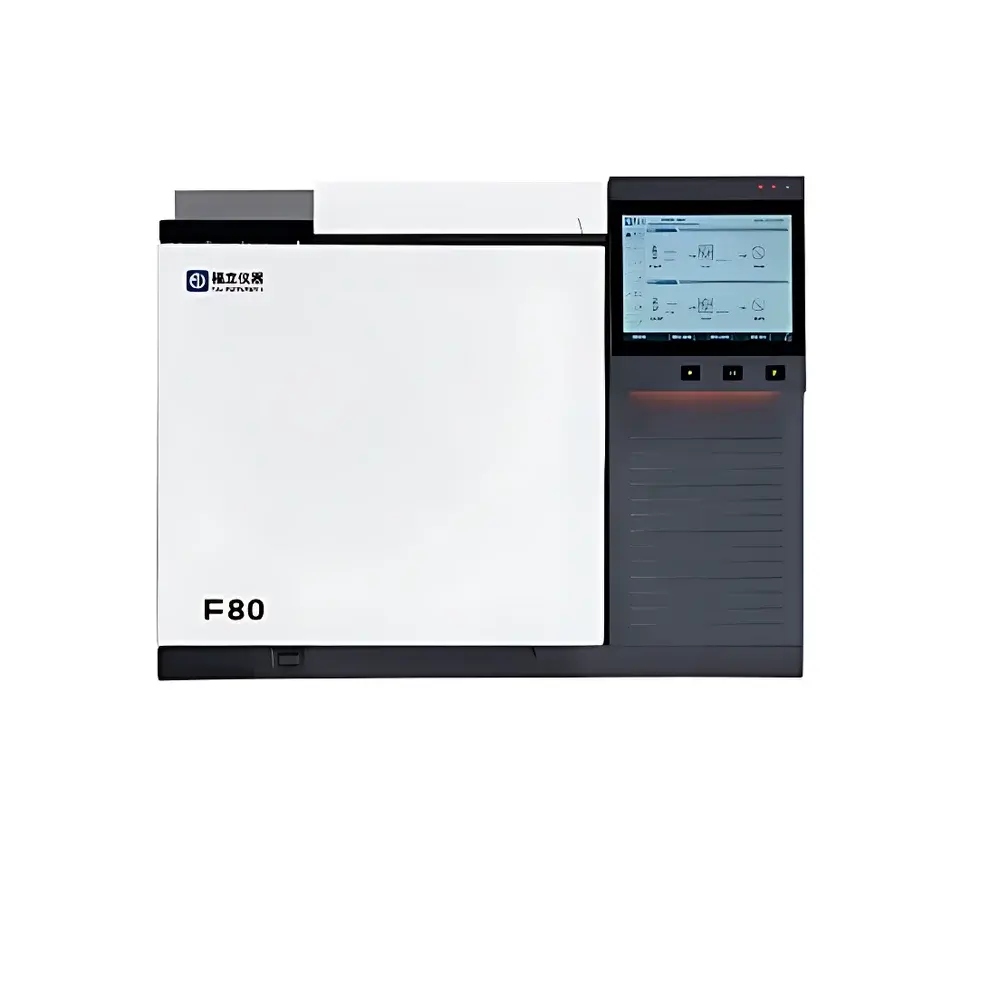
Fulit F80 Laboratory Gas Chromatograph
| Brand | Fulit |
|---|---|
| Origin | Zhejiang, China |
| Model | F80 |
| Instrument Type | Benchtop Laboratory Gas Chromatograph |
| Application Scope | General-Purpose GC Analysis |
| Oven Temperature Range | 4 °C to 450 °C |
| Maximum Ramp Rate | 250 °C/min |
| Cooling Rate | <5.0 min from 450 °C to 50 °C |
| Carrier Gas Flow Range & Control | 0–1250 mL/min (H₂ or He), 0–500 mL/min (N₂) |
| Carrier Gas Pressure Range & Control | 0–100 psi (standard), optional 0–150 psi |
| Injector Maximum Operating Temperature | 450 °C |
| Injector Pressure Setting Range | 0–100 psi (standard), optional 0–150 psi |
| Injector Total Flow Setting Range | 0–1250 mL/min (H₂/He), 0–500 mL/min (N₂) |
| Control System | Integrated high-resolution touchscreen interface with embedded real-time GC control firmware |
Overview
The Fulit F80 is a benchtop laboratory gas chromatograph engineered for precision, repeatability, and operational efficiency in routine and method-development environments. It employs classical capillary gas chromatography based on differential partitioning of analytes between a mobile phase (inert carrier gas) and a stationary phase coated inside a fused-silica column. The system integrates a thermally stable, dual-zone oven with active air circulation and high-fidelity temperature sensors, enabling precise thermal programming across a wide range—from sub-ambient (4 °C, with optional cryo-cooling module) to 450 °C. Its ultra-fast heating (up to 250 °C/min) and rapid cooling (<5 minutes from 450 °C to 50 °C) significantly reduce cycle times without compromising retention time reproducibility or peak shape integrity. Designed for compliance-driven laboratories, the F80 supports audit-ready operation through deterministic thermal calibration, traceable temperature validation protocols, and hardware-level EPC (Electronic Pneumatic Control) architecture.
Key Features
- High-resolution 7-inch capacitive touchscreen interface with intuitive icon-based navigation and real-time chromatogram preview
- Dual independent EPC modules: one for carrier gas flow/pressure regulation at the column inlet, another for auxiliary gas (make-up, detector, purge) control—each with 0.001 psi pressure resolution and ±0.01 psi long-term stability
- Thermally isolated oven chamber with PID-controlled forced-air convection and three-point temperature calibration capability
- Injector capable of split/splitless, cool-on-column, and programmed temperature vaporization (PTV) modes; maximum operating temperature 450 °C with ceramic-heated liner design
- Modular detector compatibility: supports FID, TCD, ECD, and NPD configurations with standardized electrical and pneumatic interfaces
- Embedded Linux-based firmware with non-volatile method storage, event logging, and automatic leak detection diagnostics
Sample Compatibility & Compliance
The F80 accommodates a broad spectrum of volatile and semi-volatile organic compounds—including hydrocarbons, pesticides, residual solvents, flavor/aroma volatiles, and environmental contaminants—across matrices such as water, soil extracts, pharmaceutical intermediates, and polymer additives. It meets baseline requirements for ISO/IEC 17025:2017 accredited testing laboratories and supports alignment with ASTM D3612 (petroleum hydrocarbons), USP (residual solvents), and EPA Method 8260D (volatile organics in solid/water samples). All EPC parameters are logged with timestamped metadata, satisfying GLP/GMP data integrity expectations. Optional 21 CFR Part 11-compliant software add-ons provide electronic signatures, role-based access control, and immutable audit trails.
Software & Data Management
The F80 operates natively via its onboard touch interface but integrates seamlessly with Fulit GC Navigator™—a Windows-based chromatography data system (CDS) supporting multi-instrument control, automated sequence execution, peak integration per ICH Q2(R2) guidelines, and customizable report templates. Raw data (.fid files) adhere to AIA/ANDI standards for cross-platform compatibility with third-party CDS platforms (e.g., OpenLab CDS, Chromeleon). Method transfer tools enable direct import/export of temperature programs, flow profiles, and detector settings between F80 systems or to higher-tier Fulit GC platforms. All system logs—including temperature deviations, pressure fluctuations, and EPC actuation events—are stored in encrypted SQLite databases with configurable retention policies.
Applications
- Quality control of raw materials and finished products in pharmaceutical, food & beverage, and chemical manufacturing
- Environmental analysis of VOCs and SVOCs in air, water, and soil per regulatory frameworks (e.g., EU Water Framework Directive, China HJ 639)
- Residual solvent quantification in APIs and excipients according to ICH Q3C guidelines
- Fuel composition profiling and hydrocarbon group-type analysis (HTA) in petrochemical R&D
- Forensic toxicology screening for volatile drugs of abuse and accelerants
- Essential oil fingerprinting and adulteration detection using retention index libraries
FAQ
Does the F80 support unattended overnight operation?
Yes—the system includes built-in power-fail recovery, automatic shutdown after sequence completion, and continuous monitoring of column head pressure and oven temperature stability.
Can the F80 be integrated into a LIMS environment?
Yes—via standard OPC UA or ASCII-based instrument drivers; Fulit provides documented API specifications and sample scripts for common LIMS vendors.
Is method validation documentation available for the F80?
Fulit supplies a comprehensive IQ/OQ protocol package aligned with ASTM E2656 and ISO/IEC 17025, including temperature uniformity mapping, EPC linearity verification, and retention time precision assessment procedures.
What maintenance intervals are recommended for the EPC modules?
EPC valves and pressure transducers require biannual calibration verification using NIST-traceable reference gauges; no routine replacement is needed under normal operating conditions.
Does the F80 comply with regional electrical safety standards?
Yes—it carries CE marking (EN 61010-1:2019), CCC certification (GB 4793.1–2019), and UL recognition (UL 61010-1) for global deployment.




