
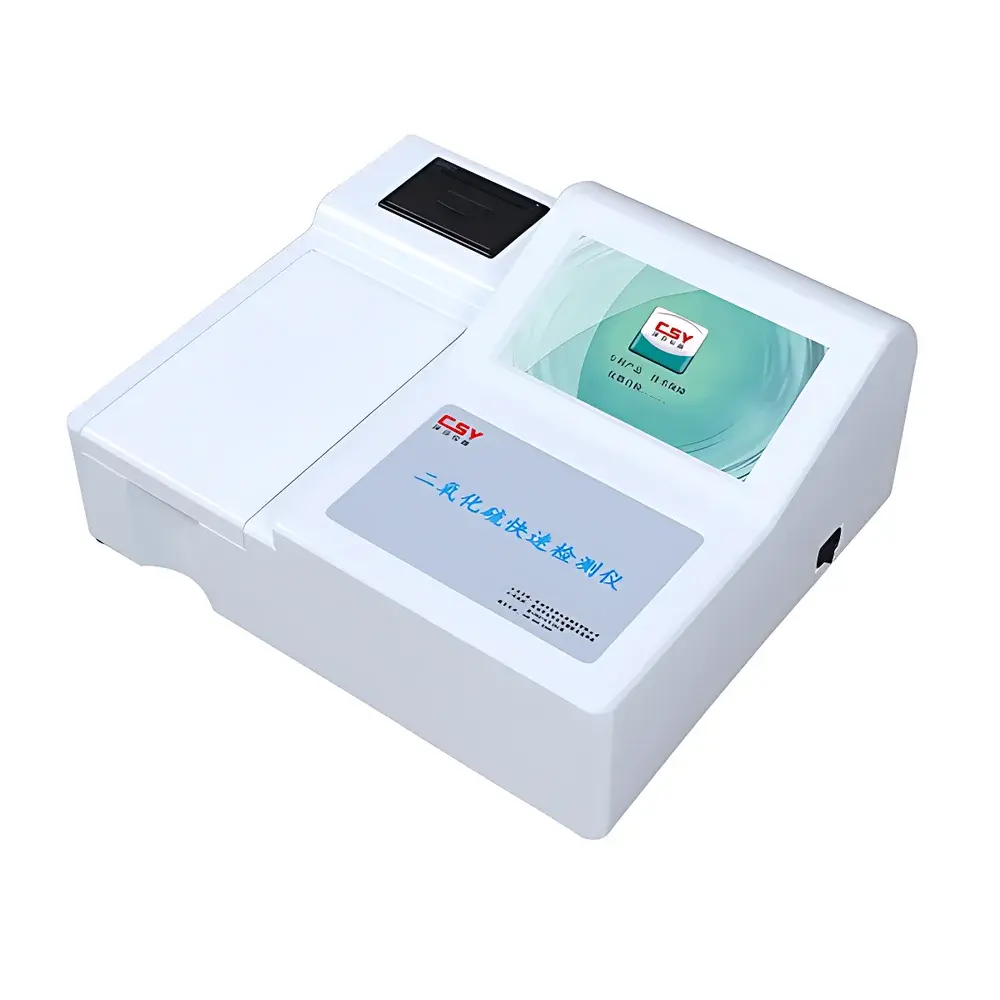
CSY-10EYHL Sulfur Dioxide Detector for Pharmaceutical and Food Safety Testing
| Brand | CSY |
|---|---|
| Origin | Guangdong, China |
| Model | CSY-10EYHL |
| Detection Principle | Visible Spectrophotometry (410 nm ± 2 nm) |
| Detection Range | Not Specified (Instrument-Specific Calibration Required) |
| Detection Limit | Not Specified (Instrument-Specific Calibration Required) |
| Accuracy Error | ±3% |
| Linearity Error | ±0.5‰ |
| Stability | ±0.001 A/hr |
| Wavelength Accuracy | <2.0 nm |
| Absorbance Range | 0.000–4.000 ABS |
| Transmittance Repeatability | ±1% |
| Data Storage Capacity | 8,000 entries |
| Sample Measurement Time | ≤3 min |
| Cuvette Size | 10 × 10 mm |
| Dimensions | 350 × 290 × 130 mm |
| Display | 7-inch color TFT LCD touchscreen |
| Optical Source | High-stability imported LED |
| Channel Configurations | 5–30 customizable photometric channels |
| Connectivity | RS-232, USB, Wi-Fi, Ethernet |
| Integrated Thermal Printer | Yes (ribbon-free, lifetime operation) |
| Software Compatibility | CSY Food Safety Monitoring Network Platform (customizable multi-tier deployment) |
Overview
The CSY-10EYHL Sulfur Dioxide Detector is a benchtop-to-field portable visible spectrophotometer engineered for quantitative determination of sulfur dioxide (SO₂) residues in pharmaceutical excipients, herbal materials, and food matrices—including dried fruits, starches, confectionery, wine, beer, malt beverages, and processed vegetables. It operates on the principle of selective chromogenic reaction: SO₂-derived sulfite ions react with proprietary acidic reagents under controlled pH and temperature to form stable colored complexes. These complexes exhibit characteristic absorbance at 410 nm ± 2 nm, enabling quantification via the Lambert–Beer law. The instrument integrates a high-stability, narrow-bandwidth LED light source, precision optical path design, and thermally stabilized photodiode detection to ensure reproducible absorbance measurements across diverse sample types and ambient conditions. Designed for compliance-critical environments, it supports traceable analysis workflows aligned with pharmacopeial guidance (e.g., USP <231>, ChP Appendix XIX B) and food safety standards (e.g., GB 5009.34–2022, Codex STAN 192–1995).
Key Features
- Multi-channel photometric architecture: Configurable 5–30 independent optical paths enable parallel analysis of multiple samples or calibration standards—reducing inter-assay variability and improving throughput for QC laboratories.
- Self-calibrating optical system: Automatic wavelength validation and baseline correction performed at startup and during idle periods; eliminates manual alignment and drift-related recalibration.
- Ribbon-free thermal printing module: Generates auditable, tamper-evident reports containing sample ID, measured absorbance, calculated SO₂ concentration (mg/kg), pass/fail status against regulatory thresholds, date/time stamp, and operator ID.
- Embedded data integrity controls: All measurements are time-stamped and stored with metadata (cuvette position, channel ID, calibration curve version); supports audit trail generation for GLP/GMP-compliant documentation.
- Low-power LED illumination: Non-thermal, long-life (≥10 years) light source ensures consistent spectral output without warm-up delay or intensity decay—critical for field-deployable reliability.
- Modular connectivity suite: Native support for RS-232 serial, USB mass storage, IEEE 802.11n Wi-Fi, and 10/100 Mbps Ethernet enables seamless integration into centralized LIMS or regional food safety surveillance networks.
Sample Compatibility & Compliance
The CSY-10EYHL accommodates homogenized liquid extracts, clarified filtrates, and acid-distillate preparations derived from solid and semi-solid matrices per standard AOAC and ISO methods (e.g., ISO 5725 for precision verification). Its 10 × 10 mm quartz-compatible cuvette chamber accepts both disposable and reusable cells, minimizing cross-contamination risk. Instrument performance meets key metrological requirements outlined in ISO/IEC 17025:2017 for testing laboratories, including demonstrated linearity (R² ≥ 0.999 over working range), repeatability (CV ≤ 1.5% at mid-range concentration), and intermediate precision across operators and days. Regulatory documentation packages—including factory calibration certificates, uncertainty budgets, and software validation summaries—are available upon request to support FDA 21 CFR Part 11 readiness and EU Annex 11 assessments.
Software & Data Management
The embedded firmware provides real-time calculation using preloaded or user-defined calibration curves (linear, quadratic, or 4-/5-parameter logistic). Raw absorbance values and derived concentrations are stored locally with SHA-256 hashed integrity checks. Optional CSY Food Safety Monitoring Network Software enables centralized database management across hierarchical deployments (national → provincial → municipal → facility levels), with role-based access control, automated report generation, and trend analytics for non-conformance tracking. All data exports comply with CSV and XML formats compatible with Microsoft Excel, LabArchives, and Oracle Clinical One. Audit logs record every configuration change, measurement event, and print action—retained for ≥36 months unless purged under documented retention policy.
Applications
- Pharmaceutical quality control: Quantification of residual SO₂ in herbal extracts, gelatin capsules, and excipient-grade starches per ICH Q5C stability guidelines.
- Fresh produce supply chain monitoring: On-site screening of SO₂-treated dried lily bulbs, daylilies, and bamboo shoots prior to distribution.
- Beverage manufacturing: Routine verification of SO₂ levels in white wine, cider, and malt-based soft drinks to ensure compliance with EU Regulation (EC) No 1333/2008 maximum limits.
- Regulatory inspection: Mobile deployment by food safety authorities for unannounced audits at processing facilities, wholesale markets, and import terminals.
- Contract testing laboratories: High-volume batch release testing with full traceability for ISO/IEC 17025 accreditation scope expansion.
FAQ
What regulatory standards does the CSY-10EYHL support for SO₂ testing?
It is validated for use with national and international methods including GB 5009.34–2022 (China), AOAC 990.29 (distillation-spectrophotometric), and ISO 20551:2017 (wine analysis), and supports documentation required for FDA, EFSA, and NMPA submissions.
Can the instrument be calibrated using certified reference materials?
Yes—traceable potassium metabisulfite (K₂S₂O₅) standards with NIST-traceable SO₂ content are recommended for initial calibration and periodic verification.
Is remote firmware update supported?
Firmware updates are delivered via encrypted USB drive or secure HTTPS upload through the network interface; all updates undergo cryptographic signature validation before installation.
How is data security ensured during wireless transmission?
Wi-Fi communications use WPA2-Enterprise authentication with TLS 1.2 encryption; local storage employs AES-256 full-disk encryption activated by default.
Does the device meet electromagnetic compatibility (EMC) requirements for laboratory use?
It complies with IEC 61326-1:2013 Class B emission and immunity specifications, verified through third-party testing per EN 61000-6-3 and EN 61000-6-2.






