
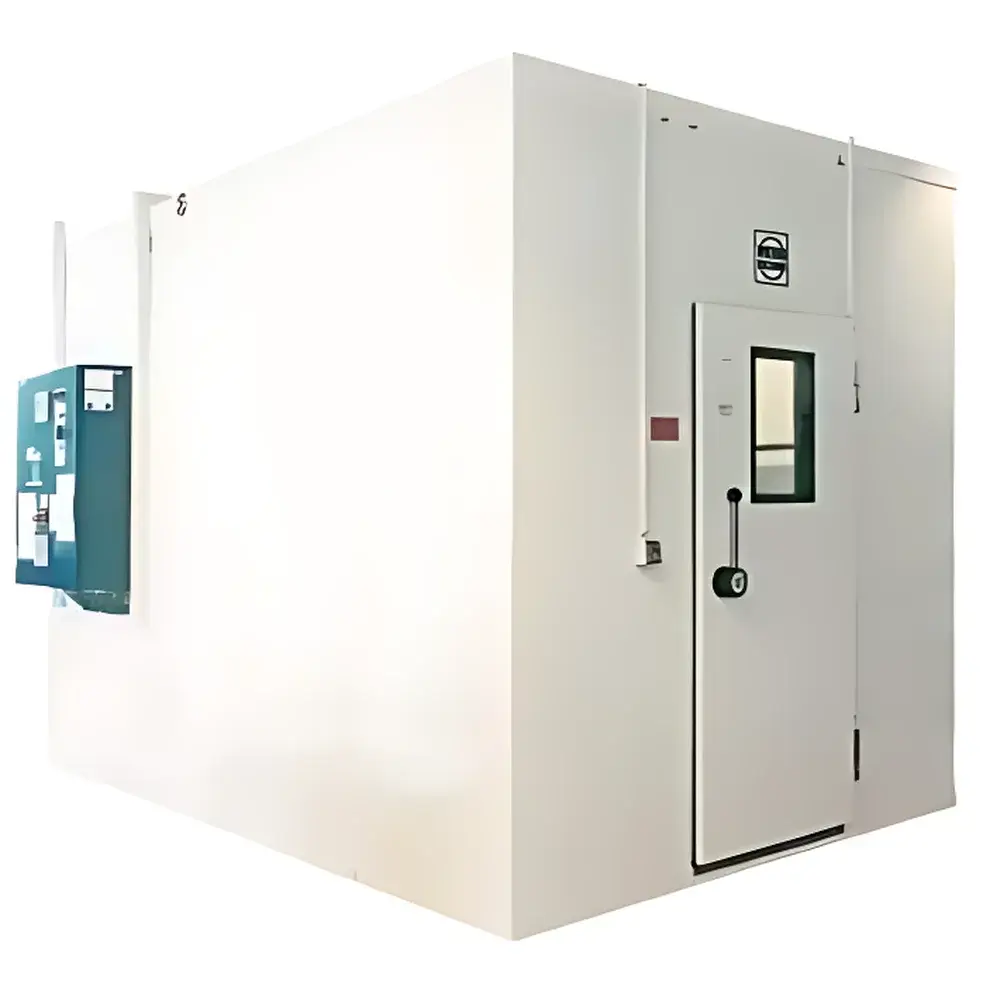
WEISS WK Walk-in Temperature and Humidity Controlled Chamber
| Brand | WEISS |
|---|---|
| Origin | Germany |
| Model | WK |
| Chamber Volume Options | 4, 10, 15, 25, 32, 41 m³ |
| Temperature Range | +20 to +45 °C |
| Temperature Uniformity | ≤ ±1 °C |
| Humidity Range | 20–80 %RH |
| Humidity Stability (over time) | ≤ ±3 %RH |
| Insulation | CFC-free polyurethane (PU) |
| Control System | Microprocessor-based, compliant with GAMP 5 and FDA 21 CFR Part 11 |
| Humidification | Ultrasonic |
| Dehumidification | Refrigerated |
| Heating | Electric |
| Cooling | Air-cooled refrigeration |
| Safety Features | Dual temperature safety cutoffs, sample temperature monitoring, emergency door release |
Overview
The WEISS WK Walk-in Temperature and Humidity Controlled Chamber is a precision-engineered environmental test system designed for long-term stability testing under strictly regulated conditions. Built upon over five decades of German engineering expertise in climate simulation, the WK series adheres to internationally recognized pharmaceutical and industrial validation frameworks—including ICH Q1, Q5, and Q7 guidelines, as well as EU Annex 15 and USP . It operates on a dual-control principle: independent regulation of temperature via electric heating and air-cooled refrigeration, and humidity via ultrasonic humidification coupled with active refrigerant-based dehumidification. This architecture ensures high reproducibility and minimal thermal lag across large-volume chambers (4–41 m³), making it suitable for ICH-compliant accelerated and real-time stability studies, shelf-life determination, and process validation in GMP environments.
Key Features
- CFC-free polyurethane (PU) insulation with double-metal-clad interior surfaces—ensuring low thermal conductivity, chemical resistance, and ease of cleaning per ISO 14644-1 Class 8 requirements.
- Microprocessor-based control system certified to GAMP 5 standards and fully compliant with FDA 21 CFR Part 11 for electronic records and signatures—supporting audit trails, user access levels, and data integrity protocols.
- Ultrasonic humidification technology delivering rapid, particle-free moisture generation without mineral residue or microbial proliferation risk—ideal for sterile and low-bioburden applications.
- Integrated sample temperature monitoring probes (optional) that operate independently from chamber air sensors—enabling direct assessment of product core temperature during extended exposure cycles.
- Redundant safety architecture: dual independent temperature limit controllers, door-mounted emergency mechanical release mechanism, and configurable alarm outputs for remote SCADA integration.
- Airflow design optimized for uniform distribution—validated via ISO 16750-4-compliant mapping procedures (including 9-point sensor grid testing at multiple load configurations).
Sample Compatibility & Compliance
The WK chamber accommodates diverse sample formats—from stacked pallets of pharmaceutical primary packaging (blister cards, vials, syringes) to automotive ECUs, aerospace composites, and polymer-based medical devices. Its interior dimensions and structural loading capacity support standard ISO pallet sizes (1200 × 800 mm and 1200 × 1000 mm) with floor-load ratings up to 1,500 kg/m². All models are supplied with full IQ/OQ documentation packages aligned with ASTM E2500-13 and ISPE Baseline Guide Vol. 5. Validation support includes thermocouple calibration certificates traceable to PTB (Physikalisch-Technische Bundesanstalt), humidity sensor NIST-traceable verification, and chamber mapping reports compliant with WHO TRS 992 Annex 6.
Software & Data Management
The integrated WEISS ClimateControl™ software provides real-time visualization, trend analysis, and automated report generation (PDF/CSV). It supports configurable alarm escalation (email/SMS via Modbus TCP or SNMP), historical data archiving with SHA-256 hashing, and seamless integration into LIMS and MES platforms via OPC UA. All system events—including setpoint changes, door openings, and maintenance alerts—are timestamped and digitally signed. Electronic signatures meet ALCOA+ principles (Attributable, Legible, Contemporaneous, Original, Accurate, Complete, Consistent, Enduring, Available), satisfying regulatory expectations for data governance under MHRA, PMDA, and Health Canada guidance.
Applications
- ICH-compliant stability testing of APIs, finished pharmaceuticals, and biologics under long-term (25 °C/60 %RH), intermediate (30 °C/65 %RH), and accelerated (40 °C/75 %RH) conditions.
- Environmental stress screening of electronic assemblies per JEDEC JESD22-A110 and MIL-STD-810H Method 507.6.
- Accelerated aging studies for polymer degradation, seal integrity evaluation, and packaging permeability assessment (ASTM F1980, ISO 11607-1).
- Validation of cold chain logistics components—including insulated shippers and phase-change materials—under dynamic temperature-humidity profiles.
- Material compatibility testing for medical device sterilization packaging per ISO 11607-2 and AAMI TIR17.
FAQ
Is the WK chamber suitable for GMP-regulated stability programs?
Yes—the system is pre-validated for compliance with ICH Q1, EU GMP Annex 15, and FDA Guidance for Industry on Stability Testing, and includes full documentation for IQ/OQ/PQ execution.
Can humidity be controlled below 20 %RH or above 80 %RH?
Standard WK configurations operate between 20–80 %RH; extended-range variants (e.g., WK-HR) supporting 10–95 %RH are available upon request with modified dehumidification and humidification subsystems.
What calibration and maintenance services are offered?
WEISS-certified engineers provide annual performance qualification (PQ), sensor recalibration (traceable to national standards), and preventive maintenance contracts including refrigerant leak checks, ultrasonic transducer inspection, and control system firmware updates.
Does the chamber support custom programming of complex cycling profiles?
Yes—ClimateControl™ allows creation of multi-segment time-temperature-humidity profiles with ramp rates, dwell times, and conditional logic (e.g., “hold until internal sample probe reaches target”); profiles can be imported/exported via CSV.
How is cybersecurity addressed in the control system?
The embedded controller runs a hardened Linux OS with disabled unused ports, TLS 1.2+ encrypted communications, role-based authentication, and optional hardware security module (HSM) integration for cryptographic key management.



