
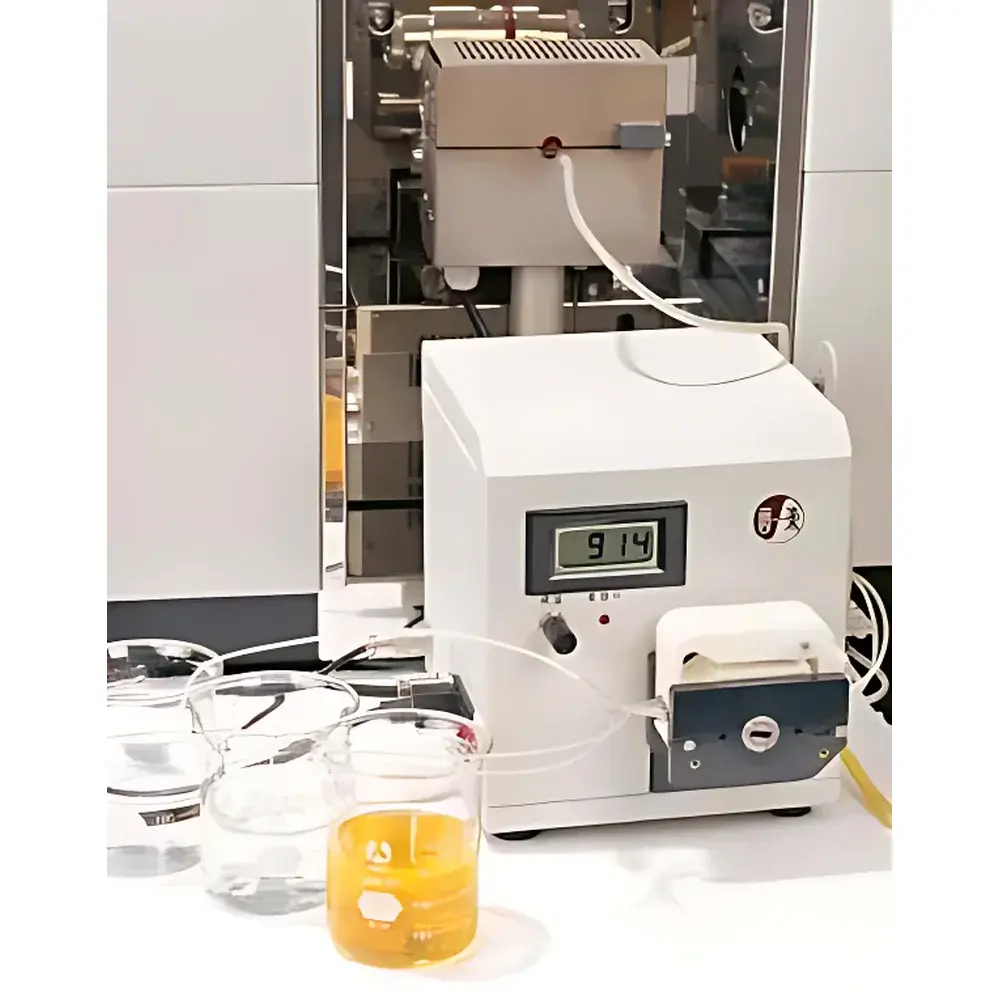
HG-01 Hydride Generation System
| Origin | Beijing |
|---|---|
| Manufacturer Type | Distributor |
| Origin Category | Domestic (China) |
| Model | HG-01 |
| Pricing | Upon Request |
Overview
The HG-01 Hydride Generation System is a dedicated, benchtop hydride vapor generation accessory engineered for integration with flame or graphite furnace atomic absorption spectrometers (AAS). It operates on the principle of chemical hydride generation—where analyte elements (As, Se, Hg, Pb, Bi, Sb, Sn, Te) are reduced in acidic medium by sodium borohydride (NaBH₄) to form volatile covalent hydride species (e.g., AsH₃, SeH₂, Hg⁰ vapor), which are then swept into a quartz tube atomizer for in situ atomization and quantification by AAS. This technique enhances detection sensitivity by 1–2 orders of magnitude compared to conventional nebulization AAS, particularly for elements exhibiting low ionization potential and high volatility as hydrides. The system is designed for routine trace and ultra-trace analysis in environmental monitoring (e.g., drinking water, soil leachates), food safety testing (rice, seafood), and geological sample digestion matrices.
Key Features
- Triple-channel peristaltic pump delivery system enabling continuous, pulse-free reagent and sample introduction at adjustable flow rates (1–5 mL/min); ensures stable hydride formation kinetics and reproducible signal response.
- High-reliability Tygon® tubing (U.S.-sourced), certified for acid resistance and low metal leaching; rated for 500–1000 hours of uninterrupted operation under typical laboratory duty cycles.
- Patented ceramic heating element integrated with fused quartz atomization tube—designed for oxidative stability up to 1000 °C without quartz devitrification or metallic contamination; eliminates carbon buildup and extends tube service life beyond 6 months under daily use.
- Precision digital temperature controller with LCD interface: rapid ramp-up (<60 s to 900 °C), smooth thermal profile, setpoint range 100–1000 °C, accuracy ±2 °C; enables empirical optimization of atomization temperature for each hydride-forming element.
- Compact modular architecture (180 × 180 × 200 mm) housing both gas–liquid separation chamber and thermal control electronics; titanium-alloy insulated heater mount minimizes thermal radiation to adjacent AAS components and facilitates direct mounting onto standard AAS雾化室 (nebulizer chamber) axial ports.
Sample Compatibility & Compliance
The HG-01 supports aqueous samples prepared via standardized EPA Method 200.9, ISO 11969, and GB/T 5750.6–2023 protocols—including acid-digested waters, plant tissues, and sediment extracts. It accommodates sample volumes from 1–5 mL and tolerates HCl concentrations of 2–10% (v/v) for optimal hydride yield. All wetted surfaces (pump tubing, reaction coil, gas–liquid separator) are chemically inert and compliant with GLP requirements for trace metal analysis. While the device itself does not carry CE or FDA 510(k) certification, its operational parameters align with ASTM D5673–16 (for arsenic in water) and USP guidelines for hydride-based elemental quantification in pharmaceutical excipients.
Software & Data Management
As a hardware-only accessory, the HG-01 requires no embedded firmware or proprietary software. It interfaces passively with any AAS instrument equipped with analog voltage output (0–1 V or 0–5 V) for absorbance signal acquisition. Temperature setpoints and pump speed are manually adjusted via front-panel controls; no USB/RS-232 connectivity is provided. For audit-ready workflows, users may log operating parameters (temperature, flow rate, acid concentration, NaBH₄ strength) in accordance with 21 CFR Part 11-compliant LIMS or ELN systems. Full traceability is maintained through manual entry of calibration curves, blank corrections, and RSD validation data per ICH Q2(R2) recommendations.
Applications
- Quantification of arsenic in groundwater per WHO guideline values (10 µg/L); detection limit of 0.015 ng/mL meets regulatory requirements for sub-part-per-trillion reporting.
- Routine screening of selenium in infant formula and dietary supplements, where hydride-AAS provides superior selectivity over matrix interferences from Ca and Mg.
- Mercury speciation support: when coupled with pre-reduction steps (e.g., SnCl₂ for Hg²⁺ → Hg⁰), enables total mercury determination in fish tissue digests with RSD <1.1% (n = 6).
- Lead and antimony analysis in electronic waste leachates (IEC 62321-5), where conventional AAS suffers from spectral overlap; hydride generation eliminates Fe/Al background interference.
- Te and Bi determination in high-purity metal alloys used in semiconductor manufacturing, where detection limits below 0.05 ng/mL ensure conformance with SEMI F57 purity specifications.
FAQ
Can the HG-01 be used with graphite furnace AAS instruments?
Yes—it is compatible with both flame and electrothermal AAS platforms. When interfacing with GF-AAS, the quartz atomizer must be positioned upstream of the graphite tube, and carrier gas flow must be synchronized with furnace temperature programming.
What maintenance is required for long-term reliability?
Routine replacement of Tygon® tubing every 500–800 hours; quarterly cleaning of the gas–liquid separator with 10% HNO₃; annual verification of ceramic heater resistance and temperature calibration using a NIST-traceable thermocouple.
Is the system suitable for automated sequential multi-element analysis?
No—the HG-01 is a single-element hydride generator. Sequential analysis requires manual reconfiguration of reagent lines and temperature settings between elements; it does not support auto-switching protocols.
Does the unit include safety interlocks for hydrogen gas handling?
Hydrogen is generated *in situ* and consumed immediately within the quartz tube; no external H₂ storage or venting is involved. The system complies with OSHA 1910.103 and NFPA 55 guidelines for transient hydride gas exposure, with built-in over-temperature cutoff at 1050 °C.
Can it be retrofitted to older AAS models manufactured before 2000?
Yes—provided the instrument has a standard nebulizer chamber port (M6 or 1/4″-28 thread) and analog absorbance output. Mechanical adapters and custom gas line fittings are available upon request.



