
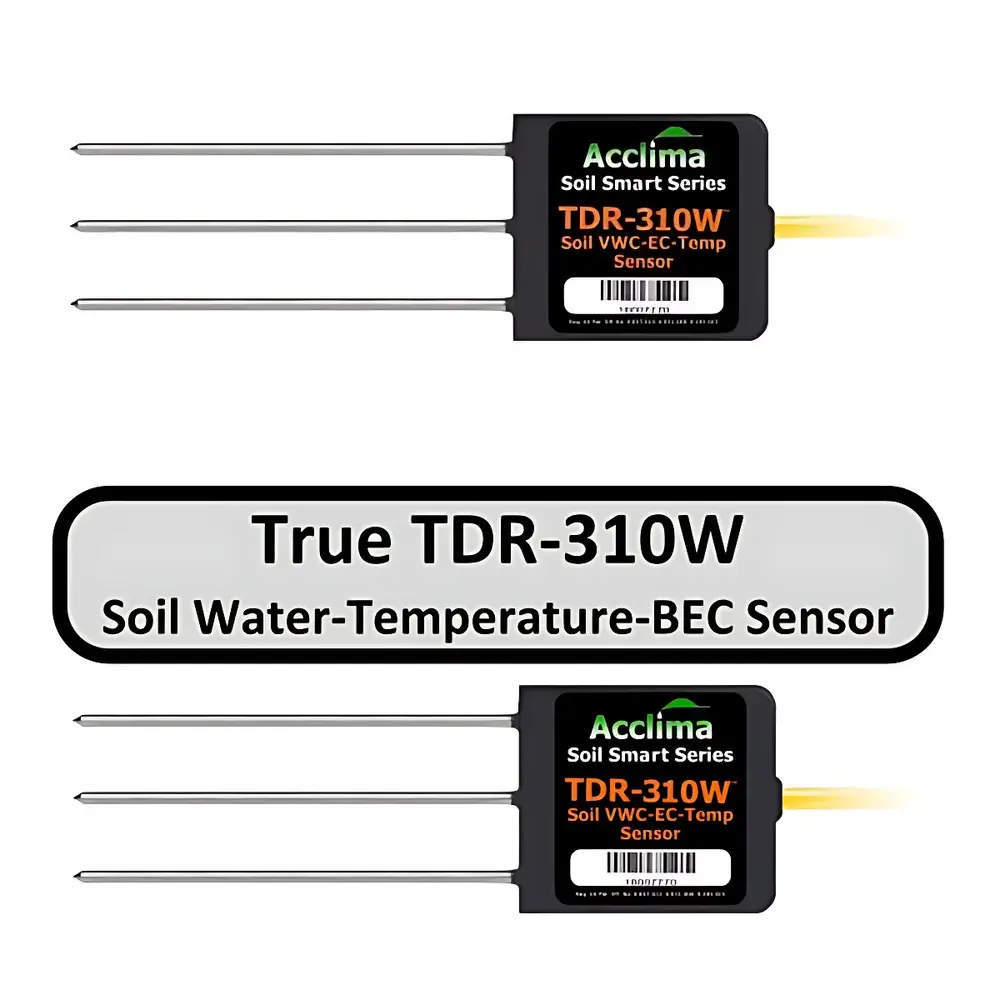
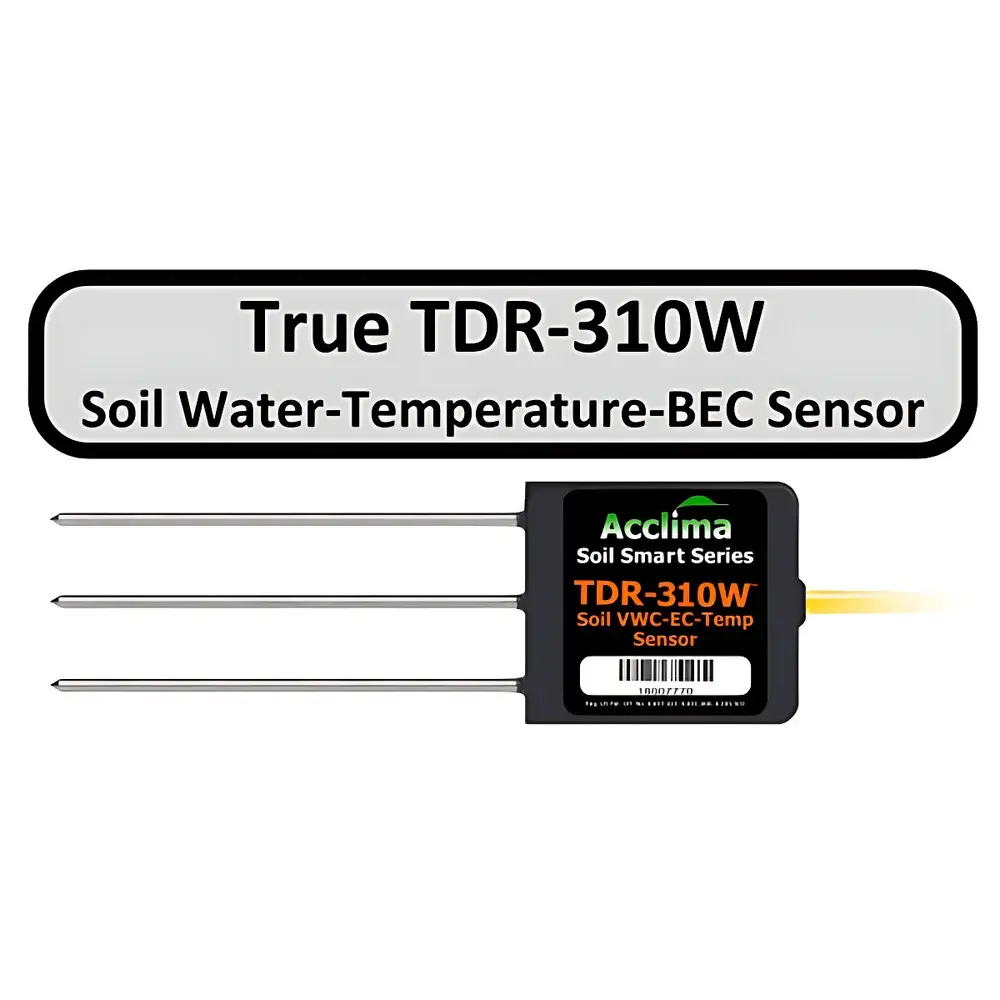
Acclima TDR310W Integrated Soil Moisture, Temperature & Electrical Conductivity Sensor
| Brand | Acclima, Inc. |
|---|---|
| Origin | USA |
| Model | TDR310W |
| Sensor Type | TDR-based Volumetric Water Content, Soil Temperature & Bulk Electrical Conductivity Sensor |
| Measurement Principle | Time-Domain Reflectometry (TDR) with Ultra-High-Speed Waveform Generation & 5 ps Timebase Resolution |
| Output Interface | 3-Wire SDI-12 v1.4 Compliant |
| Probe Length | 100 mm |
| Probe Diameter | 3.5 mm |
| Housing | Waterproof Epoxy-Filled Enclosure |
| Power Supply | 6.5–15 V DC |
| Quiescent Current | 10 µA |
| Active Current | 118 mA @ 12 V DC |
| Operating Temperature | –40 °C to +60 °C |
| Cable Length | 5 m (standard), optional 10 m |
| Weight | 94 g (sensor head only) |
| Dimensions (housing) | 160 × 53 × 20 mm |
| Volumetric Water Content Range | 0–100 % VWC |
| VWC Resolution | 0.1 % VWC |
| VWC Accuracy | ±2 % FS |
| VWC Repeatability (RMS) | 0.07 % VWC |
| Dielectric Constant Range | 1–100 |
| Dielectric Resolution | 0.1 |
| Dielectric Accuracy | ±2 % |
| Bulk EC Range | 0–6000 µS/cm |
| Bulk EC Resolution | 1 µS/cm |
| Bulk EC Accuracy | ±25 µS/cm (0–1000 µS/cm), ±2.5% (1000–2000 µS/cm), ±5% (2000–5000 µS/cm) |
| Pore Water EC (Hilhorst model) | 0–55,000 µS/cm |
| Soil Temperature Range | –40 °C to +60 °C |
| Temp Resolution | 0.1 °C |
| Temp Accuracy | ±0.25 °C (5–35 °C), ±0.5 °C (–15–50 °C) |
| Temp Repeatability (RMS) | 0.01 °C |
| Rise Time (20–80%) | 300 ps |
| Waveform Digitization Resolution | 5 ps |
| Incident Pulse Amplitude | 2.3 V |
Overview
The Acclima TDR310W is a fully integrated, high-fidelity time-domain reflectometry (TDR) sensor engineered for simultaneous, co-located measurement of volumetric water content (VWC), soil temperature, and bulk electrical conductivity (EC) in situ. Unlike conventional single-parameter or low-resolution TDR probes, the TDR310W embeds an ultra-fast waveform generator and digitizer with a precision 5 picosecond (ps) timebase — enabling true time-domain analysis of the reflected electromagnetic pulse across the entire 100 mm stainless-steel probe array. This architecture eliminates reliance on empirical curve-fitting or simplified travel-time approximations, delivering physically grounded dielectric permittivity estimation (εr = 1–100) with <±2% full-scale accuracy. Its optimized probe geometry — 100 mm length × 3.5 mm diameter — balances spatial representativeness with minimal soil disturbance during installation using a standard 34 mm flat-bottom auger. The sensor’s high-voltage output waveform (2.3 V incident amplitude) ensures signal integrity and measurement robustness in saline or clay-rich soils where conventional TDR systems suffer from signal attenuation or reflection distortion.
Key Features
- True TDR waveform capture with 5 ps timebase resolution and 300 ps 20–80% rise time — enabling sub-nanosecond temporal fidelity for accurate wavefront identification and dispersion analysis.
- Integrated triple-parameter sensing: VWC (0–100% VWC, ±2% FS), soil temperature (–40 to +60 °C, ±0.25 °C at 5–35 °C), and bulk EC (0–6000 µS/cm) with traceable accuracy across salinity gradients.
- SDI-12 v1.4 compliant interface — compatible with Campbell Scientific CR series, Onset HOBO, Decagon EM50, and other industry-standard data loggers without protocol adaptation.
- Epoxy-filled, IP68-rated housing with corrosion-resistant stainless-steel probes — rated for continuous burial in saturated, freezing, or chemically aggressive soils.
- Ultra-low power consumption: 10 µA quiescent current; 118 mA active draw only during measurement burst (typ. <100 ms), supporting multi-year deployment on solar-recharged battery systems.
- Mechanically optimized form factor: 160 × 53 × 20 mm housing designed to interface seamlessly with 1″ NPT PVC conduit for depth-controlled vertical insertion and long-term mechanical stability.
Sample Compatibility & Compliance
The TDR310W is validated for use across diverse soil textures — including sand, loam, silt, clay, organic peat, and amended horticultural substrates — without recalibration. Its high-voltage TDR excitation maintains signal-to-noise ratio in soils with bulk EC up to 3000 µS/cm, satisfying ASTM D5778 (Standard Test Method for Electronic Friction Cone and Piezocone Penetration Testing) and ISO 11274 (Soil quality — Determination of field water capacity) requirements for high-salinity environments. The sensor complies with FCC Part 15 Class B and CE EMC Directive 2014/30/EU for electromagnetic compatibility. While not certified under FDA 21 CFR Part 11, its deterministic firmware behavior, immutable timestamped SDI-12 output, and absence of internal storage support GLP/GMP-aligned data acquisition workflows when paired with audit-trail-capable data loggers.
Software & Data Management
Data output follows the standardized SDI-12 ASCII command-response protocol: commands such as aM! trigger synchronous acquisition of VWC, temperature, and bulk EC in a single atomic transaction. No proprietary drivers or middleware are required. Raw dielectric permittivity values (εr) and calibrated parameters are transmitted as discrete numeric fields, enabling direct ingestion into Python (via pyserial), R (sdilogger package), MATLAB, or SQL-based environmental databases. Firmware supports user-configurable measurement intervals, sleep modes, and diagnostic self-tests (e.g., open-circuit, short-circuit, and baseline drift verification). All calibration coefficients are factory-laser-trimmed and stored in non-volatile memory; no field recalibration is necessary under normal operating conditions.
Applications
- Irrigation scheduling and precision agriculture — real-time VWC feedback enables dynamic drip or pivot control aligned with crop-specific depletion thresholds.
- Soil salinity monitoring in coastal aquaculture zones, reclaimed farmland, or arid-region irrigation districts where EC drift impacts yield sustainability.
- Critical zone hydrology research — co-located VWC, temperature, and EC profiles support mechanistic modeling of solute transport, preferential flow, and freeze-thaw dynamics.
- Landfill cover system performance assessment — long-term burial stability and low-power operation enable multi-decade compliance monitoring per EPA SW-846 Method 9045D.
- Green infrastructure validation — quantifying infiltration rates and antecedent moisture conditions in bioswales, rain gardens, and permeable pavements.
FAQ
Does the TDR310W require soil-specific calibration?
No. Factory calibration covers the full dielectric range (εr = 1–100) and is traceable to NIST-certified reference standards. Field validation studies across >12 soil types confirm ±2% VWC accuracy without site-specific adjustment.
Can it operate in frozen soil?
Yes. The sensor functions continuously from –40 °C to +60 °C. While ice formation alters dielectric response, the TDR310W maintains stable waveform acquisition; post-processing algorithms (e.g., Topp equation variants or dual-frequency correction) can be applied offline to distinguish ice-bound vs. liquid water.
What is the maximum recommended cable length for SDI-12 communication?
The standard 5 m cable supports reliable operation at full SDI-12 data rate (1200 baud). For extended deployments, the optional 10 m cable has been verified with twisted-pair shielding and termination resistors to maintain signal integrity under noisy field conditions.
How does it differ from the TDR315N?
The TDR310W improves upon the TDR315N with higher-voltage pulse generation (2.3 V vs. 1.8 V), enhanced waveform digitization resolution (5 ps vs. 10 ps), improved low-temperature accuracy (±0.25 °C vs. ±0.5 °C), and refined probe geometry for reduced air-gap sensitivity during auger-based installation.







