
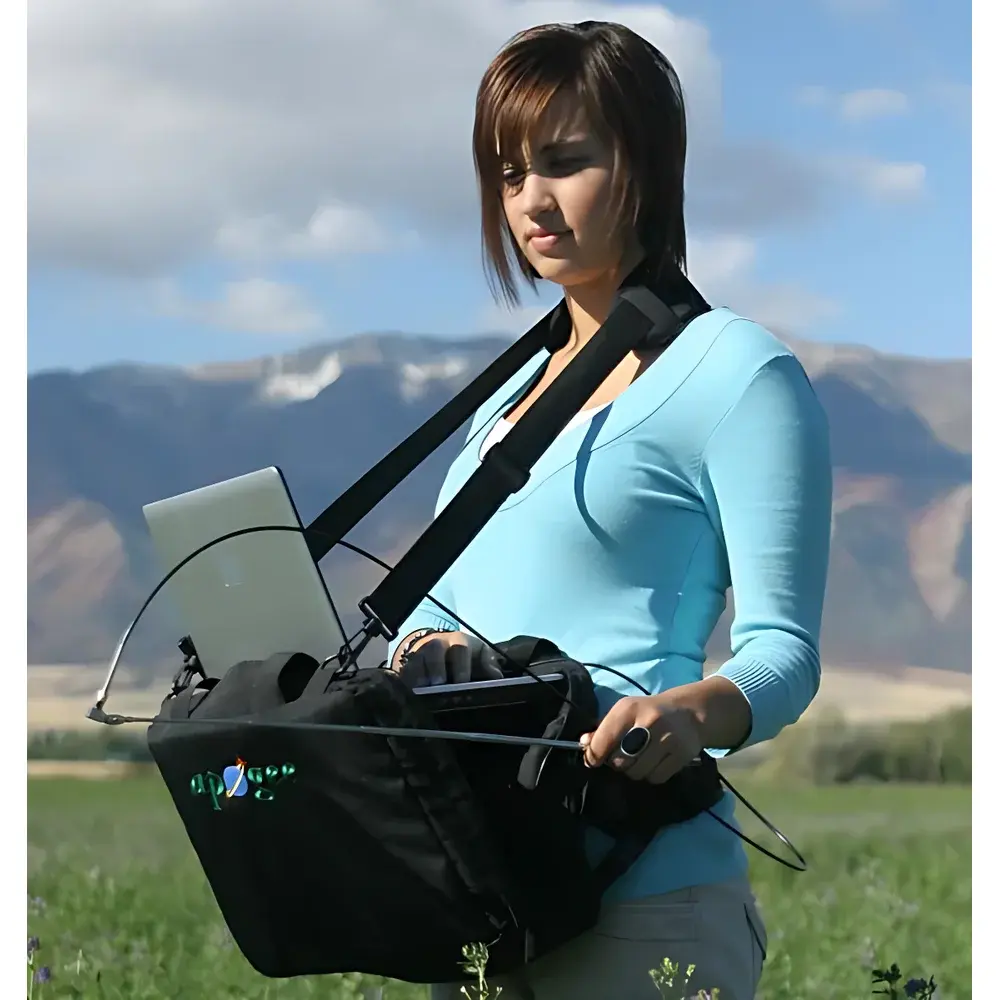
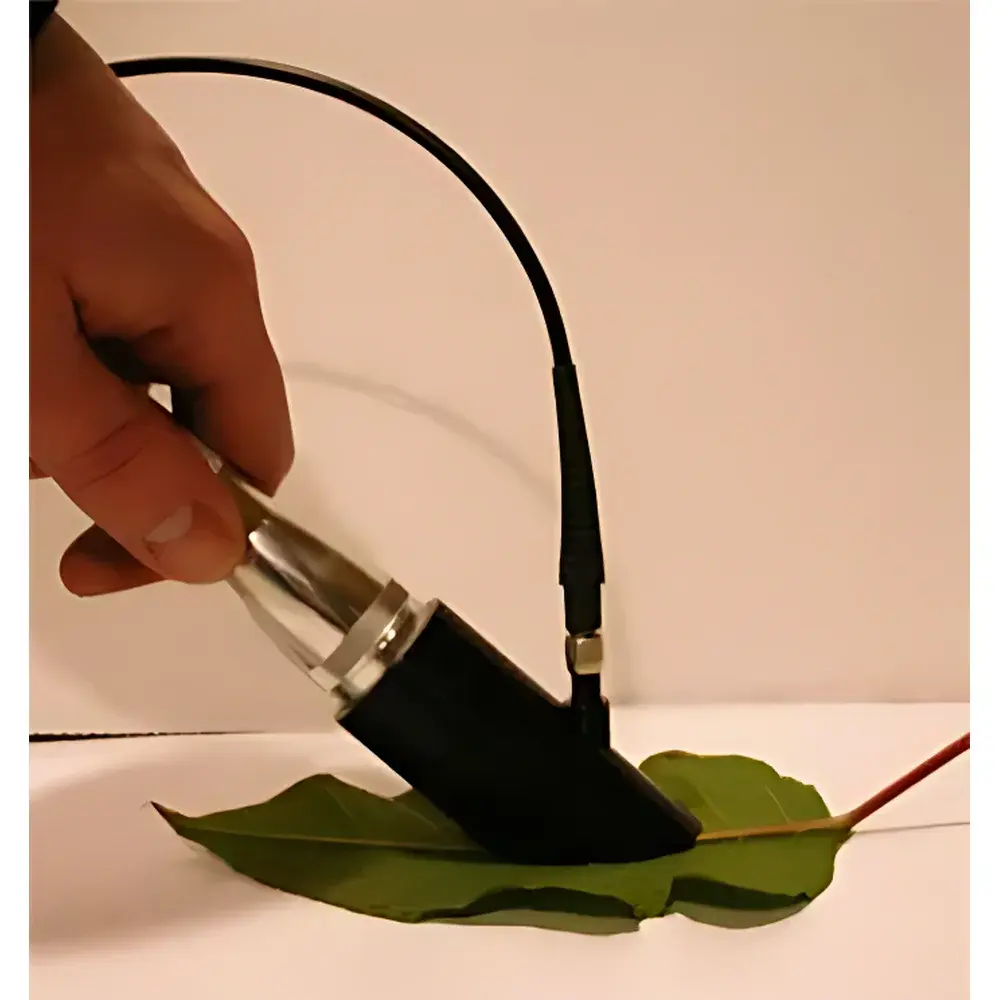
Apogee PS-300 UV-VIS-NIR Spectrometer
| Brand | Apogee |
|---|---|
| Origin | USA |
| Model | PS-300 |
| Spectral Range | 220–1100 nm |
| Calibration Range | 300–1100 nm |
| Wavelength Resolution | 1.5 nm |
| Detector | 2048-pixel CCD |
| Grating Density | 590 grooves/mm |
| A/D Conversion | 16-bit |
| Signal-to-Noise Ratio | 1000:1 |
| Stray Light | 0.02% at 435 nm, 0.2% at 220 nm |
| Repeatability | <1% |
| Radiometric Accuracy | ±10% |
| Integration Time | 1 ms – 65 s |
| Angular Response (up to 80°) | ±5% |
| Interface | USB 2.0 |
| Power | 5 V DC / 100 mA via USB |
| Operating Temperature | 0–60 °C |
| Fiber Optic Cable Length | 2 m |
| Dimensions | 69 × 100 × 150 mm |
| Weight | 900 g |
Overview
The Apogee PS-300 UV-VIS-NIR Spectrometer is a compact, high-performance benchtop spectrometer engineered for precise spectral radiometry and reflectance measurements across the ultraviolet, visible, and near-infrared domains (220–1100 nm). Utilizing a fixed-grating optical design with a 2048-pixel linear CCD array and a 590 grooves/mm holographic grating, the PS-300 delivers consistent dispersion and stable wavelength calibration—critical for quantitative irradiance, illuminance, colorimetric, and material characterization applications. Its 1.5 nm optical resolution enables reliable separation of closely spaced spectral features in LED emission profiling, solar simulator validation, thin-film interference analysis, and plant photobiology studies. The instrument operates without external power supplies—drawing regulated 5 V DC directly from a standard USB 2.0 port—making it suitable for field-deployable setups, integration into OEM systems, and laboratory environments where electrical isolation or portability is required.
Key Features
- Full-spectrum coverage from deep UV (220 nm) to NIR (1100 nm), with factory-calibrated radiometric response over 300–1100 nm
- High signal fidelity enabled by 16-bit analog-to-digital conversion and >1000:1 signal-to-noise ratio (at 1 s integration)
- Low stray light performance: ≤0.02% at 435 nm and ≤0.2% at 220 nm—essential for accurate UV absorbance and fluorescence background rejection
- Integrated cosine-corrected irradiance probe with black anodized cap ensures uniform angular response (±5% up to 80° incidence), compliant with CIE S 023 and ISO/CIE 19476 standards for spectral irradiance measurement
- Rugged aluminum housing (69 × 100 × 150 mm, 900 g) with thermal stabilization design for operation across 0–60 °C ambient conditions
- USB-powered architecture eliminates need for auxiliary power adapters; compatible with Windows, macOS, and Linux via standard CDC/ACM class drivers
Sample Compatibility & Compliance
The PS-300 supports diverse optical configurations through its detachable 2 m SMA-terminated fiber optic cable and modular accessories—including horizontal mounting brackets, handheld extension poles, and calibrated irradiance probes. It accommodates both reflective (e.g., paint, foliage, semiconductor wafers) and transmissive (e.g., filters, optical coatings, aqueous solutions) samples when paired with appropriate illumination sources (deuterium-halogen, LED arrays, or pulsed xenon). Radiometric calibration traceability follows NIST-traceable protocols, and the included certificate documents wavelength accuracy (±0.3 nm), irradiance linearity (R² > 0.9998), and responsivity uncertainty (k=2). The system meets general requirements for GLP-compliant spectral data acquisition when used with audit-trail-enabled software and controlled environmental documentation.
Software & Data Management
Apogee provides native USB drivers and the SpectraWiz™ acquisition suite (v5.x), supporting real-time spectral preview, batch acquisition, dark-current subtraction, spectral smoothing (Savitzky-Golay), and export to CSV, TXT, and XML formats. The SDK includes C/C++, Python (PyApogee), and MATLAB bindings for custom automation—enabling integration into LabVIEW, Python-based QC workflows, or LIMS environments. All spectral datasets retain embedded metadata (integration time, temperature, serial number, calibration timestamp), satisfying minimum FAIR (Findable, Accessible, Interoperable, Reusable) data principles. While the base firmware does not implement FDA 21 CFR Part 11 electronic signature controls, third-party validated wrappers are available for regulated pharmaceutical or medical device testing labs requiring audit trails and user access logs.
Applications
- LED and OLED spectral power distribution (SPD) characterization per IES LM-79 and CIE 127
- Solar simulator spectral match evaluation (Class AAA per IEC 60904-9:2020)
- Photosynthetically Active Radiation (PAR, 400–700 nm) and Phytochrome Photostationary State (PSS) quantification in agronomy and horticultural lighting
- UV-C disinfection lamp output monitoring (220–280 nm) with stray-light-corrected irradiance reporting
- Thin-film thickness and refractive index determination via interference fringe analysis in transmission mode
- Educational spectroscopy labs requiring robust, low-maintenance instrumentation with intuitive interface and curriculum-aligned examples
FAQ
Is the PS-300 calibrated for absolute irradiance measurement?
Yes—the instrument ships with a NIST-traceable calibration certificate covering 300–1100 nm, specifying responsivity (µW/cm²/nm/count) at 1 nm intervals. Calibration is valid for cosine-corrected irradiance mode using the included probe.
Can the integration time be synchronized with external triggers?
No—the PS-300 does not support hardware triggering. However, software-controlled sequential acquisition with microsecond-level timestamping is supported via the API.
What is the recommended maintenance interval for recalibration?
Annual recalibration is advised for metrology-critical applications; biennial verification suffices for routine QA/QC under stable environmental conditions.
Does the spectrometer support fiber-optic coupling to integrating spheres?
Yes—standard 400 µm core, 0.22 NA SMA-905 fibers are compatible. Sphere coupling requires matching port geometry and proper baffling to minimize port leakage artifacts.
Is the 220 nm lower limit usable for ozone absorption studies?
The detector exhibits measurable quantum efficiency down to 220 nm, but atmospheric ozone and oxygen absorption below 240 nm necessitate nitrogen-purged or vacuum-path configurations for reproducible sub-240 nm radiometry.
Related Products





