
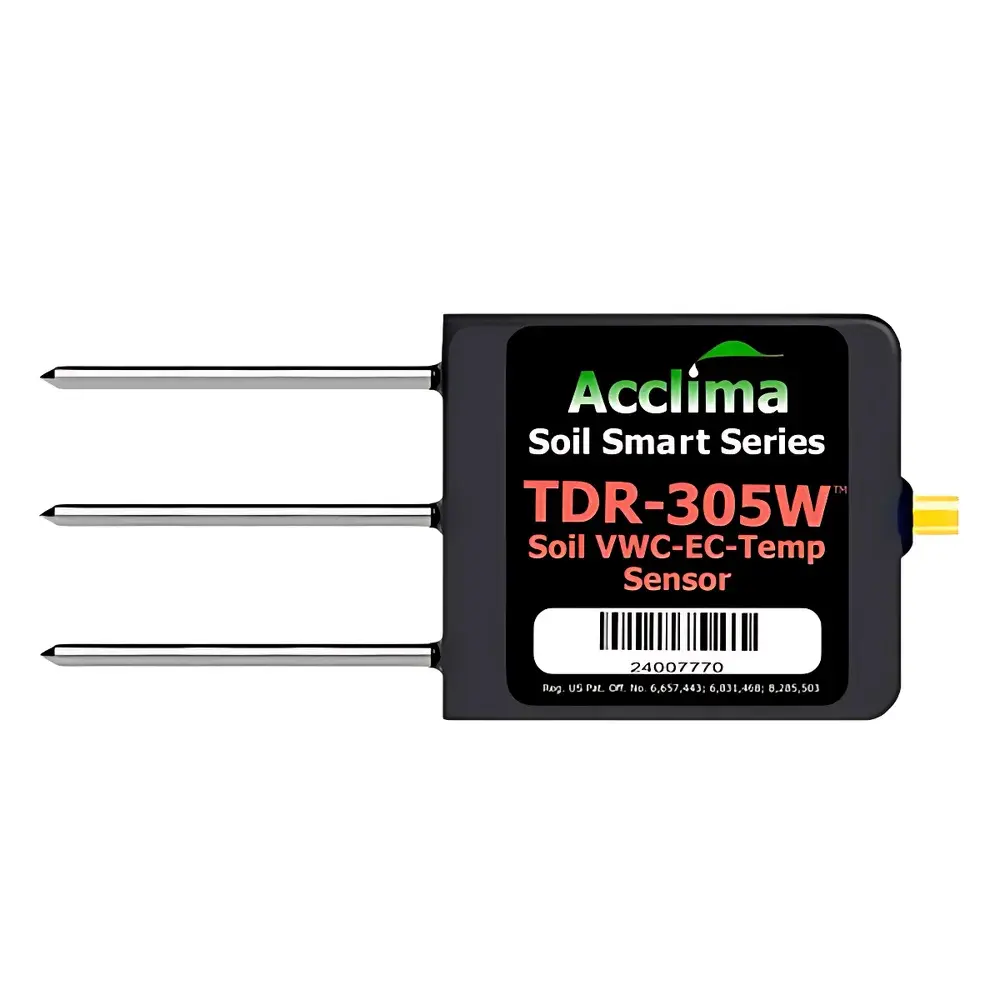
Acclima TDR305W Integrated Soil Moisture, Temperature, and Electrical Conductivity Sensor
| Brand | Acclima, Inc. |
|---|---|
| Origin | USA |
| Model | TDR305W |
| Measurement Principle | Time-Domain Reflectometry (TDR) |
| Output Interface | 3-wire SDI-12 v1.4 compliant |
| Volumetric Water Content Range | 0–100% VWC |
| Resolution | 0.1% VWC |
| Accuracy | ±5% FS |
| Bulk EC Range | 0–9000 µS/cm |
| Pore Water EC (Hilhorst model) | 0–55,000 µS/cm |
| EC Accuracy | ±25 µS/cm (0–1000 µS/cm), ±2.5% (1000–2500 µS/cm), ±5% (2500–6000 µS/cm), ±7.5% (6000–9000 µS/cm) |
| Dielectric Constant Range | 1–100 |
| Resolution | 0.1 |
| Accuracy | ±4% |
| Temperature Range | −40 to +55 °C |
| Resolution | 0.1 °C |
| Accuracy | ±0.25 °C (5–35 °C), ±0.5 °C (−15–50 °C) |
| Waveform Digitization Resolution | 5 ps |
| Input Pulse Amplitude | 2.3 V |
| Housing | Waterproof epoxy-filled enclosure |
| Power Supply | 4.2–15 V DC |
| Quiescent Current | <26 µA |
| Active Current | 90 mA @ 12 V DC |
| Dimensions (sensor head) | 110 × 53 × 20 mm |
| Probe Length | 49.55 mm |
| Probe Diameter | 3.5 mm |
| Weight (bare sensor) | 94 g |
| Standard Cable Length | 5 m (optional: 10 m) |
Overview
The Acclima TDR305W is a fully integrated, high-fidelity time-domain reflectometry (TDR) sensor engineered for simultaneous, in-situ measurement of volumetric water content (VWC), bulk electrical conductivity (EC), pore water EC (via Hilhorst model), and soil temperature. Unlike conventional capacitance-based or single-frequency impedance sensors, the TDR305W employs true time-domain analysis—generating ultrafast electromagnetic pulses and digitizing reflected waveforms with 5 picosecond timing resolution. This enables direct quantification of signal propagation velocity and attenuation, which are physically linked to dielectric permittivity and ionic conduction losses in the soil matrix. Its compact, low-profile design (110 × 53 × 20 mm) and short 49.55 mm probe geometry were specifically optimized for use in mineral-deficient growing media—including peat, coco coir, rockwool, and hydroponic substrates—where high salinity and low dielectric contrast challenge conventional TDR and FDR instruments.
Key Features
- True TDR architecture with on-board waveform generation, acquisition, and real-time analysis firmware—eliminating reliance on external data loggers for pulse processing.
- Enhanced signal amplitude (2.3 V incident pulse) and improved waveform SNR, enabling robust operation in high-conductivity soils (>3,000 µS/cm bulk EC) without signal saturation or distortion.
- High-resolution 5 ps timebase ensures precise determination of reflection travel time, critical for accurate dielectric constant calculation and VWC derivation across diverse soil textures and organic media.
- SDI-12 v1.4-compliant 3-wire interface supports seamless integration with industry-standard environmental data loggers (e.g., Campbell Scientific CR series, Onset HOBO, Decagon EM50), including legacy systems.
- Epoxy-filled, IP68-rated housing provides long-term resistance to moisture ingress, root intrusion, and chemical corrosion—validated for continuous burial in agricultural, greenhouse, and vertical farming installations.
- Ultra-low quiescent current (<26 µA) enables multi-year deployment on solar-recharged or battery-limited networks, while active current draw remains predictable and stable across −35 to +50 °C ambient conditions.
Sample Compatibility & Compliance
The TDR305W is validated for direct insertion into mineral soils (sand, loam, clay), structured horticultural substrates (perlite, vermiculite), and organic media (peat moss, coconut fiber, sphagnum). Its short probe length minimizes lateral signal dispersion in heterogeneous media, improving spatial representativeness at shallow depths (0–15 cm). The sensor complies with ASTM D5778 (Standard Test Method for Electronic Friction Cone and Piezocone Penetration Testing) for waveform integrity and signal fidelity. While not certified under ISO/IEC 17025 for calibration traceability, its factory calibration adheres to NIST-traceable reference standards for dielectric permittivity and thermal response. Data output meets GLP-aligned field documentation requirements when paired with SDI-12 loggers supporting timestamped, non-volatile storage and audit trails.
Software & Data Management
Raw waveform data is processed internally using Acclima’s proprietary firmware, implementing full deconvolution of incident and reflected pulses to compute dielectric constant, apparent EC, and temperature-corrected VWC per ASTM D6988 and ISO 11272. No post-processing software is required for standard outputs; however, optional Acclima TDR Studio (Windows/macOS) enables advanced diagnostics—including waveform visualization, reflection coefficient mapping, and custom calibration curve import. All SDI-12 commands support asynchronous polling, command queuing, and error-checking CRC—ensuring interoperability in mixed-sensor networks. When deployed with FDA 21 CFR Part 11–compliant data loggers (e.g., Campbell CR6 with secure firmware), the system supports electronic signatures, audit logs, and data integrity verification for regulated horticultural or research applications.
Applications
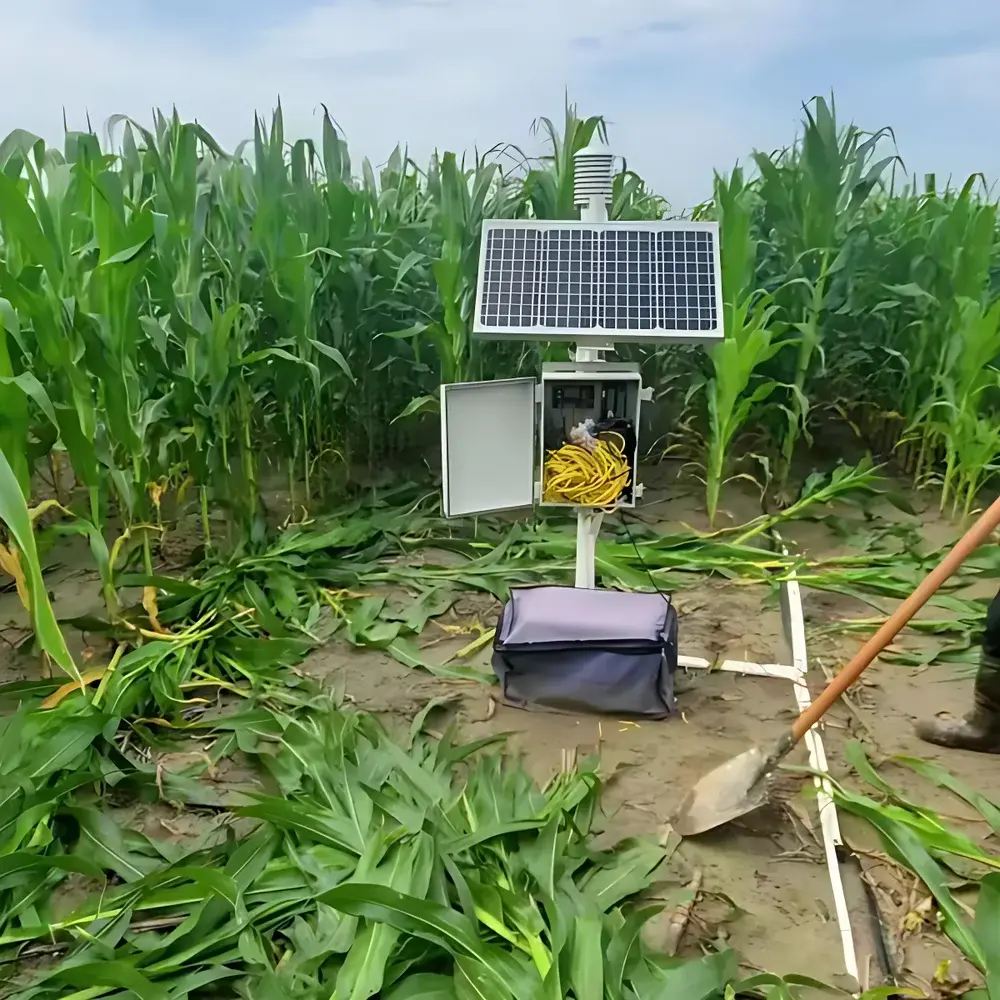
- Irrigation scheduling in precision agriculture and controlled-environment agriculture (CEA), where real-time VWC and pore water EC inform fertigation decisions.
- Salinity monitoring in reclaimed soils, coastal farmland, and greenhouse substrates subject to sodium accumulation.
- Root-zone phenotyping studies requiring sub-hourly resolution of water dynamics in hydroponic and aeroponic systems.
- Long-term ecological monitoring in edaphic research—particularly where low-biomass, high-organic soils exhibit non-linear dielectric behavior.
- Calibration reference for proximal sensing platforms (e.g., cosmic-ray neutron probes, ground-penetrating radar) due to its high spatial specificity and physical measurement basis.
FAQ
Does the TDR305W require external calibration for different soil types?
No—its physics-based TDR method eliminates empirical soil-specific calibrations. However, users may apply optional site-specific offset corrections for VWC or EC if operating outside Acclima’s validated mineral/organic media range.
Can the sensor be installed horizontally or only vertically?
It is designed for vertical insertion, and Acclima supplies alignment guide rails to ensure parallel probe orientation during installation. Horizontal mounting is not recommended due to asymmetric waveguide coupling and potential air-gap artifacts.
Is the 5 m cable shielded and suitable for buried deployment?
Yes—the standard cable uses twisted-pair, tinned-copper conductors with polyethylene insulation and UV-stabilized PVC jacket, rated for direct burial and continuous immersion.
How does the TDR305W handle freezing conditions?
The sensor operates from −40 to +55 °C, and its epoxy encapsulation prevents ice-lens formation within the electronics cavity. However, frozen soil may attenuate the TDR signal; VWC readings below 0 °C should be interpreted with caution and cross-verified with thermocouple data.
What is the expected service life under continuous field exposure?
Based on accelerated aging tests and field deployments exceeding 5 years, the TDR305W demonstrates >95% functional reliability at 7 years when installed per Acclima’s mechanical stress guidelines (e.g., avoiding bending at the sensor-head junction).
Related Products







