
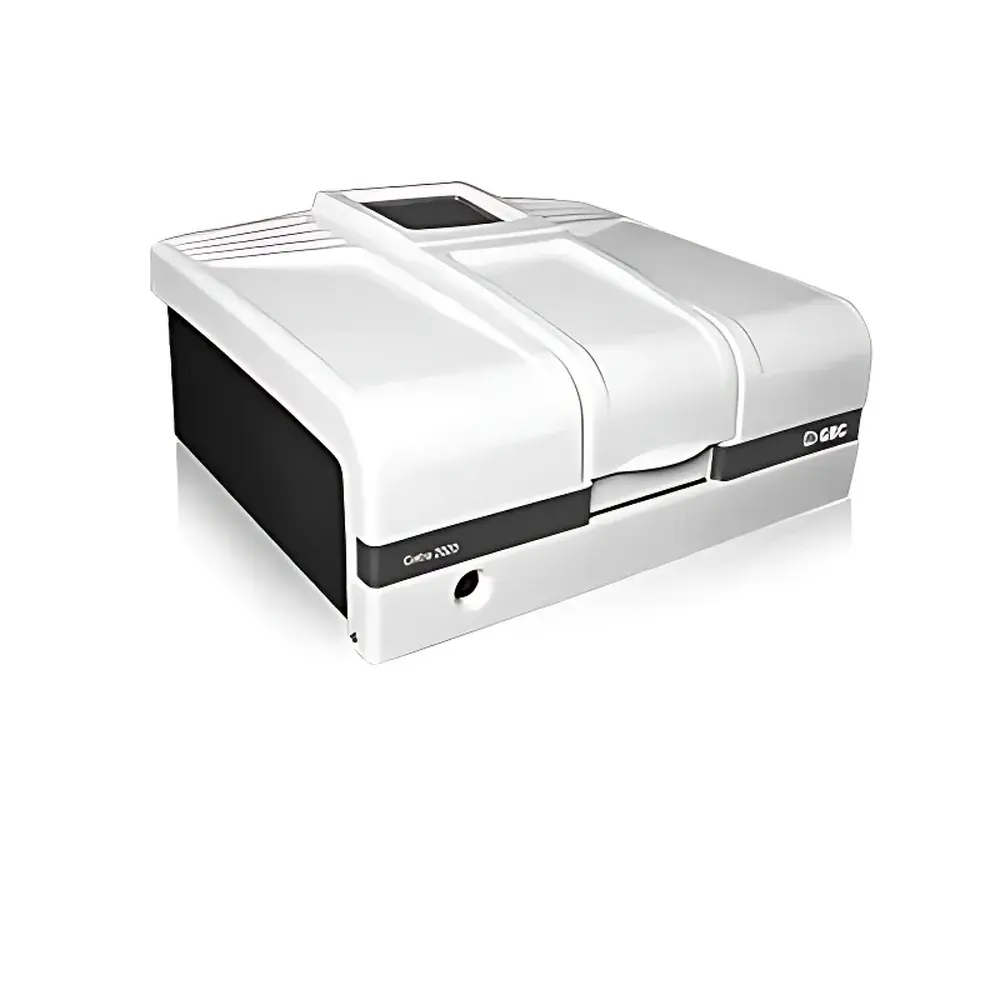
GBC Cintra1010 Dual-Beam UV-Vis Spectrophotometer
| Brand | GBC |
|---|---|
| Origin | Australia |
| Model | Cintra1010 |
| Optical Design | Dual-Beam |
| Detector Type | Photodiode Array (PDA) |
| Wavelength Range | 190–1100 nm |
| Spectral Bandwidth | 2.0 nm (fixed) |
| Wavelength Accuracy | ±0.5 nm |
| Stray Light | <0.01% T at 220 nm and 340 nm |
| Automation | Motorized Wavelength Scanning & Auto-Zero |
| Compliance | ASTM E275, ISO 6223, USP <857>, FDA 21 CFR Part 11 (with optional audit trail module) |
Overview
The GBC Cintra1010 is a dual-beam ultraviolet-visible (UV-Vis) spectrophotometer engineered for precision, reliability, and routine laboratory performance. Based on a robust double-beam optical architecture with real-time reference beam compensation, it minimizes drift caused by lamp instability or environmental fluctuations—ensuring high photometric reproducibility across extended measurement sessions. Its core optical path employs a Czerny-Turner monochromator with holographic grating, coupled to a high-density photodiode array (PDA) detector that enables rapid full-spectrum acquisition (190–1100 nm) without mechanical scanning. The fixed 2.0 nm spectral bandwidth delivers optimal balance between resolution and signal-to-noise ratio for general-purpose quantitative analysis in pharmaceutical QC, environmental testing, academic teaching labs, and industrial R&D settings.
Key Features
- Dual-beam optical design with simultaneous sample/reference monitoring for enhanced baseline stability and reduced thermal drift
- Photodiode array (PDA) detector enabling full-spectrum acquisition in under 1 second with no moving parts in detection path
- Wavelength accuracy of ±0.5 nm and repeatability better than ±0.1 nm—validated per ASTM E275 and ISO 6223 protocols
- Stray light level <0.01% T at critical wavelengths (220 nm and 340 nm), meeting stringent requirements for high-absorbance measurements (up to 3.5 Abs)
- Motorized wavelength drive with auto-zero and auto-calibration functions for consistent instrument readiness
- Integrated cuvette holder with temperature-insensitive alignment and optional 8-position autosampler compatibility
- Robust mechanical construction with thermally stable optical bench and sealed optical compartment to minimize dust ingress and humidity effects
Sample Compatibility & Compliance
The Cintra1010 supports standard 10 mm square quartz, glass, or plastic cuvettes (pathlengths from 1 mm to 50 mm via adapters), as well as microvolume accessories including capillary cells and 2–5 µL direct-load microplates. It complies with international regulatory frameworks applicable to analytical instrumentation: ASTM E275 (Standard Test Methods for Absorbance Accuracy of UV-Vis Spectrophotometers), ISO 6223 (Performance verification of molecular absorption spectrometers), and USP (Spectrophotometry and Light-Scattering). When configured with the optional GLP/GMP software package, the system provides full 21 CFR Part 11 compliance—including electronic signatures, user-level access control, and immutable audit trails for all method changes, calibration events, and data exports.
Software & Data Management
Cintral™ software (v5.x) serves as the native platform for instrument control, data acquisition, and post-processing. It includes validated modules for quantitative analysis (single/multi-point calibration, Beer-Lambert regression), kinetic time-course studies, spectral overlay and derivative analysis, colorimetric calculations (CIE L*a*b*, ΔE), and DNA/RNA purity assessment (A260/A280, A260/A230 ratios). The “Automatic System Performance Verification” module executes IQ/OQ protocols per vendor-defined specifications and supports user-defined test sequences aligned with pharmacopeial standards (e.g., EP 2.2.25, JP 2.07). Data export formats include CSV, XML, PDF reports with embedded metadata, and direct integration with LIMS via ODBC or HL7-compliant interfaces.
Applications
The Cintra1010 is routinely deployed in applications requiring trace-level quantification and spectral fidelity under regulated conditions: active pharmaceutical ingredient (API) assay and dissolution testing; water quality analysis (nitrate, phosphate, COD); enzyme kinetics and protein concentration determination (Bradford, BCA, Lowry); polymer characterization (additive concentration, degradation monitoring); food and beverage quality control (color index, preservative content); and educational laboratories for fundamental spectroscopy instruction. Its low noise floor ( 0.9999 over 0–2.5 Abs) support accurate calibration curves across diverse matrix types.
FAQ
What is the maximum absorbance range supported by the Cintra1010?
The instrument maintains photometric linearity up to 3.5 Abs with an optical density dynamic range exceeding 4.0 Abs.
Is the Cintra1010 compatible with fiber-optic probes or flow cells?
Yes—via optional external port interface and third-party accessory kits certified for use with GBC’s optical coupling specifications.
Can the system be validated for GMP environments?
Yes—when equipped with Cintral™ GLP/GMP software and paired with documented IQ/OQ/PQ protocols provided in the Validation Support Package.
Does the PDA detector require periodic recalibration?
No—wavelength calibration is performed automatically during startup using internal holmium oxide and didymium references; intensity calibration uses a stabilized tungsten-halogen source.
What maintenance is required for long-term operational stability?
Annual optical alignment verification and desiccant replacement in the detector housing are recommended; no lamp alignment or grating servicing is needed under normal usage.





