
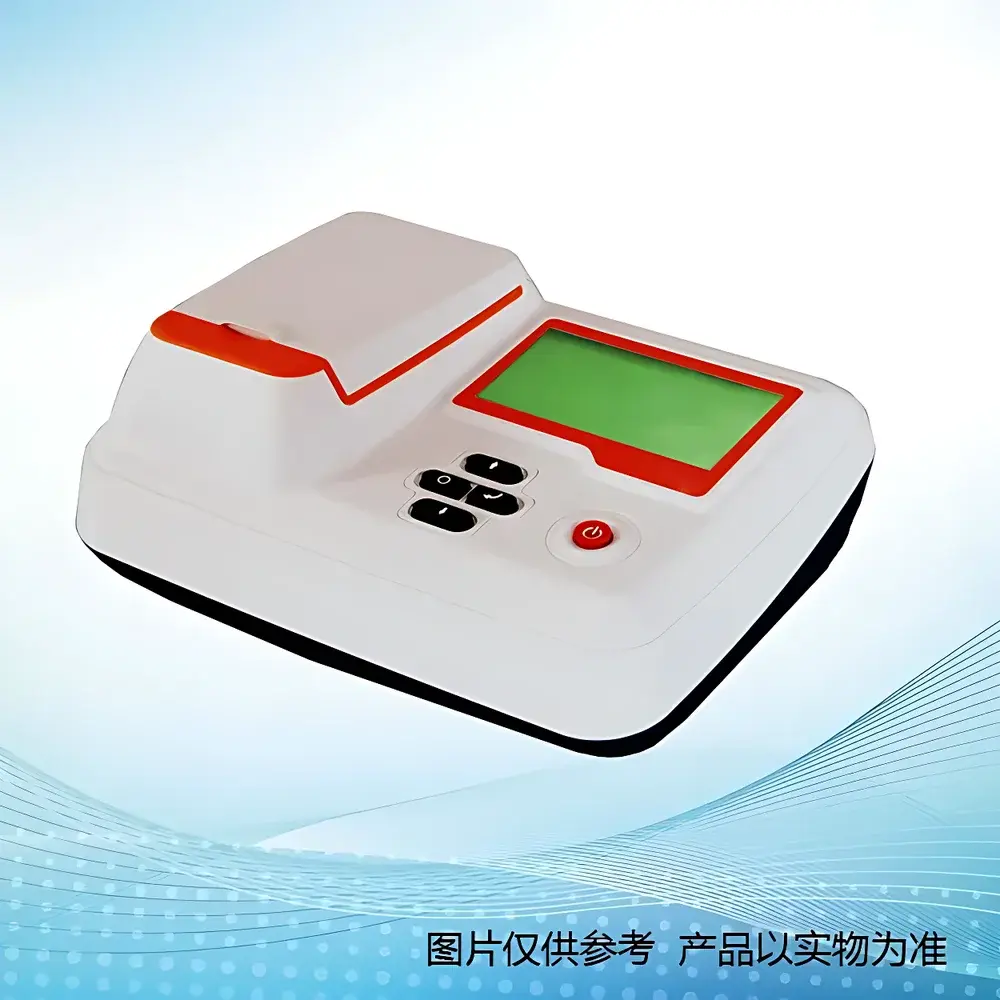
JiDa-Xiaotianshen GDYQ-201SX Beer Formaldehyde Analyzer
| Brand | JiDa-Xiaotianshen |
|---|---|
| Origin | Jilin, China |
| Manufacturer Type | Direct Manufacturer |
| Regional Category | Domestic (PRC) |
| Model | GDYQ-201SX |
| Instrument Type | Beer-Specific Formaldehyde Analyzer |
| Application | Laboratory Use |
| Dimensions (L × W × H) | 310 mm × 225 mm × 125 mm |
| Weight | 1.7 kg |
| Detection Limit | 1.0 mg/kg |
| Measurement Range | 0.0–100.0 mg/kg |
| Accuracy | ±2% |
| Method Reference | Modified GB/T 5009.49–2003 |
| Analysis Time | ≤15 minutes per sample |
| Display | Backlit LCD with Chinese UI |
| Control System | Embedded MCU with integrated data management functions |
| Sample Prep | Dedicated pretreatment kit + single-use reagent cartridges |
Overview
The JiDa-Xiaotianshen GDYQ-201SX Beer Formaldehyde Analyzer is a dedicated laboratory instrument engineered for the quantitative determination of formaldehyde in finished beer and related malt beverages. It operates on a spectrophotometric principle based on the acetylacetone (3-methyl-2,4-pentanedione) colorimetric reaction—modified in strict accordance with the national standard GB/T 5009.49–2003, which specifies analytical methodology for formaldehyde in food products. In this reaction, formaldehyde reacts with acetylacetone under acidic heating conditions to form a stable yellow chromophore (3,5-diacetyl-1,4-dihydrolutidine), measurable at 412 nm. The GDYQ-201SX integrates optical detection, temperature-controlled reaction incubation, and embedded microcontroller-based signal processing into a compact benchtop platform. Its design prioritizes reproducibility, operator safety, and regulatory traceability—critical requirements for QC laboratories performing routine release testing of commercial beer batches under food safety quality systems.
Key Features
- Compliant methodology: Implements a validated, GB/T 5009.49–2003–aligned protocol with documented method equivalence for formaldehyde quantification in low-turbidity, ethanol-containing matrices.
- Rapid analysis cycle: Delivers quantitative results within ≤15 minutes per sample—including reagent addition, thermal reaction (60 °C, 10 min), optical readout, and automatic concentration calculation.
- Dedicated sample preparation system: Includes proprietary disposable reagent cartridges and a compact, integrated pretreatment module to minimize cross-contamination and eliminate manual pipetting variability.
- Embedded intelligence: Features an 8-bit MCU with non-volatile memory for storing up to 500 test records, calibration curves, user-defined batch IDs, and timestamped measurement logs.
- Human-centered interface: Equipped with a 128×64 pixel backlit monochrome LCD supporting full Chinese character display, menu navigation, real-time status prompts, and on-device help guidance.
- Robust mechanical architecture: Compact footprint (310 × 225 × 125 mm), lightweight (1.7 kg), and designed for stable operation on standard lab benches without external vibration isolation.
Sample Compatibility & Compliance
The GDYQ-201SX is validated for use with filtered, clarified beer samples (lager, pilsner, ale, stout, and non-alcoholic variants) across alcohol contents of 2–8% v/v. It accommodates typical brewery filtration methods (diatomaceous earth, sheet filters, or sterile membrane filtration ≤0.45 µm). Interference studies confirm minimal matrix effects from common beer constituents including iso-α-acids, residual sugars (<2 g/L), ethanol, and hop oils when samples are processed per the included pretreatment protocol. While not certified to ISO/IEC 17025 by default, the instrument supports GLP-compliant workflows through its audit-ready data logging (user ID, date/time stamp, calibration verification flag, raw absorbance values). Optional RS-232 output enables integration with LIMS platforms compliant with FDA 21 CFR Part 11 requirements when paired with validated third-party software.
Software & Data Management
All operational logic—including photometric calibration, blank subtraction, curve fitting (linear or 2-point calibration), and concentration derivation—is executed onboard. No PC dependency is required for basic operation. Calibration curves may be stored for up to five distinct lot numbers of reagent cartridges. Each test record includes: sample ID, operator code, measurement date/time, raw A412, blank-corrected absorbance, calculated concentration (mg/kg), and pass/fail flag relative to internal specification limits (configurable). Data export is supported via serial interface using ASCII-delimited format compatible with Excel, LabArchives, or custom SQL ingestion scripts. Firmware updates are delivered via UART bootloader—ensuring long-term maintainability without hardware replacement.
Applications
- Final product release testing in brewery QC labs to verify compliance with China’s GB 2758–2012 (National Food Safety Standard for Fermented Alcoholic Beverages), which sets a maximum formaldehyde limit of 20 mg/kg in beer.
- Process validation during cold stabilization and filtration stages where formaldehyde-forming agents (e.g., formaldehyde-releasing preservatives or unintended Maillard-derived formation) may accumulate.
- Raw material screening of adjuncts (e.g., rice grits, corn syrup) and brewing water for exogenous formaldehyde contamination.
- Contract laboratory support for brand owners requiring documented, repeatable formaldehyde data under CNAS-accredited testing scopes.
- Educational use in food science programs focusing on analytical method validation, spectrophotometry, and food additive safety assessment.
FAQ
What formaldehyde detection principle does the GDYQ-201SX employ?
It uses the acetylacetone colorimetric method per modified GB/T 5009.49–2003, generating a measurable chromophore at 412 nm.
Is the instrument suitable for unfiltered or hazy beer samples?
No—samples must be clarified by filtration (≤0.45 µm) prior to analysis to avoid turbidity-induced photometric error.
Can calibration curves be imported from external standards?
Calibration is performed in situ using supplied certified reference standards; external curve import is not supported.
Does the device meet international regulatory requirements such as EU Regulation (EC) No 1333/2008?
It provides measurement data consistent with formaldehyde quantification needs under multiple jurisdictions; formal regulatory acceptance depends on local method validation per laboratory SOPs.
How often must the optical path be cleaned or recalibrated?
The cuvette holder and LED-photodiode optical assembly require cleaning only if visible residue accumulates; factory calibration remains stable for ≥12 months under normal use.
Related Products






