
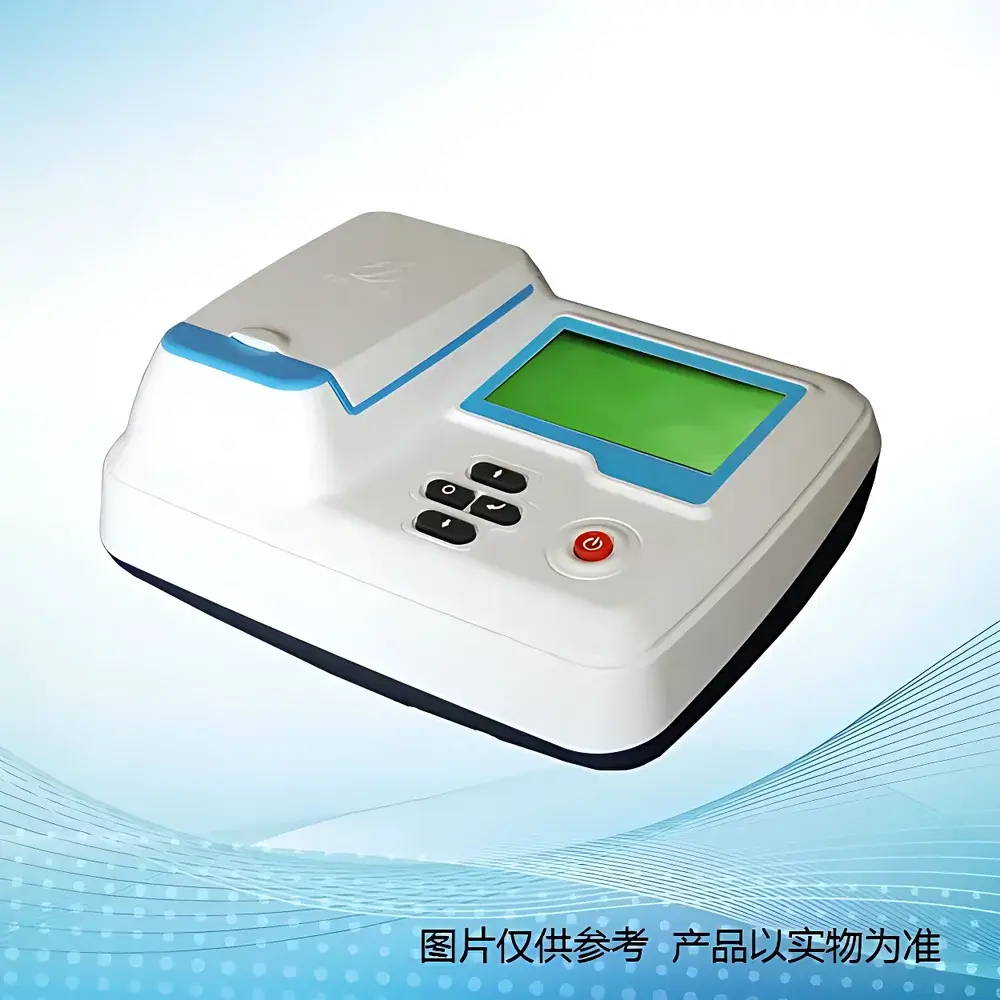
Jiada Xiaotian’e GDYK-401RC Indoor Air Quality Analyzer
| Brand | Jiada Xiaotian'e |
|---|---|
| Origin | Jilin, China |
| Manufacturer Type | Direct Manufacturer |
| Model | GDYK-401RC |
| Detection Principle | Colorimetric Method |
| Measurement Range | Formaldehyde: 0.00–2.00 mg/m³ |
| Ammonia | 0.00–5.00 mg/m³ |
| Benzene & BTEX | 0.00–1.00 mg/m³ |
| TVOC | 0.00–4.00 mg/m³ |
| Resolution | 0.01 mg/m³ |
| Repeatability | ≤ ±5% |
| Sampling Method | Pump-aspirated |
| Response Time (Formaldehyde) | 22 min |
| Operating Temperature | 10–40 °C |
| Relative Humidity Range | 15–95% RH |
| Detection Limits | Formaldehyde: 0.01 mg/m³ |
| Ammonia | 0.10 mg/m³ |
| Benzene & BTEX | 0.05 mg/m³ |
| TVOC | 0.05 mg/m³ |
Overview
The Jiada Xiaotian’e GDYK-401RC Indoor Air Quality Analyzer is a field-deployable, multi-analyte colorimetric instrument engineered for quantitative on-site assessment of key indoor air pollutants. It operates on the principle of spectrophotometric absorption measurement following chemical derivatization—where target gases (formaldehyde, ammonia, benzene, BTEX, and total volatile organic compounds) react with pre-formulated reagents to generate chromophores with characteristic absorbance maxima. The integrated optical path employs a high-stability LED light source coupled with a monochromator module, enabling precise photometric quantification at defined wavelengths. Designed for compliance with Chinese national standards—including GB/T 18204.2–2014 for formaldehyde and ammonia in public premises—the GDYK-401RC delivers trace-level detection under ambient environmental conditions without requiring laboratory infrastructure. Its pump-aspirated sampling system ensures consistent volumetric draw across variable pressure and temperature gradients, while built-in compensation algorithms adjust raw absorbance values to standard reference conditions (0 °C, 101.325 kPa), supporting regulatory reporting and longitudinal trend analysis.
Key Features
- Single-channel, multi-parameter capability: Simultaneous quantification of formaldehyde, ammonia, benzene/BTEX, and TVOC using dedicated reagent kits and embedded calibration curves.
- Integrated photometric system: Monochromator-coupled high-luminance LED source with >100,000-hour operational lifetime and minimal spectral drift.
- Real-time environmental compensation: On-device input of ambient temperature and atmospheric pressure enables automatic conversion to standardized concentration units (mg/m³ at STP).
- Intuitive human interface: 4.7-inch backlit LCD display presenting real-time concentration values, absorbance readings, and system status in English-language UI.
- Portable power architecture: Dual-mode operation via AC mains (220 V ±10%, 50 Hz) or internal rechargeable Li-ion battery with low-power alert and >6 hours continuous runtime.
- Precision-engineered fluidics: Constant-flow diaphragm pump with flow rate stabilization ensures reproducible sample introduction and minimizes carryover between measurements.
Sample Compatibility & Compliance
The GDYK-401RC is validated for use with air samples collected directly from residential, commercial, and institutional indoor environments—including offices, schools, hospitals, newly renovated dwellings, and childcare facilities. Its analytical methodology aligns with GB/T 18204.2–2014 for formaldehyde and ammonia determination, and supports method adaptation for benzene and TVOC per GB/T 18883–2002 (Indoor Air Quality Standard). While not certified to ISO 16000 series or ASTM D5197/D6196 by default, the instrument’s documented repeatability (≤±5%), resolution (0.01 mg/m³), and detection limits meet minimum performance criteria for preliminary screening and QA/QC workflows in non-regulated or semi-regulated settings. All reagent kits are factory-prepared, lot-controlled, and labeled with expiration dates to ensure analytical consistency and chain-of-custody integrity.
Software & Data Management
The GDYK-401RC includes PC-based companion software for post-acquisition data handling and reporting. Users may assign custom sample IDs, location tags, operator names, and testing timestamps prior to measurement. The software stores raw absorbance, compensated concentration, environmental parameters, and reagent lot numbers in structured format, exporting fully traceable datasets as native Excel (.xlsx) files. Audit trails include date/time stamps for each data entry, modification, and export event. Although the current firmware does not support FDA 21 CFR Part 11-compliant electronic signatures or role-based access control, the exported logs maintain sufficient metadata for GLP-aligned documentation in internal quality systems.
Applications
- Rapid pre- and post-remediation verification for IAQ service providers performing formaldehyde abatement or VOC mitigation.
- Batch validation of air purification devices (e.g., photocatalytic filters, activated carbon modules) under controlled exposure scenarios.
- On-site screening during construction handover or lease inspections to assess compliance with GB/T 18883–2002 thresholds.
- Educational and vocational training in environmental health sciences, where hands-on exposure to standardized colorimetric protocols is required.
- Community-level public health initiatives monitoring classroom or elderly care facility air quality over seasonal cycles.
FAQ
What gases can the GDYK-401RC measure simultaneously?
It quantifies formaldehyde, ammonia, benzene and related aromatic hydrocarbons (BTEX), and total volatile organic compounds (TVOC) — one parameter per test cycle using dedicated reagent kits.
Is the instrument suitable for outdoor or industrial stack monitoring?
No. It is calibrated and validated exclusively for indoor ambient air matrices within specified temperature (10–40 °C) and humidity (15–95% RH) ranges.
How often must the optical system be recalibrated?
Factory calibration remains stable for ≥12 months under normal use; annual verification against NIST-traceable reference standards is recommended.
Can third-party reagents be used with this analyzer?
Only manufacturer-supplied, lot-specific reagent kits are validated for accuracy and interference rejection; substitution voids performance guarantees.
Does the device store historical measurement data internally?
Yes — up to 1,000 test records including concentration, time stamp, temperature, pressure, and operator ID are retained in non-volatile memory until exported.
Related Products







