
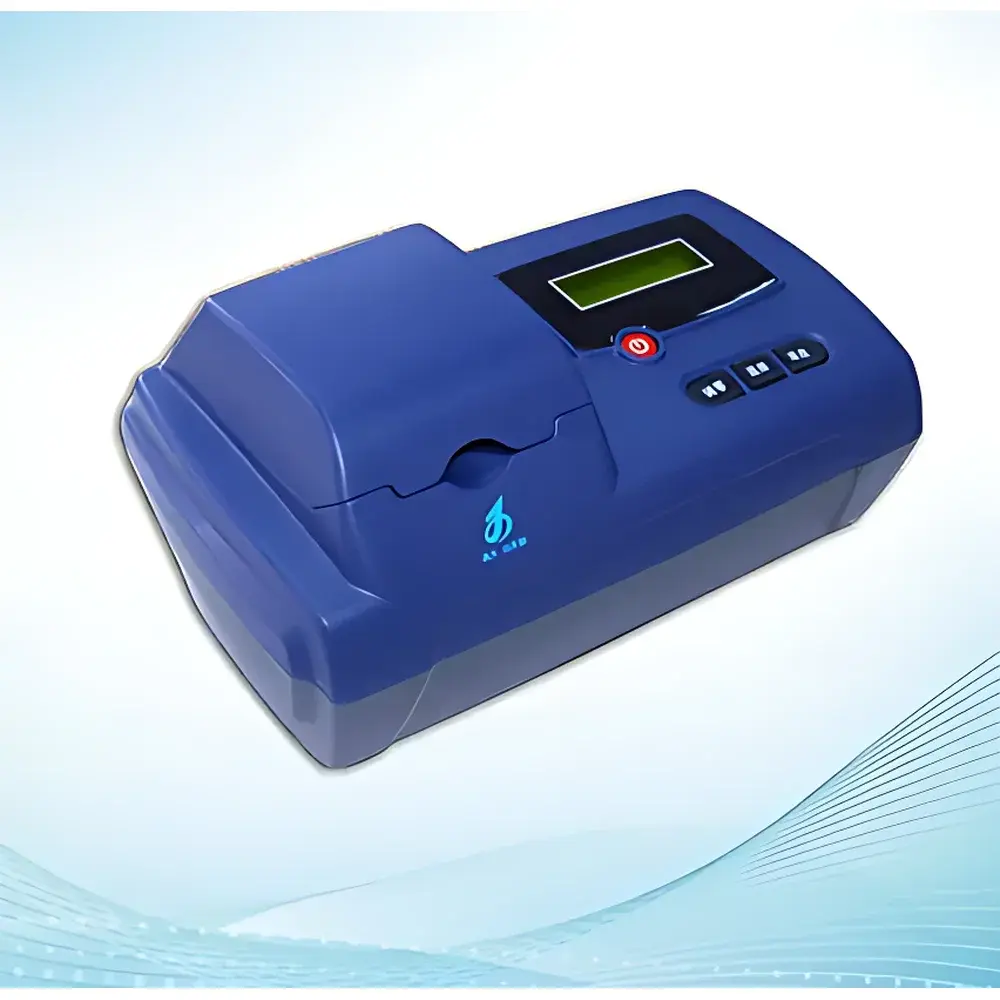
Jiada Xiaotianshe GDYS-101SM2 Portable Manganese Analyzer
| Brand | Jiada Xiaotianshe |
|---|---|
| Origin | Jilin, China |
| Manufacturer Type | Direct Manufacturer |
| Country of Origin | China |
| Model | GDYS-101SM2 |
| Instrument Type | Portable/Handheld Water Quality Analyzer |
| Analyte | Manganese |
| Detection Limit | 0.50 mg/L |
| Measurement Range | 0.00–4.00 mg/L |
| Accuracy | ±5% |
| Compliance Standard | GB/T 5750.6–2006 |
| Analysis Time | ≤10 minutes per sample |
| Reagent Format | Single-use proprietary test kit |
Overview
The Jiada Xiaotianshe GDYS-101SM2 Portable Manganese Analyzer is a field-deployable photometric instrument engineered for rapid, on-site quantification of dissolved manganese (Mn²⁺) in drinking water, surface water, groundwater, and wastewater effluents. It operates on the principle of colorimetric analysis based on the oxidation of manganese(II) to permanganate (MnO₄⁻) under controlled acidic conditions, followed by spectrophotometric measurement at 525 nm. This methodology aligns strictly with the Chinese National Standard GB/T 5750.6–2006 “Standard Examination Methods for Drinking Water – Metal Parameters”, ensuring regulatory traceability and methodological equivalence to laboratory-grade benchtop procedures. Designed for environmental technicians, water utility field staff, and municipal QA/QC personnel, the GDYS-101SM2 delivers laboratory-comparable results without requiring centralized instrumentation or skilled spectroscopist oversight.
Key Features
- Field-optimized optical path design with LED light source and precision interference filter centered at 525 nm, minimizing spectral drift and ambient light interference.
- Integrated microprocessor-controlled timing and signal processing, eliminating manual stopwatch use and subjective endpoint judgment.
- Dedicated single-use reagent kits pre-calibrated for the 0.00–4.00 mg/L range—each kit contains stabilized oxidant, acid buffer, and color-developing agent in sealed, moisture-resistant packaging.
- Self-contained calibration verification: each kit includes a reference standard solution for daily system verification prior to analysis.
- Robust, IP65-rated housing with rubberized grip and shock-absorbing casing suitable for outdoor deployment in variable temperature (5–40 °C) and humidity (30–85% RH) conditions.
- No external power supply required: powered by four AA alkaline batteries providing ≥200 measurements per set under typical usage.
Sample Compatibility & Compliance
The GDYS-101SM2 accepts untreated, filtered (≤0.45 µm), or centrifuged aqueous samples with turbidity <5 NTU. It is validated for use with potable water, river/lake water, treated effluent, and low-salinity groundwater (TDS <500 mg/L). Interference testing confirms minimal cross-reactivity from Fe²⁺ (<2 mg/L), Cu²⁺ (<0.5 mg/L), and Ni²⁺ (<0.3 mg/L); elevated levels require optional masking agents supplied separately. Method validation data meet the performance criteria outlined in GB/T 5750.6–2006, including repeatability (RSD ≤4.2%, n=6), recovery (94–103% across spiking levels), and detection capability (LOD = 0.50 mg/L, determined per ISO 11843-2). While not certified to ISO/IEC 17025, the instrument supports GLP-aligned documentation through its built-in result logging and manual record-keeping workflow.
Software & Data Management
The GDYS-101SM2 operates as a standalone, firmware-based analyzer with no embedded software stack or wireless connectivity. All calculations—including blank subtraction, calibration curve interpolation (linear fit), and concentration derivation—are executed in real time using factory-stored algorithm coefficients. Results are displayed numerically on a high-contrast LCD screen and may be manually recorded in field logs compliant with internal QA protocols. For laboratories integrating this device into broader data ecosystems, raw absorbance values and timestamps can be transcribed into LIMS-compatible spreadsheets. Though lacking FDA 21 CFR Part 11–compliant electronic signatures or audit trails, its deterministic, non-programmable architecture ensures unambiguous result attribution and simplifies validation for routine monitoring programs governed by national drinking water regulations.
Applications
- Routine surveillance of manganese in municipal drinking water distribution systems, particularly where groundwater sources exhibit natural Mn enrichment.
- Compliance verification against China’s GB 5749–2022 “Drinking Water Hygienic Standard” (maximum contaminant level: 0.1 mg/L for Mn).
- Pre- and post-treatment assessment at oxidation-filtration plants targeting manganese removal via greensand or manganese dioxide media.
- Field screening during emergency response (e.g., after pipeline disturbances or well contamination events) to prioritize laboratory follow-up.
- Educational use in environmental science curricula for teaching standardized metal analysis principles and field method validation concepts.
FAQ
What sample pretreatment is required before analysis?
Samples must be free of visible particulates; filtration through a 0.45 µm membrane syringe filter is recommended. No digestion or acidification is needed for soluble Mn²⁺ determination.
Can the instrument measure total manganese?
No—the GDYS-101SM2 quantifies only dissolved (filterable) manganese. Total manganese requires hot nitric acid digestion prior to analysis, which is outside the scope of this portable platform.
How often must the optical system be cleaned or recalibrated?
The optical path is sealed and maintenance-free. Calibration is performed automatically per test using the integrated reference standard in each reagent kit; no user recalibration is necessary.
Is the reagent kit compatible with other analyzers?
No—reagents are formulation- and geometry-specific to the GDYS-101SM2’s reaction chamber and photometric alignment; cross-platform use will compromise accuracy and reproducibility.
Does the device comply with international standards such as ISO 8466 or ASTM D1068?
It implements the chemistry and procedural logic of GB/T 5750.6–2006. While not formally certified to ISO or ASTM standards, its method performance characteristics (LOD, linearity, precision) fall within the ranges reported for comparable ISO 8466–1–based photometric Mn methods.
Related Products







