
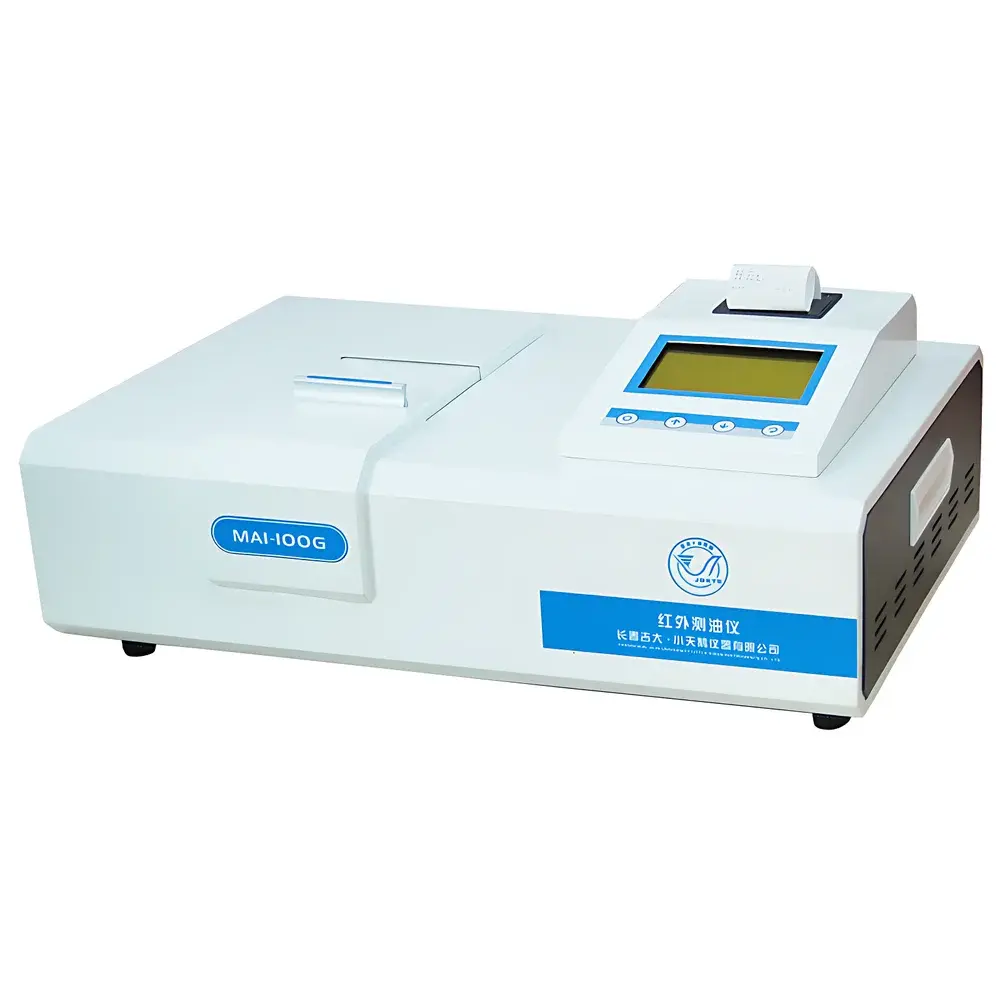
Jilin University–Xiaotian’e MAI-100G Infrared Oil Content Analyzer
| Brand | Jilin University–Xiaotian’e |
|---|---|
| Origin | Jilin, China |
| Manufacturer Type | Direct Manufacturer |
| Regional Category | Domestic (China) |
| Model | MAI-100G Infrared Oil Content Analyzer |
| Instrument Type | Laboratory Benchtop Analyzer |
| Measurement Principle | Infrared Spectrophotometry (C–H Stretch Absorption at 2930 cm⁻¹, 2960 cm⁻¹, and 2850 cm⁻¹) |
| Measurement Range | 0.40–100 mg/L (using 4-cm pathlength cell, standard n-hexane extract, 1:1 extraction ratio) |
| Detection Limit | < 0.1 mg/L (per JJG 950–2012 verification protocol) |
| Accuracy | ±5% RSD (at 40 mg/L standard solution) |
| Compliance | HJ 637–2018, JJG 950–2012 Class A requirements, ASTM D7066–22 (equivalent IR methodology), ISO 9377-2:2000 (Water quality — Determination of hydrocarbon oil index — Part 2: Infrared spectrometric method) |
Overview
The Jilin University–Xiaotian’e MAI-100G Infrared Oil Content Analyzer is a dedicated benchtop instrument engineered for quantitative determination of total petroleum hydrocarbons (TPH), mineral oil, and animal/vegetable oils in aqueous matrices using dual-beam infrared absorption photometry. It operates on the fundamental principle of measuring C–H bond vibrational absorbance in the mid-infrared region—specifically at three characteristic wavenumbers (2960 cm⁻¹, 2930 cm⁻¹, and 2850 cm⁻¹)—corresponding to CH₃ asymmetric stretch, CH₂ asymmetric stretch, and CH₂ symmetric stretch, respectively. This spectral selectivity enables discrimination between aliphatic hydrocarbons (e.g., petroleum distillates) and ester-linked triglycerides (e.g., cooking oils), supporting compliance with HJ 637–2018—the Chinese national standard aligned with international IR-based oil quantification frameworks such as ISO 9377-2 and ASTM D7066. Designed for routine environmental laboratories, wastewater treatment facilities, and regulatory testing centers, the MAI-100G delivers trace-level sensitivity, high reproducibility, and operational flexibility without requiring gas-phase optics or cryogenic detectors.
Key Features
- Triple-wavelength, single-wavelength, and full-spectrum scanning measurement modes—enabling method adaptation for petroleum hydrocarbons, biodiesel blends, or custom organic contaminants.
- Automatic wavelength calibration via reference standard scan—eliminating manual alignment and ensuring long-term spectral fidelity per JJG 950–2012 Class A metrological requirements.
- Onboard calibration curve generation and storage—supports up to 12 independent working curves (linear or polynomial) with correlation coefficients r > 0.999 when calibrated using certified n-hexane standards (0.4–6.4 mg/L, 4-cm cell).
- Dual operation mode: fully autonomous standalone operation with integrated touchscreen interface, or PC-controlled acquisition and analysis via USB-connected software platform.
- Integrated thermal printer for immediate report generation—including sample ID, date/time stamp, calibration status, measured concentration, and operator ID—meeting basic GLP documentation needs.
- Optical path optimized for 4-cm quartz cuvettes; compatible with standard EPA-compliant liquid–liquid extraction protocols using n-hexane or CCl₄ (where permitted), with 1:1 extraction ratio support.
Sample Compatibility & Compliance
The MAI-100G is validated for use across diverse aqueous and semi-solid environmental matrices, including municipal and industrial wastewater, surface water, groundwater, leachate, and sludge extracts (per GB 4284–2018). Its optical design accommodates samples pre-treated by standard liquid–liquid extraction (LLE) or solid-phase extraction (SPE), provided the final extract is dissolved in IR-transparent solvents meeting HJ 637–2018 specifications. The instrument satisfies metrological verification criteria defined in JJG 950–2012 for Class A oil analyzers—including linearity, repeatability, zero stability, and wavelength accuracy—and supports audit-ready data integrity through timestamped calibration logs and measurement history. While not inherently 21 CFR Part 11 compliant, its software architecture allows integration with validated LIMS environments supporting electronic signatures and audit trails.
Software & Data Management
The optional PC-based control software provides comprehensive instrument management: method configuration, spectral visualization, peak integration, multi-point calibration, QC flagging (e.g., drift alerts, outlier detection), and customizable reporting templates exportable as PDF or CSV. All raw absorbance spectra and processed results are stored with metadata (operator, date, instrument serial number, calibration ID), enabling retrospective review and trend analysis. Data export conforms to ISO/IEC 17025 traceability requirements when paired with accredited calibration services. Firmware updates are delivered via secure USB transfer, with version logging embedded in every measurement record.
Applications
- Regulatory monitoring of effluent discharge under GB 8978–1996, GB 18918–2002, and sector-specific standards (e.g., GB 13456–2012 for steel industry, GB 13458–2013 for ammonia synthesis).
- Oil-in-water quantification in marine outfalls and offshore produced water (per GB/T 17923–2017 and GB 4914–2008).
- Sludge characterization for agricultural reuse (GB 4284–2018) and landfill leachate screening.
- Stack emission testing for油烟 (cooking oil fume) and oil mist in industrial exhaust streams (HJ 1077–2019).
- Method development for emerging contaminants—e.g., biodegradable lubricants or microplastic-associated hydrophobic organics—leveraging programmable wavelength selection.
FAQ
What extraction solvents are compatible with the MAI-100G?
n-Hexane is the primary solvent specified in HJ 637–2018; alternatives such as cyclohexane or Freon-113 may be used if validated for equivalent recovery and spectral transparency.
Can the instrument measure emulsified oil directly?
No—samples must undergo phase separation and extraction prior to analysis; the MAI-100G measures only dissolved or extracted hydrocarbon content in clear organic phases.
Is the 4-cm pathlength cell mandatory?
Yes—the stated detection limit and measurement range assume use of the supplied 4-cm quartz cell; shorter pathlengths reduce sensitivity and require revalidation.
Does the system support multi-laboratory collaborative studies?
Yes—calibration files and spectral libraries can be shared across instruments; inter-laboratory precision is maintained through standardized extraction protocols and reference material traceability.
How often does wavelength calibration need verification?
Per JJG 950–2012, wavelength accuracy must be verified before each analytical batch or daily—automated calibration reduces this to a one-step process using certified polystyrene film or n-hexane standard.







