
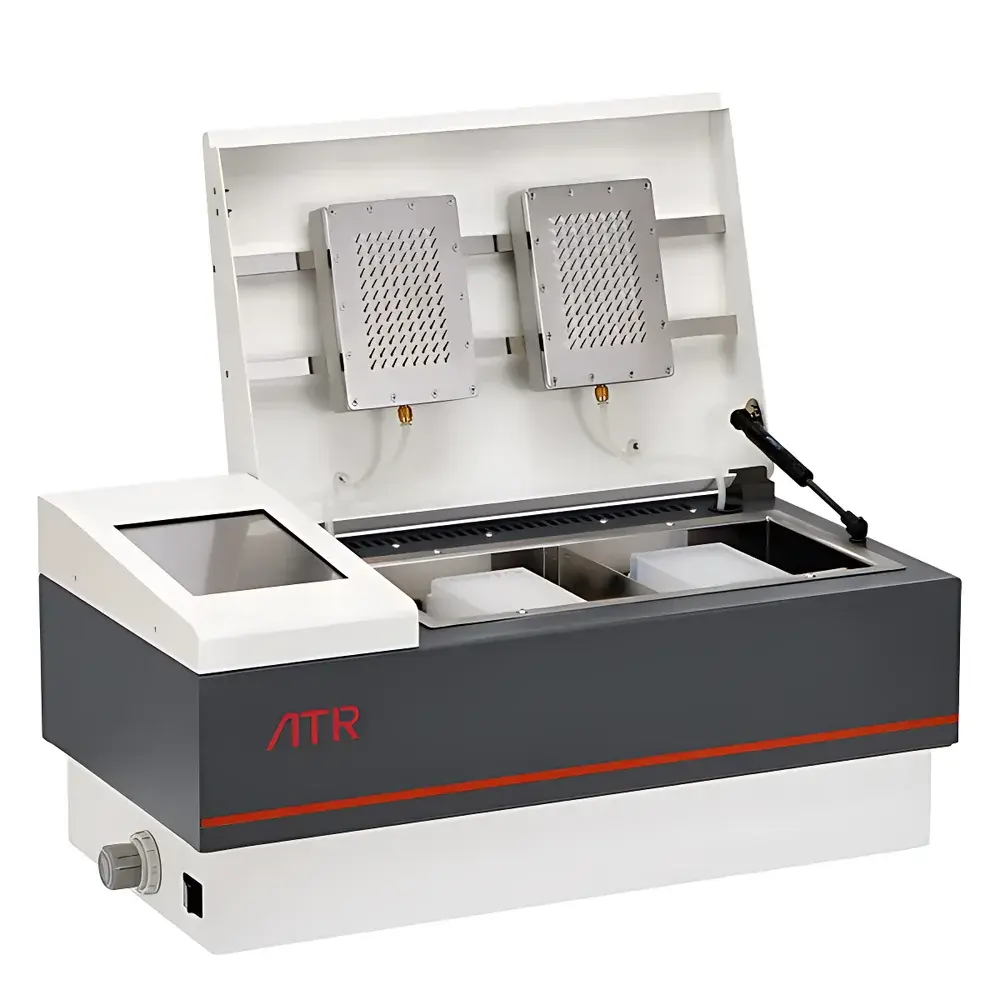
ATR AutoVap S96 96-Well Plate Automated Nitrogen Evaporator
| Brand | ATR |
|---|---|
| Origin | USA |
| Model | AutoVap S96 |
| Heating Method | Dry Block Heating |
| Temperature Range | Ambient to 85 °C |
| Temperature Stability | ±0.1 °C |
| Sample Format | 96-well microplates (standard or deep-well, 8×12 format) |
| Gas Flow Rate | 0–60 L/min (0–99 scfh) |
| Total Sample Capacity | 192 wells (2 plates) |
| Heating Power | 620 W |
| Dimensions | 62.2 × 32 × 27.5 cm |
| Timer Range | 0–999.9 min |
Overview
The ATR AutoVap S96 is a precision-engineered automated nitrogen evaporator designed specifically for high-throughput solvent removal from 96-well microplates and deep-well plates. Unlike conventional open-tube nitrogen blow-down systems, the AutoVap S96 employs a patented vortex gas delivery architecture that directs laminar, tangential nitrogen flow across the liquid surface—generating controlled convective evaporation without splashing, cross-contamination, or well-to-well carryover. This principle leverages fluid dynamics to maximize surface-area exposure while maintaining consistent thermal and mass-transfer conditions across all 96 wells simultaneously. The system operates on dry-block heating technology, eliminating water bath maintenance and contamination risks, and is calibrated for reproducible temperature control within ±0.1 °C—critical for thermally sensitive analytes in regulated workflows such as bioanalytical method development, forensic toxicology screening, and pharmaceutical stability studies.
Key Features
- Vortex gas flow technology: Non-contact, radial nitrogen dispersion ensures uniform solvent removal without droplet ejection or well overflow—even with high-boiling solvents like DMSO, DMF, and TFA.
- Dual-plate configuration: Accommodates two standard 96-well plates (192 total samples) in parallel; compatible with both shallow microplates (0.2–0.5 mL) and deep-well plates (1–2 mL).
- Independent parameter control: Precise, independent adjustment of nitrogen flow (0–60 L/min), block temperature (ambient to 85 °C), and evaporation time (0–999.9 min) via intuitive membrane keypad interface.
- Method memory function: Stores up to 10 user-defined protocols—including flow, temperature, and timer settings—for rapid recall and repeatable execution across shifts or operators.
- Integrated exhaust management: Dedicated vent channel routes displaced solvent vapors externally (via optional ducting), minimizing lab ambient exposure and complying with OSHA and local ventilation codes.
- Compact footprint (62.2 × 32 × 27.5 cm): Designed for benchtop use outside fume hoods—reducing infrastructure dependency while maintaining Class I safety compliance for flammable solvent handling.
Sample Compatibility & Compliance
The AutoVap S96 supports a broad range of sample matrices and solvent systems commonly encountered in regulated laboratories, including aqueous buffers, acetonitrile/water gradients, methanol, ethyl acetate, and aggressive solvents such as trifluoroacetic acid (TFA), dimethyl sulfoxide (DMSO), and N,N-dimethylformamide (DMF). Its stainless-steel gas manifolds and PTFE-coated internal surfaces resist corrosion and adsorption, ensuring long-term integrity during repeated exposure. The instrument meets general electrical safety requirements per UL 61010-1 and IEC 61010-1. While not intrinsically rated for Class I Division 1 environments, it is routinely deployed in GLP-compliant bioanalytical labs, forensic toxicology units (per SWGTOX guidelines), and FDA-regulated QC facilities where audit-ready documentation of evaporation parameters is required. Optional data logging (via RS-232 or USB) enables alignment with 21 CFR Part 11 expectations when paired with validated LIMS or ELN platforms.
Software & Data Management
The AutoVap S96 operates via embedded firmware with no external PC dependency—ensuring robustness and minimal IT overhead. All operational parameters (setpoints, actuals, elapsed time, error logs) are timestamped and stored in non-volatile memory. An optional serial/USB interface allows export of run records (CSV format) for traceability and integration into laboratory quality systems. When used in GxP environments, users may implement procedural controls—such as documented method validation, operator training records, and periodic temperature/flow calibration checks—to satisfy ISO/IEC 17025 clause 5.5.2 (equipment verification) and USP Analytical Instrument Qualification protocols. No proprietary software installation is required; raw data files are human-readable and compatible with common statistical analysis tools.
Applications
- High-throughput sample preparation for LC-MS/MS bioanalysis—especially in pharmacokinetic (PK) and toxicokinetic (TK) studies requiring parallel processing of plasma, urine, or tissue extracts.
- Routine evaporation in clinical toxicology labs processing hundreds of forensic blood or urine specimens weekly under CAP or CLIA requirements.
- Residue testing in food and beverage safety labs targeting pesticide multiresidue methods (e.g., QuEChERS extracts in 96-well format).
- Genomics and proteomics core facilities performing cleanup of enzymatic digests, oligonucleotide synthesis eluates, or MALDI matrix preparations.
- Academic research groups conducting metabolomics or lipidomics workflows where reproducible solvent removal directly impacts downstream chromatographic peak shape and quantitation accuracy.
FAQ
Can the AutoVap S96 handle deep-well plates with volumes up to 2 mL?
Yes—it accepts both ANSI/SLAS-standard 96-well shallow plates (0.2–0.5 mL) and deep-well plates (up to 2 mL), with adjustable height positioning to maintain optimal gas-to-surface distance.
Is calibration documentation provided with the instrument?
ATR supplies a factory calibration certificate covering temperature accuracy (±0.1 °C at 40 °C and 70 °C) and flow linearity (±2% FS); users may perform field verification using NIST-traceable RTDs and calibrated flow meters.
Does the system support unattended overnight operation?
Yes—the timed shutdown function, thermal cutoff protection, and stable dry-block design enable safe,无人值守 operation for durations up to 16.6 hours (999.9 min).
How is cross-contamination prevented between wells?
The vortex gas flow pattern eliminates direct vertical impingement; combined with individually isolated gas channels per plate quadrant and non-recirculating exhaust, it prevents aerosol-mediated transfer.
What maintenance is required for long-term reliability?
Routine cleaning of the gas manifold and heating block with isopropanol; annual inspection of O-rings and flow sensors is recommended—no consumables or scheduled service contracts are mandatory.



