
Fiber Bragg Grating (FBG) Array – HI980 Series
| Brand | AOE Tech |
|---|---|
| Origin | Shanghai, China |
| Component Category | Optical Element |
| Fiber Type Compatibility | HI980, HI1060, SMF-28e, PM980, PM1550, Active Fibers, or Custom |
| Center Wavelength Range | 1510–1590 nm ±0.05% |
| Reflectivity | 1–99.999% ±0.5% |
| Full Width at Half Maximum (FWHM) | 0.03–1.0 nm |
| Side Mode Suppression Ratio (SMSR) | >20 dB |
| Grating Length | 0.2–50 mm |
| Coating | Acrylate Recoating |
| Operating Temperature Range | −5 to +80 °C |
Overview
The AOE Tech HI980 Fiber Bragg Grating (FBG) Array is a precision-engineered optical sensing component designed for distributed, multi-point, and long-haul photonic measurement applications. Based on the principle of wavelength-selective reflection via periodic modulation of the core refractive index—achieved through UV-induced permanent photoinscription—the FBG array leverages Bragg resonance conditions (λB = 2neffΛ) to enable highly stable, absolute wavelength-encoded sensing of strain, temperature, pressure, and vibration. Unlike discrete sensor configurations, this monolithic array integrates multiple FBGs within a single continuous fiber segment, eliminating splicing losses and inter-sensor coupling uncertainties. Its inherent all-fiber architecture ensures low insertion loss, polarization-maintaining capability (when fabricated on PM fibers), and immunity to electromagnetic interference—making it suitable for deployment in harsh industrial, aerospace, civil infrastructure, and energy-sector environments where long-term stability and traceable calibration are critical.
Key Features
- Monolithic integration of up to 32 FBGs per fiber (customizable spacing and reflectivity profiles)
- Center wavelength tunability across the C- and L-bands (1510–1590 nm), with tight spectral tolerance (±0.05% of λB)
- High side-mode suppression ratio (>20 dB) ensures minimal crosstalk between adjacent gratings in dense wavelength division multiplexing (DWDM) interrogation schemes
- Controlled FWHM (0.03–1.0 nm) enables flexible trade-offs between resolution and signal-to-noise ratio in dynamic sensing applications
- Acrylate recoating provides mechanical protection while preserving bend-insensitive performance and compatibility with standard fiber handling tools
- Validated thermal and mechanical reliability across −5 °C to +80 °C, supporting operation in uncontrolled outdoor enclosures and embedded structural monitoring systems
- Compatible with industry-standard interrogation units including Micron Optics sm125, HBM FiberSensing FS22, and Luna ODiSI platforms
Sample Compatibility & Compliance
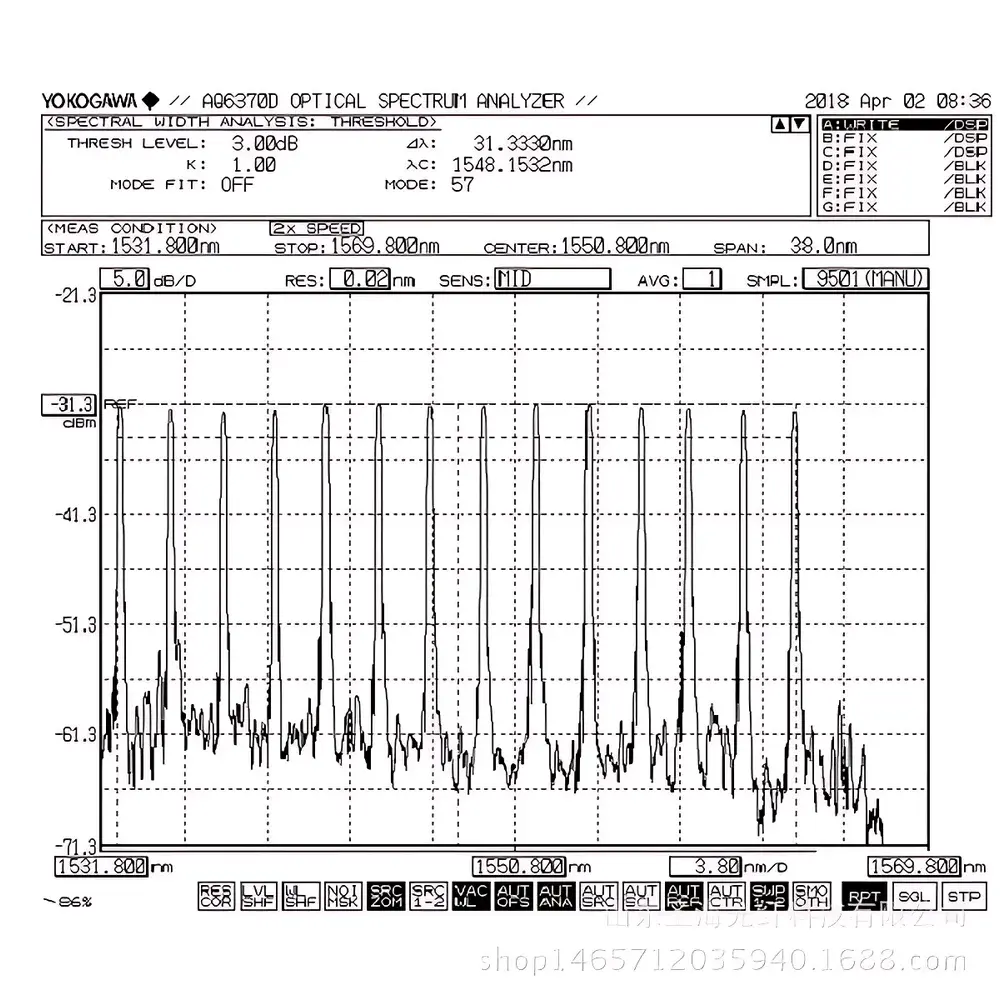
The HI980 FBG Array supports heterogeneous fiber substrate options—including standard single-mode fiber (SMF-28e), polarization-maintaining fibers (PM980/PM1550), high-numerical-aperture fibers (HI980/HI1060), and specialty active or photosensitive fibers—enabling application-specific optimization of mode field diameter, dispersion, and photosensitivity. All arrays are manufactured under controlled cleanroom conditions and undergo 100% spectral characterization using calibrated optical spectrum analyzers traceable to NIST standards. While not certified as a standalone medical or safety-critical device, the component complies with IEC 61300-2-4 (mechanical endurance), Telcordia GR-1209-CORE (reliability), and RoHS 2011/65/EU directives. Documentation includes full spectral response data sheets, grating position maps, and batch-level thermal drift coefficients—supporting audit readiness for GLP/GMP-aligned R&D labs and ISO 9001-certified manufacturing facilities.
Software & Data Management
AOE Tech delivers comprehensive spectral metadata with each array shipment, including CSV-formatted wavelength/reflectivity traces and Excel-based grating parameter tables (center λ, peak reflectivity, FWHM, SMSR, isolation). These files integrate natively with MATLAB, Python (via scipy.io or pyLaser libraries), and commercial optical sensing software such as OptiGrating and FiberSensing’s FS-Link. For traceable calibration workflows, users may import reference spectra into LabVIEW-based DAQ systems supporting IEEE 1451.4 TEDS templates. The acrylate-coated geometry maintains compatibility with standard fiber optic cleaving, connectorization (FC/APC, SC/APC), and adhesive-free mounting techniques—facilitating seamless integration into OEM sensor housings without requiring proprietary tooling or firmware.
Applications
- Structural health monitoring (SHM) of bridges, dams, wind turbine blades, and composite aircraft fuselages
- Distributed temperature and strain profiling in oil & gas downhole sensing and power cable hot-spot detection
- Multi-parameter biomedical instrumentation, including catheter-based pressure mapping and minimally invasive endoscopic force feedback
- Dynamic vibration analysis in rotating machinery, where phase-stable wavelength encoding eliminates timing jitter inherent in electrical transducers
- Reference-grade wavelength stabilization in tunable laser sources and external cavity diode lasers (ECDLs)
- Calibration transfer standards for optical time-domain reflectometers (OTDRs) and optical frequency domain reflectometers (OFDRs)
FAQ
Can the HI980 FBG Array be spliced directly to non-AOE fibers?
Yes—standard fusion splicing with optimized arc parameters achieves insertion losses below 0.1 dB when joining to SMF-28e or PM1550. Splice loss budgets and mode-field matching calculations are provided upon request.
Is custom center wavelength selection available within the 1510–1590 nm range?
Yes—wavelengths can be specified in 0.1 nm increments; minimum order quantity applies for non-stock configurations.
What is the long-term wavelength stability under constant thermal load?
Typical drift is ≤±1.5 pm/°C over 10,000 hours at 60 °C, verified via accelerated aging per IEC 60793-2-50.
Do you provide spectral response certificates with NIST-traceable calibration?
Yes—each array ships with a certificate listing measured λB, reflectivity, FWHM, and SMSR, referenced to a NIST-traceable OSAs (Yokogawa AQ6370D).
Can the array be used in vacuum or hydrogen-rich environments?
Standard acrylate recoating is rated for 10−5 mbar vacuum; hydrogen darkening mitigation requires optional polyimide coating—contact engineering support for qualification data.






