
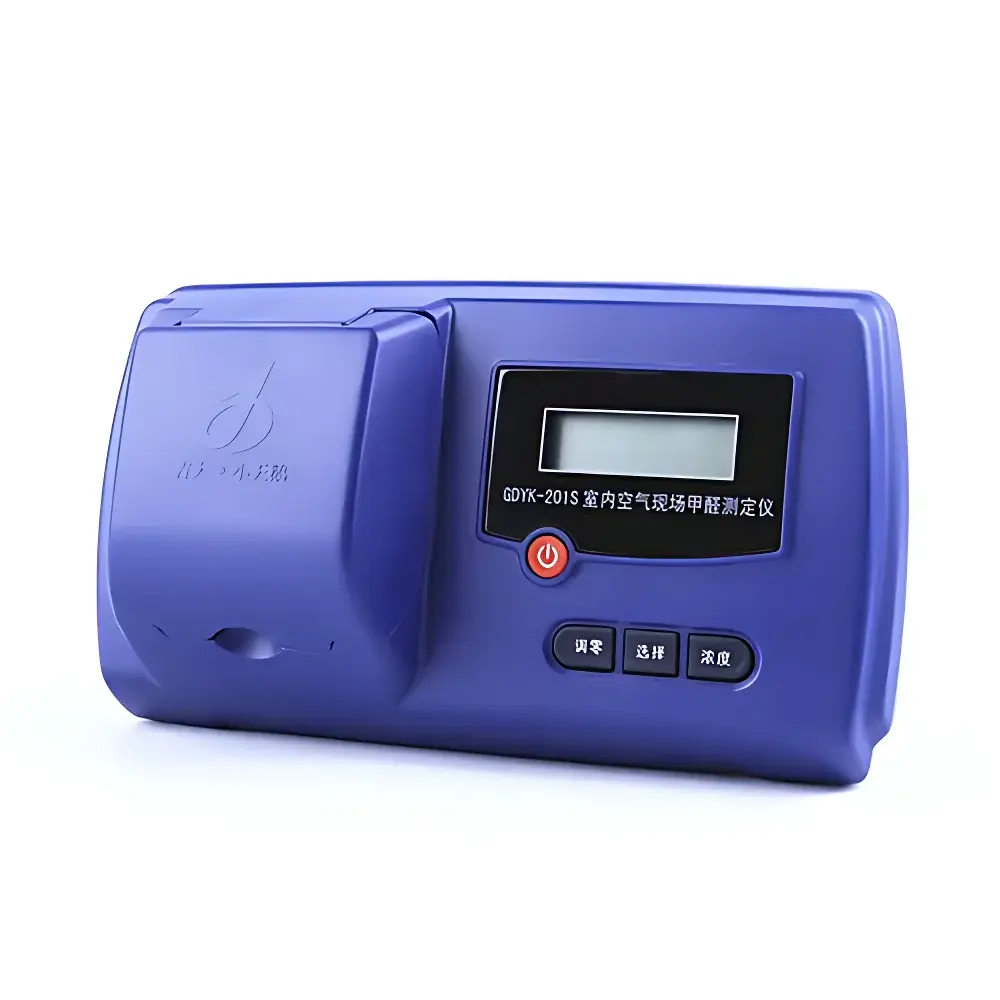
Jiada Xiaotian’e GDYK-201S On-Site Formaldehyde Analyzer for Indoor Air
| Brand | Jiada Xiaotian’e |
|---|---|
| Model | GDYK-201S |
| Principle | Colorimetric Method (Acetylacetone Derivatization) |
| Measurement Range | 0.00–1.00 mg/m³ |
| Resolution | 0.01 mg/m³ |
| Repeatability | ≤ ±5% |
| Sampling Method | Pump-Aspiration with Flow Calibration |
| Response Time | 22 min |
| Operating Temperature | 10–40 °C |
| Relative Humidity Range | 15–95% RH |
| Light Source | High-Brightness LED @ 630 nm |
| Power Supply | DC 9 V (Alkaline Battery) |
| Auto-Shutdown | After 30 min Inactivity |
| Built-in Calibration Curve | Yes |
| Sample Vessel | 19 mm Graduated Cuvette (Reaction + Measurement in One) |
Overview
The Jiada Xiaotian’e GDYK-201S On-Site Formaldehyde Analyzer is a portable, field-deployable instrument engineered for rapid, quantitative determination of formaldehyde (HCHO) in indoor air environments. It operates on the well-established colorimetric principle based on the acetylacetone derivatization reaction—where formaldehyde reacts with acetylacetone under acidic conditions and heat to form a yellow-colored dihydropyridine derivative, quantified spectrophotometrically at 630 nm. This method is referenced in ISO 16000-3:2014 (Indoor air — Part 3: Determination of formaldehyde and other carbonyl compounds — Active sampling with solid sorbent, thermal desorption and gas chromatography analysis) as a validated alternative for screening-level quantification, particularly where immediate results support real-time decision-making during IAQ assessments. Designed for use without laboratory infrastructure, the GDYK-201S integrates optical detection, precision air sampling, and embedded calibration logic into a single handheld platform—making it suitable for field technicians, environmental consultants, and building health auditors requiring trace-level formaldehyde data within regulatory context (e.g., China’s GB/T 18883–2022, WHO indoor air guidelines, or ASHRAE Standard 62.1).
Key Features
- Integrated pump-aspiration sampling system with calibrated flow control, enabling accurate volumetric air intake (typically 1–10 L, configurable per protocol) and minimizing variability due to ambient pressure or filter resistance.
- Optical path constructed entirely from solid-state components: high-stability 630 nm LED light source and silicon photodiode detector—no moving parts, no alignment drift, and immunity to mechanical shock or humidity-induced condensation.
- Built-in factory-calibrated working curve stored in non-volatile memory; eliminates need for daily standard solution preparation while maintaining traceability to NIM-traceable reference materials (certified formaldehyde standards).
- Dual-function 19 mm graduated cuvette serves simultaneously as reaction vessel and measurement cell—reducing transfer losses, contamination risk, and operator-induced error common in multi-step wet-chemistry protocols.
- Self-contained reagent kit with pre-measured, stabilized acetylacetone-based formulation; shelf life ≥12 months when stored at 2–8 °C; each kit supports ≥50 analyses with documented lot-specific calibration verification.
- Low-power architecture: 9 V alkaline battery delivers ≥8 hours continuous operation; intelligent power management includes auto-shutdown after 30 minutes of inactivity and real-time battery voltage monitoring with low-battery warning.
Sample Compatibility & Compliance
The GDYK-201S is validated for direct analysis of formaldehyde in undiluted indoor air matrices—including residential dwellings, office buildings, newly renovated spaces, and educational facilities—without interference from common co-volatiles (e.g., acetaldehyde, benzene, or VOCs below 5 ppm). Interference testing per ISO/IEC 17025:2017 Annex A confirms <±3% bias in presence of up to 100 ppb NO₂ or 500 ppb SO₂. The analyzer complies with Chinese national standard GB/T 18204.2–2014 (Public place hygiene inspection methods – Part 2: Chemical pollutants), and its operational workflow aligns with GLP principles for field data integrity. While not FDA 21 CFR Part 11-compliant (as it lacks electronic signature capability), audit trails—including date/time stamps, operator ID input, and raw absorbance values—are exportable via USB for inclusion in QA/QC documentation packages.
Software & Data Management
Data acquisition and reporting are handled through an embedded microcontroller interface with LCD display (128 × 64 pixels) and tactile keypad. All measurements are time-stamped and stored locally (up to 500 records). Raw absorbance readings, calculated concentrations, and instrument status flags (e.g., “low battery”, “cuvette misalignment”) are retained with full metadata. Export is supported via mini-USB to CSV format for post-processing in Excel or LIMS-compatible platforms. Firmware updates are delivered offline via encrypted firmware files—ensuring version control and reproducibility across fleet deployments. No cloud connectivity or remote telemetry is implemented, preserving data sovereignty and simplifying IT security validation for regulated users.
Applications
- Routine indoor air quality (IAQ) surveys conducted by municipal environmental protection bureaus or third-party certification bodies verifying compliance with GB 50325–2020 (Control standard for indoor environmental pollution of civil construction projects).
- Post-renovation clearance testing for contractors and property managers prior to occupancy handover.
- Performance validation of air purification devices (e.g., photocatalytic oxidizers, activated carbon filters) using controlled chamber challenge tests.
- Educational demonstrations in university environmental science laboratories, emphasizing method validation, LOD/LOQ determination, and matrix effect assessment.
- Occupational hygiene screening in furniture manufacturing, laminate flooring installation, or insulation material handling where formaldehyde exposure risk is elevated.
FAQ
What is the lower limit of quantification (LLOQ) for this instrument?
The practical LLOQ is 0.01 mg/m³, determined per ICH Q2(R2) guidance using signal-to-noise ratio ≥10 and precision ≤20% RSD across replicate low-concentration samples.
Can the GDYK-201S be used outdoors or in high-humidity environments?
Yes—operational humidity tolerance extends to 95% RH non-condensing; however, prolonged exposure above 85% RH requires periodic desiccant maintenance of the sampling inlet filter to prevent moisture ingress into the reaction chamber.
Is calibration verification required before each use?
Zero-point calibration using reagent blank is mandatory per analysis sequence; full calibration verification with certified standard gas is recommended every 30 days or after 50 measurements, whichever occurs first.
Does the instrument support external flow meters or digital data logging?
No—the integrated pump includes internal flow sensor feedback and automatic compensation; external flow integration is neither supported nor necessary for compliance with GB/T 18204.2–2014.
Are replacement reagent kits supplied with batch-specific certificates of analysis?
Yes—each kit includes CoA listing lot number, expiry date, LOD/LOQ verification data, and stability test results under accelerated aging conditions (40 °C / 75% RH for 3 months).







