
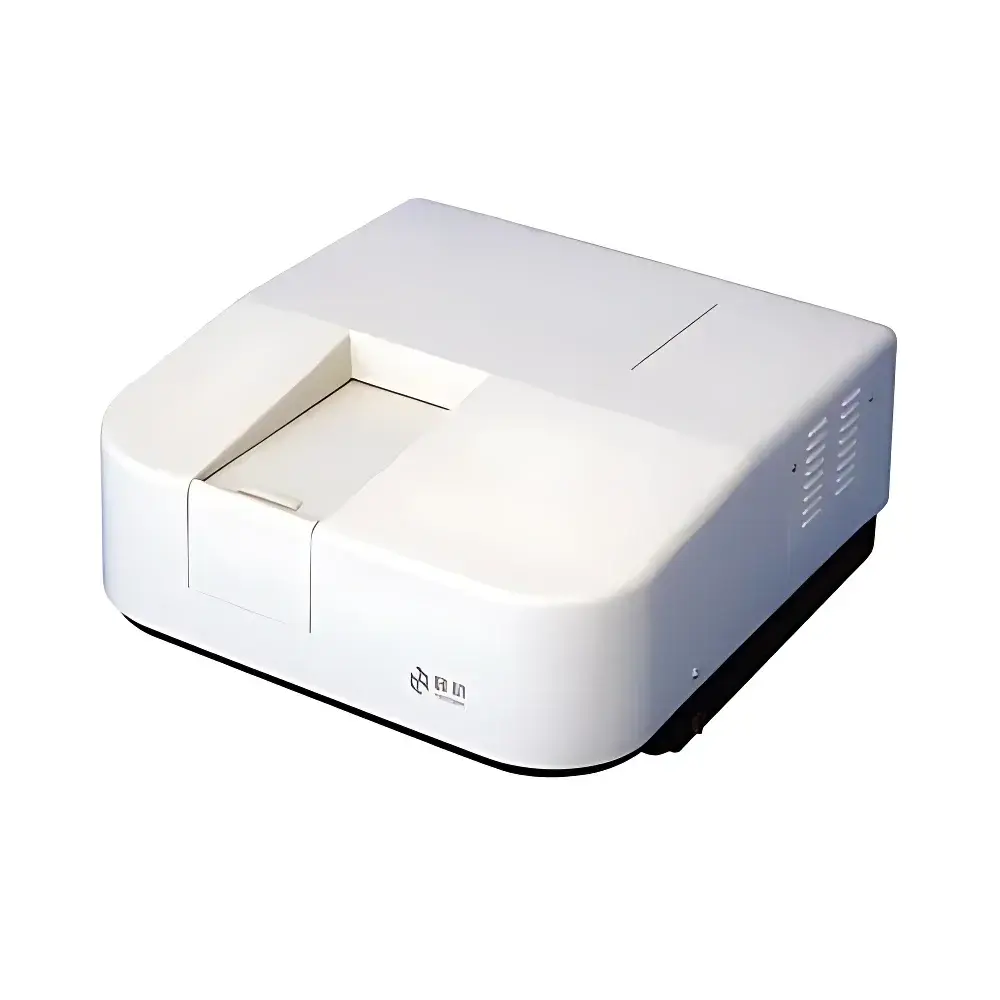
Purkinje TU-1901 Dual-Beam Ultraviolet-Visible Spectrophotometer
| Brand | Purkinje |
|---|---|
| Origin | Beijing, China |
| Manufacturer Type | Direct Manufacturer |
| Model | TU-1901 / TU-1900 |
| Optical System | Dual-Beam |
| Detector | Photomultiplier Tube (PMT) |
| Wavelength Range | 190 nm – 900 nm |
| Wavelength Accuracy | ±0.3 nm (auto-calibrated at startup) |
| Wavelength Repeatability | ≤0.15 nm |
| Spectral Bandwidth | 0.1 nm, 0.2 nm, 0.5 nm, 1.0 nm, 2.0 nm, 5.0 nm |
| Stray Light | ≤0.01%T at 220 nm (NaI), ≤0.05%T at 360 nm (NaNO₂) |
| Photometric Accuracy | ±0.002 Abs (0–0.5 Abs), ±0.004 Abs (0.5–1.0 Abs), ±0.3%T (0–100%T) |
| Photometric Range | –4.0 to +4.0 Abs |
| Baseline Flatness | ±0.001 Abs |
| Baseline Drift | 0.0004 Abs/h (at 500 nm, 0 Abs, after 2 h warm-up) |
| Photometric Noise | ±0.0004 Abs |
Overview
The Purkinje TU-1901 is a high-performance dual-beam ultraviolet-visible (UV-Vis) spectrophotometer engineered for precision quantitative and qualitative analysis across research laboratories, quality control environments, and regulatory-compliant facilities. Based on the fundamental principle of Beer–Lambert law absorption spectroscopy, the instrument measures the attenuation of monochromatic light as it passes through a sample solution—enabling accurate determination of analyte concentration, purity assessment, kinetic studies, and spectral characterization. Its optical architecture integrates a high-efficiency Czerny–Turner monochromator with imported holographic gratings, ensuring minimal aberration and exceptional wavelength fidelity. The dual-beam design continuously balances reference and sample beam intensities in real time, effectively compensating for source drift, detector sensitivity fluctuations, and environmental perturbations—thereby delivering superior baseline stability and long-term measurement reproducibility.
Key Features
- Dual-beam dynamic feedback ratio recording system for enhanced baseline stability and reduced photometric drift over extended acquisition periods
- High-sensitivity photomultiplier tube (PMT) detector optimized for low-light UV response and wide dynamic range detection
- Imported holographic diffraction grating enabling ultra-low stray light performance (≤0.01%T at 220 nm with NaI) and improved spectral resolution
- Multi-bandwidth selection (0.1–5.0 nm) supporting both high-resolution scanning and high-throughput screening applications
- Modular lamp design with plug-in deuterium and tungsten-halogen sources—lamp replacement requires no optical realignment or recalibration
- Automated wavelength calibration at power-on ensures consistent spectral accuracy without manual intervention
- Robust mechanical construction with temperature-compensated optical bench and vibration-damped housing for operation in non-climate-controlled lab spaces
Sample Compatibility & Compliance
The TU-1901 accommodates standard 10 mm pathlength quartz and fused silica cuvettes (1 cm, 2 cm, 5 cm, and 10 cm options available), as well as microvolume cells (down to 2 µL), thermostatted holders (±0.1 °C stability), integrating spheres for diffuse reflectance, and fiber-optic probes for remote or in-situ measurements. Its photometric accuracy and repeatability meet or exceed requirements defined in ISO 8579-1:2020 (spectrophotometer performance verification), ASTM E275 (standard practice for describing and measuring performance of UV-Vis spectrophotometers), and USP (spectrophotometric analysis). Data integrity features—including user access levels, audit trail logging, and electronic signature support—are configurable to align with FDA 21 CFR Part 11 and GLP/GMP documentation workflows when used with compliant software configurations.
Software & Data Management
The instrument operates under Purkinje UVWin Control Software—a Windows-based application offering full instrument control, spectral acquisition, kinetic profiling, multi-wavelength quantitation, and derivative spectroscopy. Raw absorbance, transmittance, and reflectance data are stored in vendor-neutral ASCII and CSV formats; spectral overlays, peak identification, baseline correction algorithms, and custom calibration curve generation (linear, quadratic, cubic, and non-linear fitting) are natively supported. All method parameters, acquisition logs, and operator metadata are embedded within each data file. Optional LIMS integration via ASTM E1384-compliant export protocols enables seamless transfer to enterprise laboratory information management systems. Software validation documentation (IQ/OQ/PQ templates) and electronic record retention policies are provided for regulated environments.
Applications
- Pharmaceutical QC: Assay of active pharmaceutical ingredients (APIs), excipient compatibility testing, dissolution profile monitoring per USP
- Biochemical analysis: Protein quantification (Bradford, Lowry, BCA), nucleic acid purity (A260/A280 ratios), enzyme kinetics (NADH/NADPH assays)
- Environmental testing: Nitrate, phosphate, heavy metal (e.g., Cr(VI), Cd²⁺) quantification in water per EPA Method 353.2 and ISO 15681-1
- Food & beverage: Colorimetric evaluation of pigments (anthocyanins, carotenoids), antioxidant capacity (FRAP, DPPH), preservative content (sorbates, benzoates)
- Materials science: Thin-film thickness estimation via interference fringe analysis, bandgap energy calculation from Tauc plots
- Academic research: Ligand-binding stoichiometry, aggregation state analysis, pH-dependent spectral shifts
FAQ
What wavelength calibration standards are recommended for routine verification?
Standard reference materials including NIST-traceable holmium oxide (Ho₂O₃) and didymium filters are recommended for wavelength accuracy verification at 241.1, 279.4, 287.5, 333.7, 360.9, 418.5, 460.0, 484.5, 536.2, and 637.5 nm.
Is the TU-1901 compatible with third-party accessories such as flow cells or Peltier temperature controllers?
Yes—the instrument’s standardized optical interface and TTL/RS-232 control protocol support integration with commercially available flow-through cells, thermoelectrically controlled cuvette holders, and automated sample changers from major accessory vendors.
How does the dual-beam architecture improve measurement reliability compared to single-beam designs?
Dual-beam operation eliminates errors arising from temporal variations in lamp intensity and detector gain by simultaneously measuring reference and sample beams—resulting in lower baseline drift, higher photometric reproducibility, and reduced need for frequent zeroing during extended analytical runs.
Can the TU-1901 perform kinetic measurements with time-resolved data capture?
Yes—UVWin software supports time-scan mode with user-defined interval settings (as fast as 0.1 s per spectrum) and up to 10,000 sequential scans per acquisition, enabling robust enzyme kinetics, reaction monitoring, and photochemical degradation studies.
What maintenance procedures are required to sustain optimal optical performance?
Routine cleaning of cuvette compartments and optical windows with lint-free wipes and spectroscopic-grade methanol; annual verification of wavelength and photometric accuracy using certified reference standards; periodic inspection of desiccant in the optical compartment to prevent moisture-induced grating degradation.





